INTRODUCTION
Early in our lives, we become aware of the tendency of all material objects to be attracted towards the earth. Anything thrown up falls down towards the earth, going uphill is lot more tiring than going downhill, raindrops from the clouds above fall towards the earth and there are many other such phenomena. Historically it was the Italian Physicist Galileo (1564 – 1642) who recognised the fact that all bodies, irrespective of their masses are accelerated towards the earth with a constant acceleration.
A seemingly unrelated phenomenon, observation of stars, planets and their motion has been the subject of attention in many countries since the earliest of times. About 2000 years ago Ptolemy who was a Greco-Roman mathematician and astronomer had proposed the “Geocentric Model” the earliest recorded model for planetary motions, in which all the celestial bodies, stars, the Sun and the planets, all revolved around the earth. Similar theories were also advanced by Indian astronomers some 400 years later.
However a more elegant model “Heliocentric Model” was proposed by a Polish monk named Nicholas Copernicus (1473 – 1543) which was already mentioned by Aryabhatta (5th century A.D.) in which the Sun was the centre around which the planets move in circles. His theory was discredited by the church, but notable amongst it’s supporters was Galileo who had to face prosecution from the state for his beliefs.
It was around the same time as Galileo, a nobleman called Tycho Brahe (1546 – 1601) hailing from Denmark, spent his entire lifetime recording observations of the planets with the naked eye. His compiled data were analysed later by his assistant Johannes Kepler (1571 – 1640). He could extract from the data three elegant laws that now go by the name of Kepler’s Laws. These laws were known to Newton and enabled him to make a great scientific leap in proposing his universal law of gravitation.
KEPLER’S LAWS
The three laws of Kepler can be stated as follows :
1. Law of Orbits :
” All planets move in elliptical orbits with the Sun situated at one of the focii (S and S’) of the ellipse “.
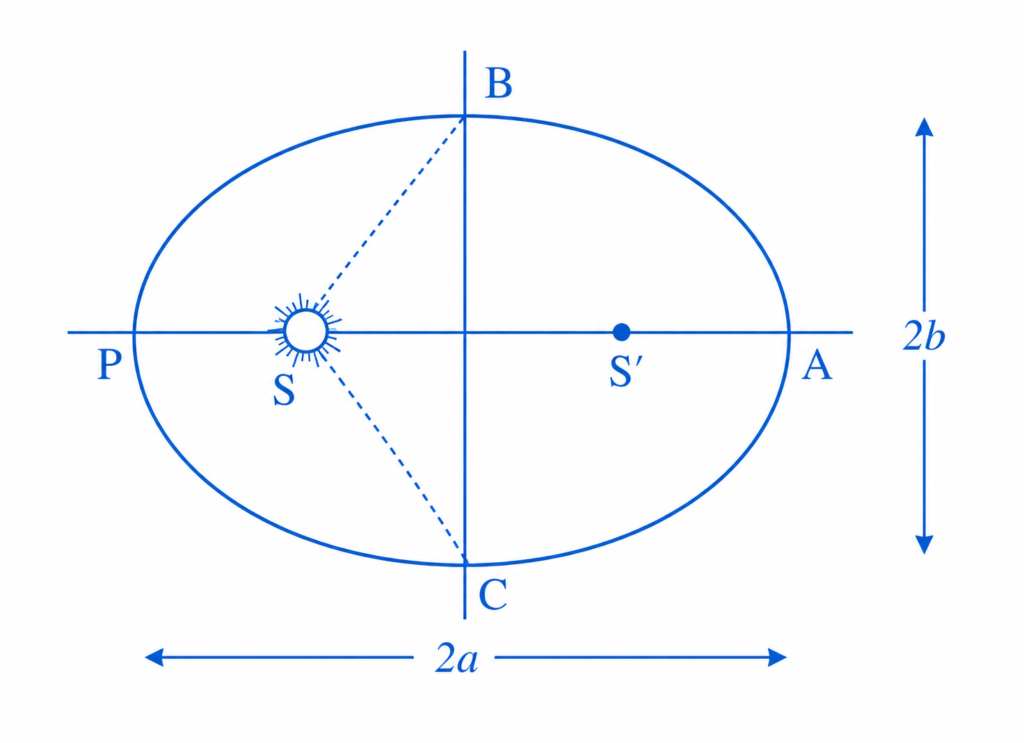
” An ellipse traced out by a planet around the Sun. The closest point is ‘p’ and the farthest point is ‘A’. P is called the perihelion and A is the Aphelion. The semi major axis ‘a’ is half the distance AP (2a) “.
This law was a deviation from the Copernican model which allowed only circular orbits. The ellipse, of which the circle is a special case, is a closed curve which can be drawn very simply as follows.
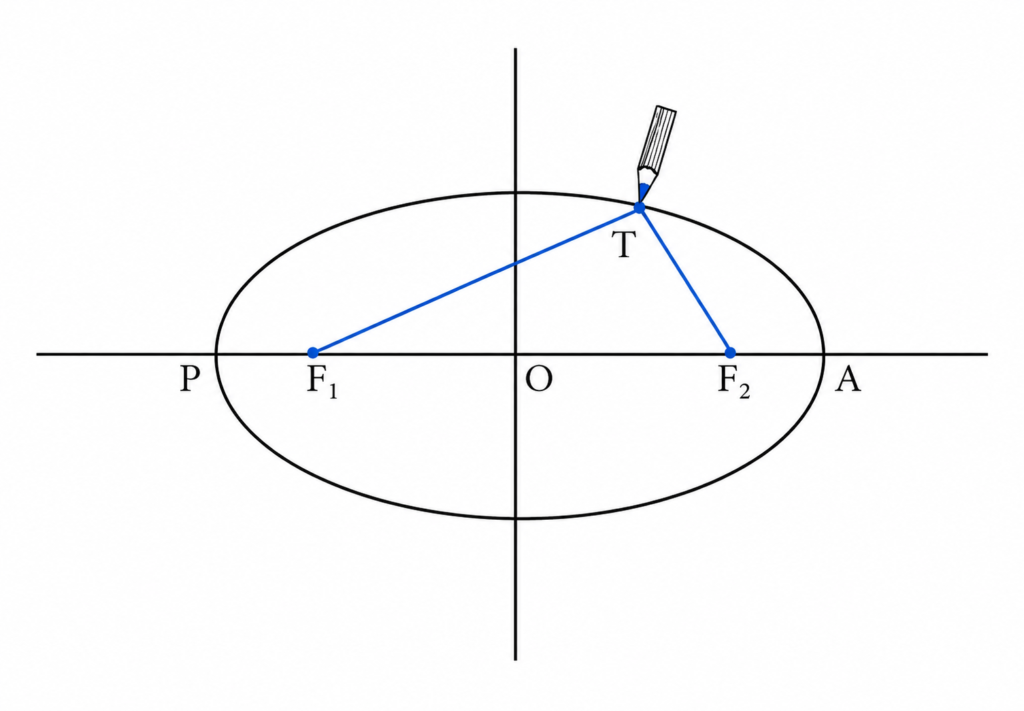
” Drawing an ellipse. A string has its ends fixed at F1 and F2. The tip of a pencil holds the string taut and is moved around “.
Select two points F1 and F2. Take a length of a string and fix its ends at F1 and F2 by pins. With the tip of a pencil stretch the string taut and then draw a curve by moving the pencil keeping the string taut throughout. The closed curve you get is called an ellipse. Clearly for any point ‘T’ on the ellipse, the sum of the distances from F1 and F2 is a constant. F1 and F2 are called the focii. Join the points F1 and F2 and extend the line to intersect the ellipse at points ‘P’ and ‘A’ as shown in figure. The midpoint of the line PA is the centre of the ellipse ‘O’ and the length PO = AO is called the semi major axis of the ellipse. For a circle, the two focii merge into one and the semi-major axis becomes the radius of the circle.
2. Law of Areas :
” The line that joins any planet to the Sun sweeps equal areas in equal intervals of time “.
This law comes from the observation that planets appear to move slow or when they are further from the sun then when they are nearer.
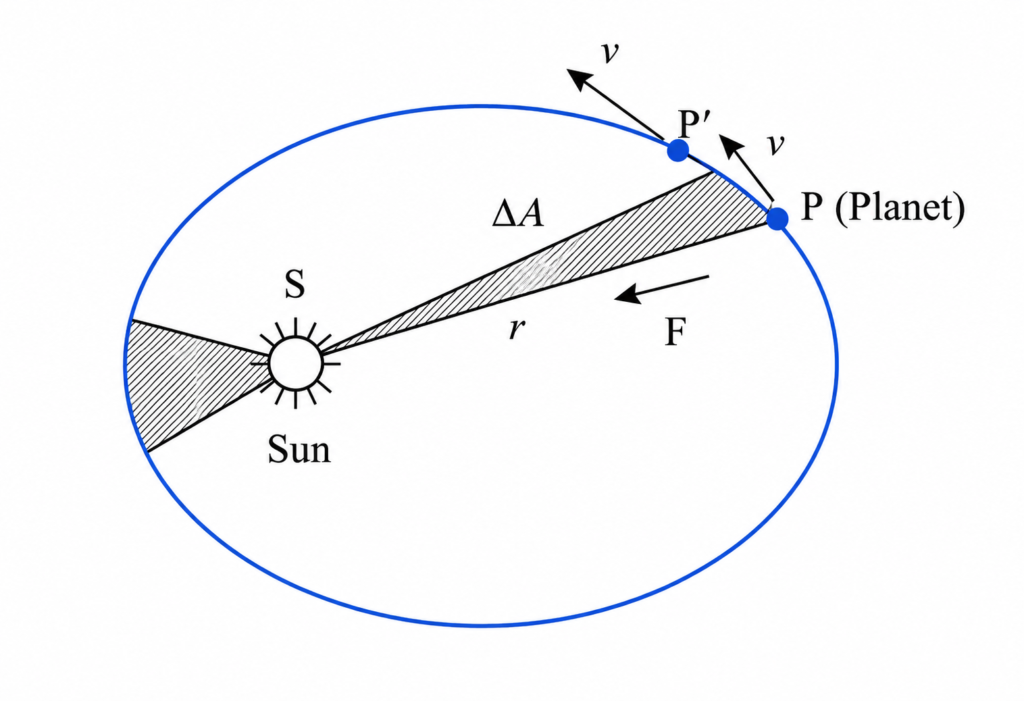
The planet ‘P‘ moves around the Sun in an electrical orbit. The shaded area is the area ΔA swept out in a small interval of time Δt.
The law of areas can be understood as a consequence of conservation of angular momentum which is valid for any Central force. A central force is such that the force on the planet is along the vector joining the Sun and the planet. Let the Sun be at the origin and let the position and momentum of the planet be denoted by r and p respectively. Then the area swept out by the planet of mass m in time interval Δt is given by
(Since, Momentum P = mass m × Velocity v)
Therefore, the above equation is called Law of Areas.
Where L is the angular momentum equal to (r×p). For a central force, which is directed along r. L is a constant as the planet goes around. Hence, ΔA/Δt is a constant according to the final equation.
Gravitation is a central force and hence the law of areas follows.
3. Law of Periods :
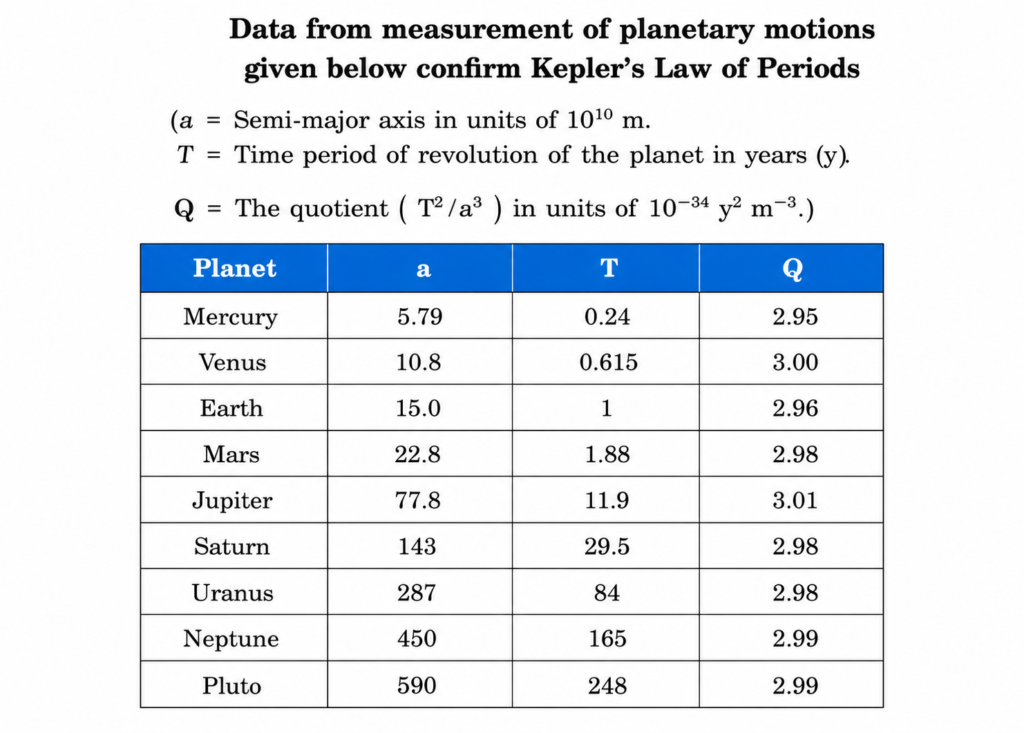
” The square of the time period of revolution of a planet is proportional to the cube of the semi major axis of the ellipse traced out by the planet “.
- Where a is semi major axis in units of 1010 m.
- T is Time Period of revolution of the Planet in years (y).
- Q is the quotient in units of 10-34 y2m-3