Motion is one of the most fundamental concepts in Physics. In this chapter, you will learn about rest and motion, distance and displacement, speed, velocity, acceleration, equations of motion, graphical representation of motion, and uniform circular motion.
TABLE OF CONTENTS
- What is Motion
- What is one dimensional motion or rectilinear motion
- What is Rest
- why rest and motion are relative terms
- What is Distance
- What is Displacement
- Differences between distance and displacement
- What is speed
- Instantaneous speed
- Average Speed
- Uniform Speed
- Non uniform speed
- Velocity
- Uniform velocity
- Differences between speed and velocity
- Acceleration and Retardation
- Equations of Motion
- Conditions for applying Equations of Motion
- Exceptional Cases
- Importance of the Equations of Motion
- First Equation of Motion
- Second Equation of Motion
- Third Equation of Motion
- Distance-Time Graph
- velocity-Time graph
1. What is Motion ?
Motion is the change in the position of an object with respect to a reference point as time passes. If an object’s position changes over time relative to a reference point, it is said to be in motion. If its position does not change, it is said to be at rest.
Reference Point: A reference point is a fixed object or place used to determine whether an object is in motion or at rest.
Real Life Examples of Motion :
Example: A car is moving on a road. Conclusion: The car is in motion with respect to the road.
What is One Dimensional Motion or Rectilinear Motion?
when a body moves along a straight line path, it’s motion is said to be the one dimensional motion. It is also called the motion in a straight line or rectilinear motion.
- For example, the motion of a train on a straight track.
- A stone falling down vertically.
- A car moving on a long and straight road.
Representation of one dimensional motion :
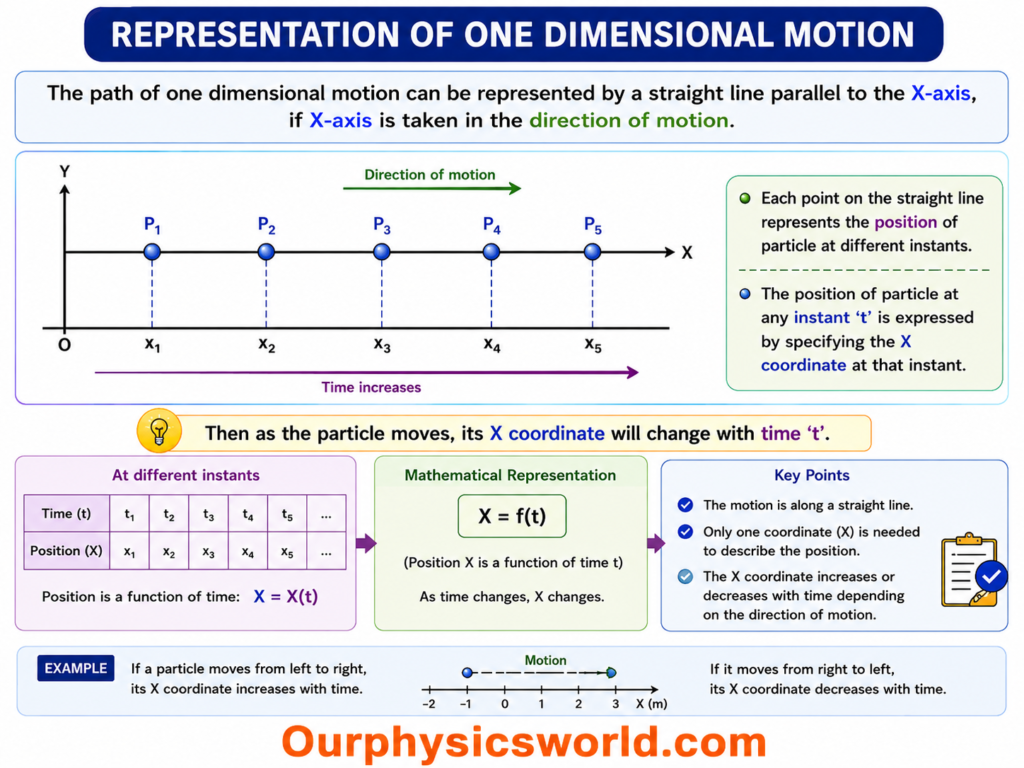
The path of one dimensional motion can be represented by a straight line parallel to the X-axis, if X-axis is taken in the direction of motion. Each point on the straight line represents the position of particle at different instants. The position of particle at any instant ‘t’ is expressed by specifying the X coordinate at that instant. Then as the particle moves, its X coordinate will change with time ‘t’.
2. What is Rest ?
An object is said to be at rest if its position does not change with respect to a reference point over a period of time.
Just like motion, rest is also relative. The same object may appear at rest to one observer and in motion to another observer.
Real Life Examples of the State ‘Rest’ :
- Example: A book placed on a table. Conclusion: The book is at rest with respect to the table.
- Example: A parked car beside the road. Conclusion: The car is at rest with respect to the road.
- Example: A person sitting inside a stationary classroom. Conclusion: The person is at rest with respect to the classroom.
- Example: A passenger sitting inside a moving bus. Conclusion: The passenger is at rest with respect to the bus but is in motion with respect to a person standing on the roadside.
- Example: A tree beside the road. Conclusion: The tree is at rest with respect to the ground but appears to move backward to a person travelling in a moving vehicle.
Key Point to Remember :
Rest is always measured with respect to a reference point.
Why Rest and Motion are Relative Terms :
- An object at rest for one observer may be in motion for another observer.
- For example, say two passengers are sitting inside a moving train.
- The two passengers are said to be at rest with respect to each other. Because, their positions are not changing with respect to each other and time.
- And the same two passengers are said to be in motion at the same time with respect to the objects like tree and other objects outside the train.
- Because the positions of the two passengers are changing with respect to the trees and other objects outside the train.
- Hence, we can conclude that a body can exist in both states of motion and rest at a same instant.
- Hence, we can say rest and motion are relative.
What is Distance ?
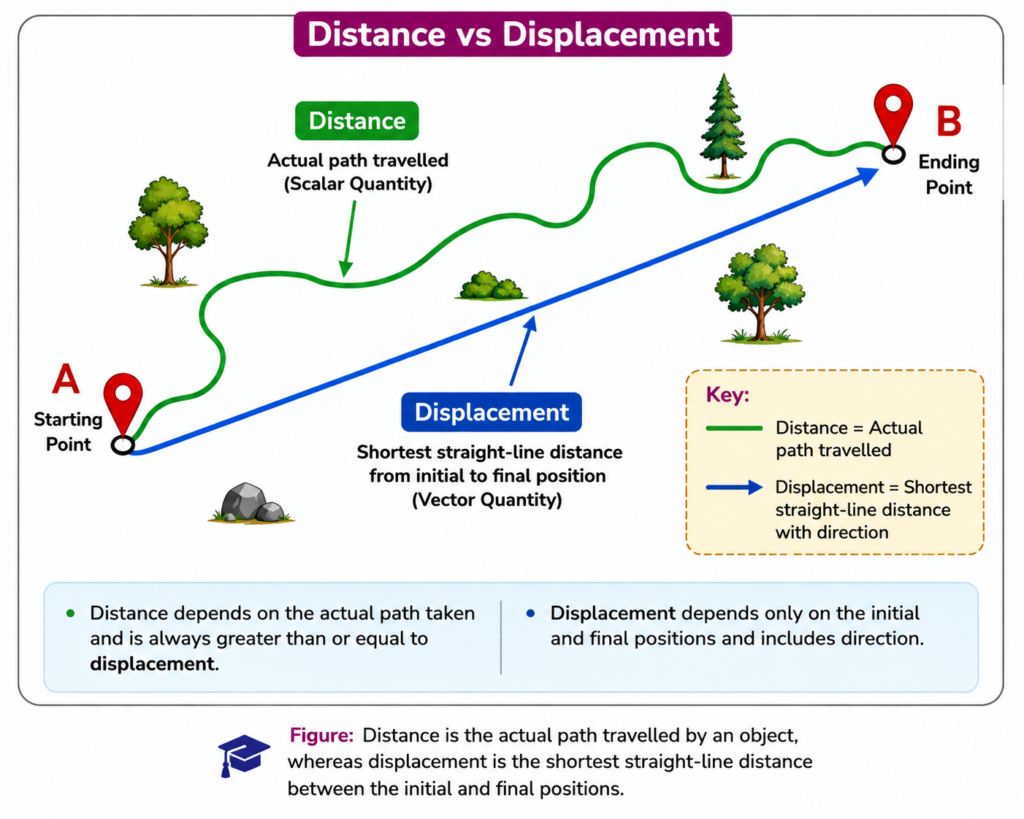
Distance is the total length of the actual path travelled by an object, irrespective of the direction.
Characteristics of Distance:
- Distance is a scalar quantity. It is generally represented by the letter ‘S’.
- It has only magnitude.
- It is always positive.
- It depends on the actual path travelled.
- SI unit is metre (m).
Real-Life Examples:
Example: A person walks 200 m east and then 100 m west.
Distance = 200 + 100 = 300 m
Example: A runner completes one full lap of a 400 m track.
Distance = 400 m
What is Displacement?
Displacement is the shortest straight-line distance between the initial position and the final position of an object, along with its direction.
Characteristics of Displacement:
- Displacement is a vector quantity. It is generally represented by the letter ‘S’.
- It has both magnitude and direction.
- It may be positive, negative, or zero, depending on the chosen direction.
- It depends only on the initial and final positions.
- SI Unit: metre (m)
Real-Life Examples:
Example: A person walks 200 m east and then 100 m west.
Displacement = 100 m east
Example: A runner completes one full lap of a circular track and returns to the starting point.
Displacement = 0 m
Differences Between Distance and Displacement:
| Distance | Displacement |
| Actual path travelled | Shortest straight line path |
| Depends on actual path | Depends only on initial and final positions |
| No direction | Has direction |
| Always positive | Can be positive, negative or zero |
| Scalar Quantity | Vector Quantity |
Diagram showing the difference between distance and displacement :
Key Points to Remember:
- Distance is always greater than or equal to displacement.
- Distance can never be less than displacement.
- When an object moves in a straight line without changing direction, distance equals displacement.
- If an object returns to its starting point, displacement becomes zero, but the distance is not zero.
4. What is Speed?
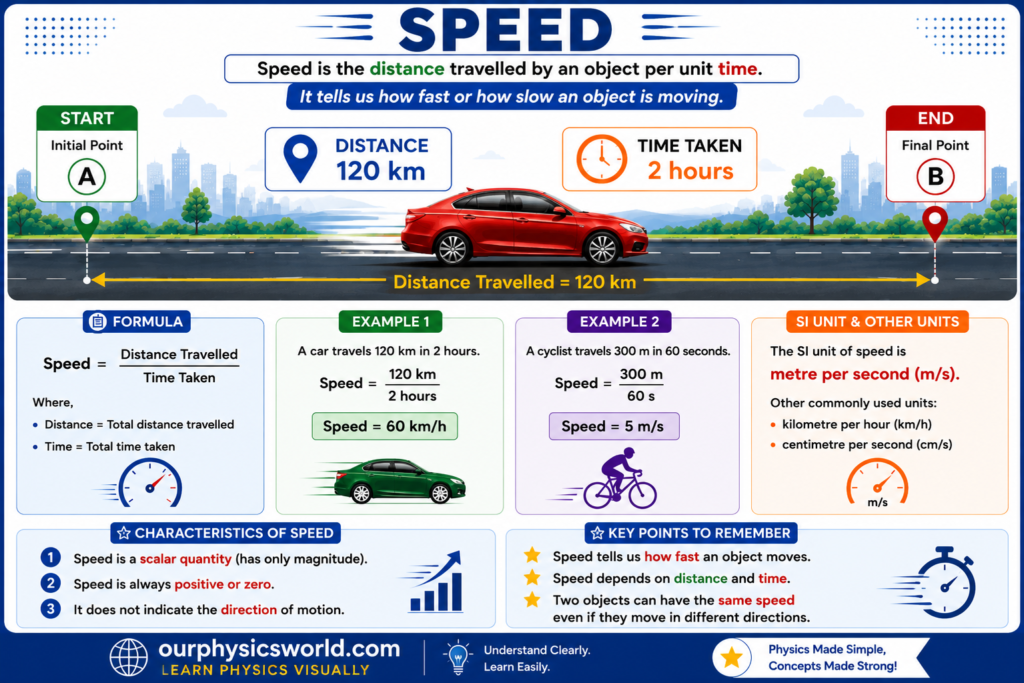
Speed is the distance travelled by an object per unit time.
In simple words, speed tells us how fast or how slow an object is moving.
Formula for Speed :
Speed (v) = Distance(d) / Unit Time(t)
v = d / t
SI Unit of Speed
The SI unit of speed is metre per second (m/s).
Other commonly used units are:
- kilometre per hour (km/h)
- centimetre per second (cm/s)
Real-Life Examples of Speed
- Speedometers in vehicles display the instantaneous speed of the vehicle.
- Speed limits on roads help reduce accidents.
- Athletes’ performance is often measured using speed.
- Meteorologists measure wind speed to forecast weather.
Example 1
A car travels 120 km in 2 hours.
Speed = 120 ÷ 2 = 60 km/h
Example 2
A cyclist travels 300 m in 60 seconds.
Speed = 300 ÷ 60 = 5 m/s
characteristics of speed
- Speed is a scalar quantity because it has only magnitude.
- Speed is always positive or zero.
- It does not indicate the direction of motion.
Key Points to Remember
- Speed tells us how fast an object moves.
- Speed depends on distance and time.
- Two objects can have the same speed even if they move in different directions.
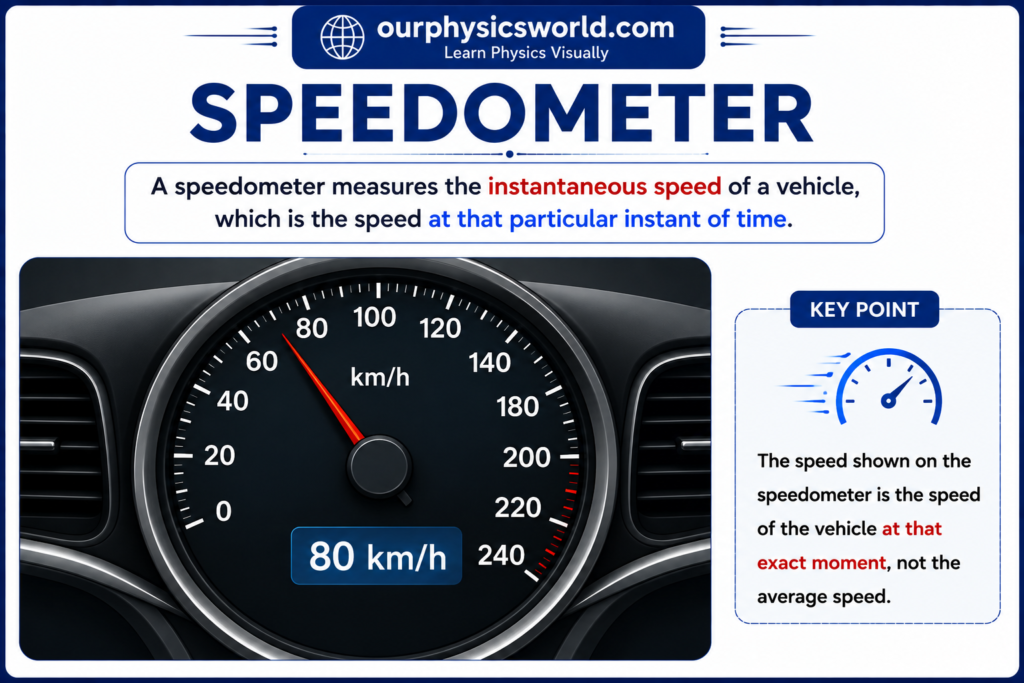
What is Instantaneous Speed ?
When the speed of a body keeps on changing continuously with time, it’s speed at any instant is known as the instantaneous speed.
It is found by measuring the distance travelled by the body in a very short time interval and then dividing the distance with the time interval.
- The speedometer of a vehicle measures the instantaneous speed.
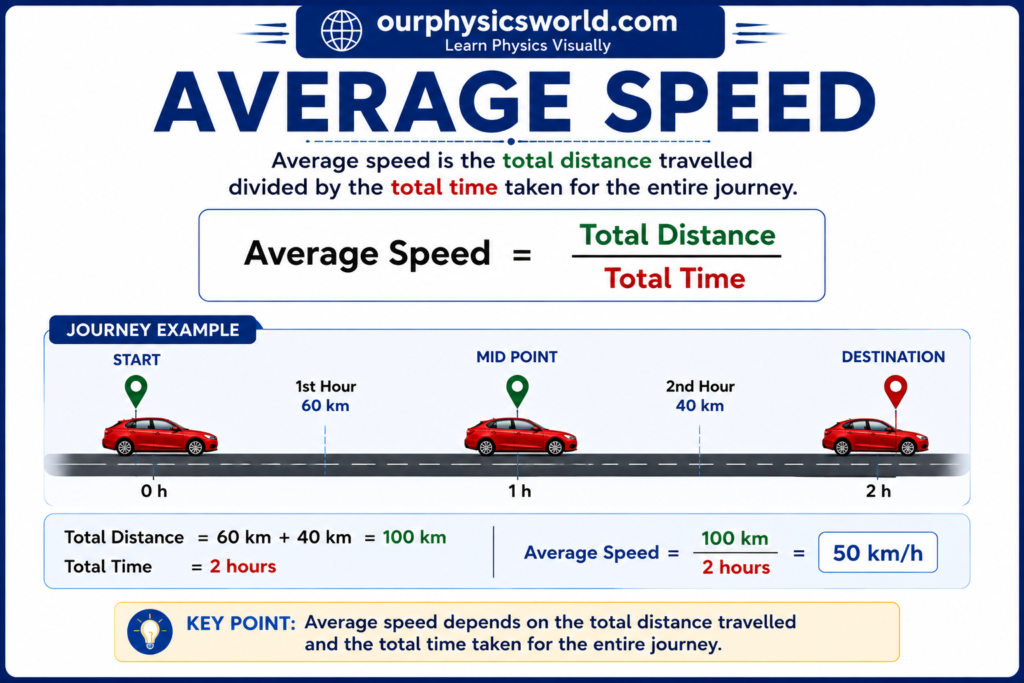
What is Average Speed?
Average Speed is the ratio of the total distance travelled by the body to the total time of journey.
Formula of Average Speed
Average Speed = Total Distance ÷ Total Time
Note: In case of a body moving with uniform speed, the instantaneous speed and the average speed are equal (same as the uniform speed) at any instant.
Real-Life Examples of Average Speed
A car travels,
- 60 km in the first hour
- 40 km in the second hour
Total Distance = 60+40 = 100 km
Total Time = 1+1 = 2 hours
Average Speed = 100 ÷ 2 = 50 km/h
Uniform Speed and Non Uniform Speed ?
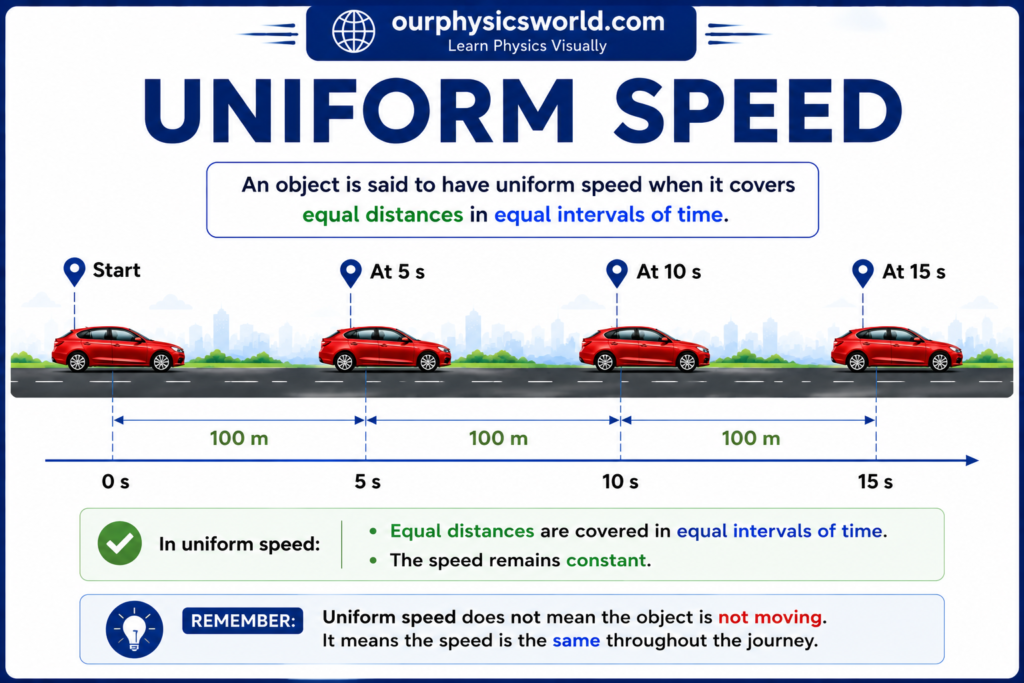
What is Uniform Speed ?
An object is said to move with uniform speed if it covers equal distances in equal intervals of time.
Real-Life Examples
- Planets revolving around the sun
- A train moving at a constant 60 km/h.
- A conveyor belt moving continuously.
- The second hand of a clock moving steadily.
Uniform Motion :
A body moving with uniform speed i.e. covering equal distances in equal intervals of time is said to be in uniform motion.
Non Uniform Speed
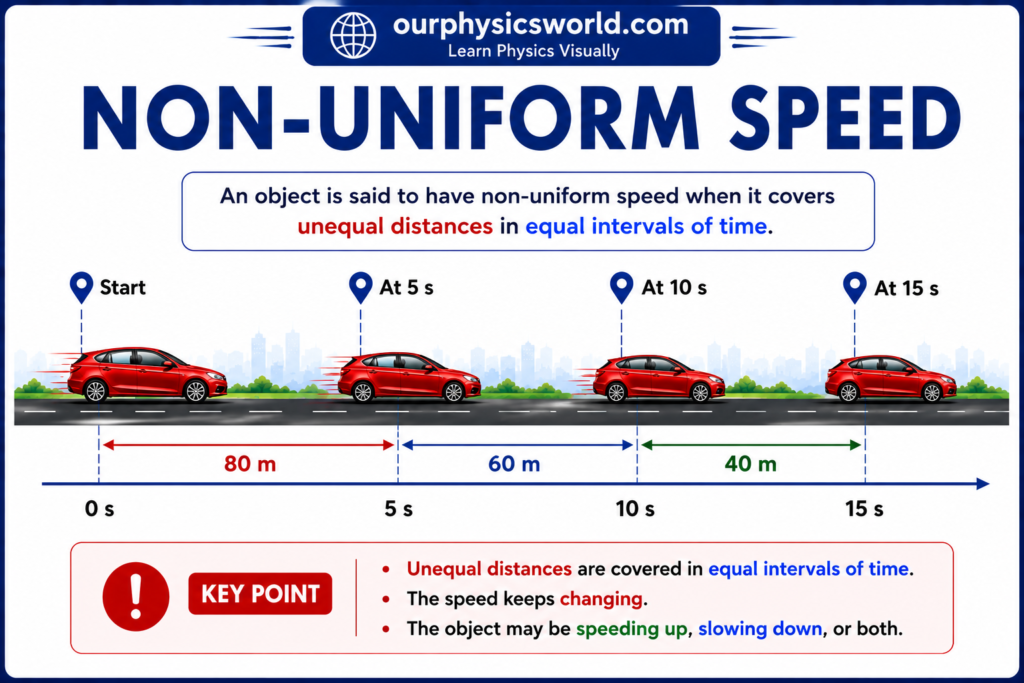
What is Non Uniform Speed ?
An object moves with non-uniform speed if it covers unequal distances in equal intervals of time, or equal distances in unequal intervals.
Examples of Non Uniform Speed
- A city bus stopping at bus stops.
- A motorcycle moving through traffic.
- A cricket ball after being hit.
Non Uniform Motion
An object moving with non-uniform speed i.e. covering unequal distances in equal intervals of time or equal distances in unequal intervals of time is said to be in Non Uniform Motion.
Comparison table of uniform speed and non-uniform speed
| Uniform Speed | Non Uniform Speed |
| Equal distances in equal time | Unequal distances in equal time |
| Speed remains constant | Speed changes continuously |
| Distance per unit time | Total distance/ Total time |
Key Points to Remember
- Average speed depends on total distance and total time.
- Uniform speed remains constant.
- Most vehicles in daily life move with non-uniform speed.
- Speed never has a direction.
5. Velocity
What is Velocity ?
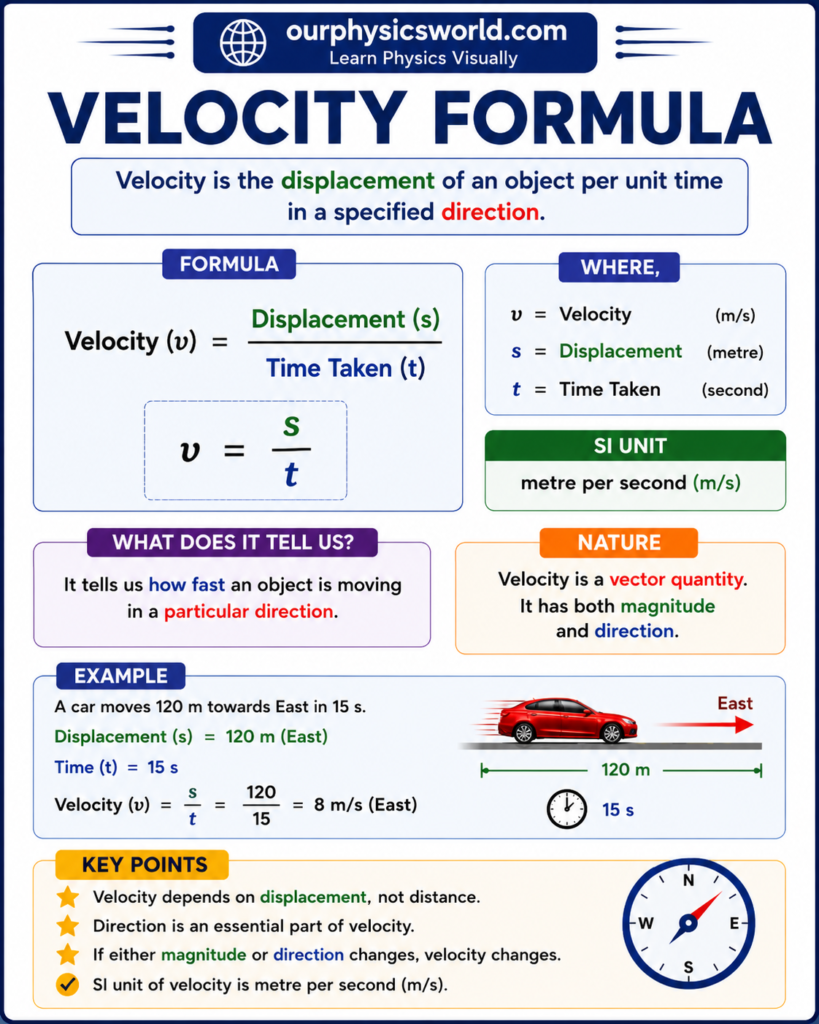
Velocity is the displacement of an object per unit time in a specified direction.
Simple Explanation of Velocity :
- Velocity tells us how fast an object moves and in which direction it moves.
- Unlike speed, velocity always includes direction.
Formula of velocity :
Velocity = Displacement / Time Taken
v = s/t
SI Unit of Velocity
metre per second (m/s)
Characteristics of Velocity :
- Velocity is a vector quantity.
- It has both magnitude and direction.
- If the direction changes, the velocity also changes, even if the speed remains the same.
- Two bodies are said to be moving with same velocities, if both of them move with the ‘same speed’ in the ‘same direction’.
- But if these bodies move with the ‘same speed’, in ‘different directions’, they are said to be moving with different velocities.
Real-Life Examples of Velocity
Example 1: A car moves 100 m east in 10 s.
Velocity = 100 / 10 = 10 m/s in east direction.
Example 2: A boy walks 50 m north in 25 s.
Velocity = 50 / 25 = 2 m/s north
Key Points to Remember
- Velocity depends on displacement, not distance.
- Direction is an essential part of velocity.
- Two objects can have the same speed but different velocities if they move in different directions.
Infographic for velocity
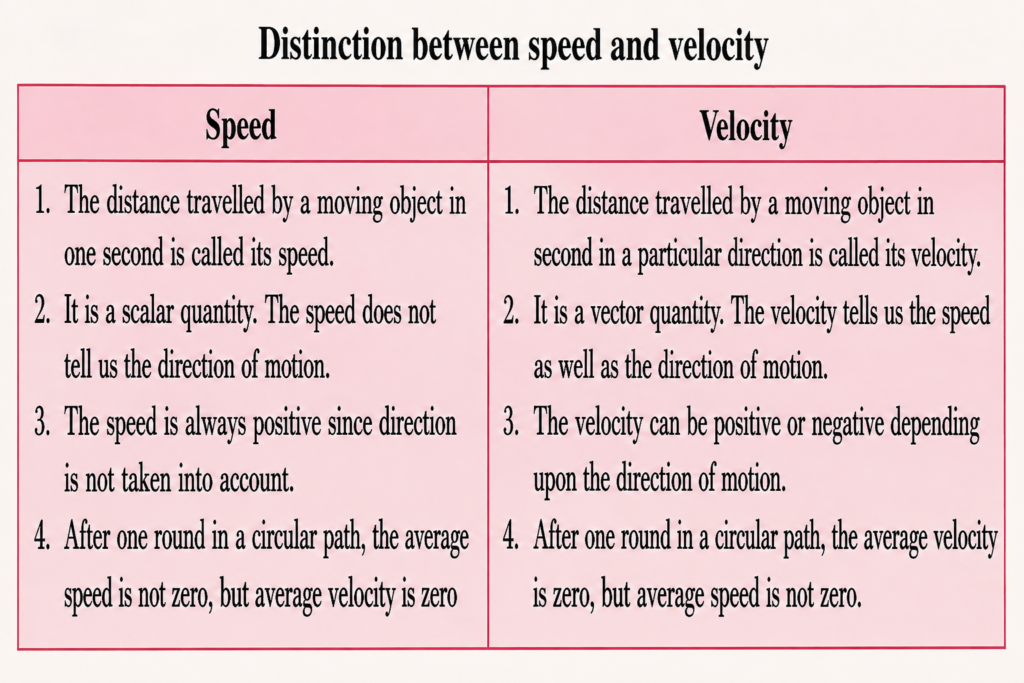
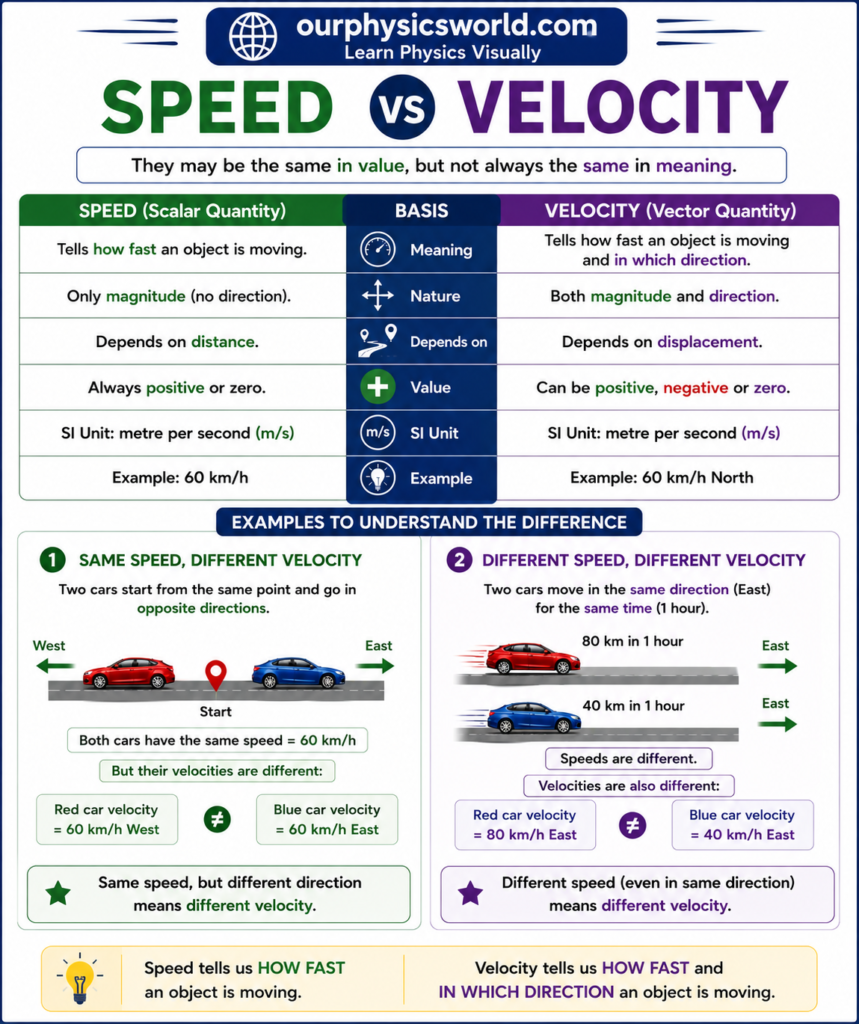
Differences between speed and velocity
Uniform Velocity :
If a body travels equal distances in equal intervals of time along a particular direction, the body is said to be moving with a uniform velocity.
Example: The rain drops reach on earth’s surface falling with uniform velocity.
6. Acceleration and Retardation
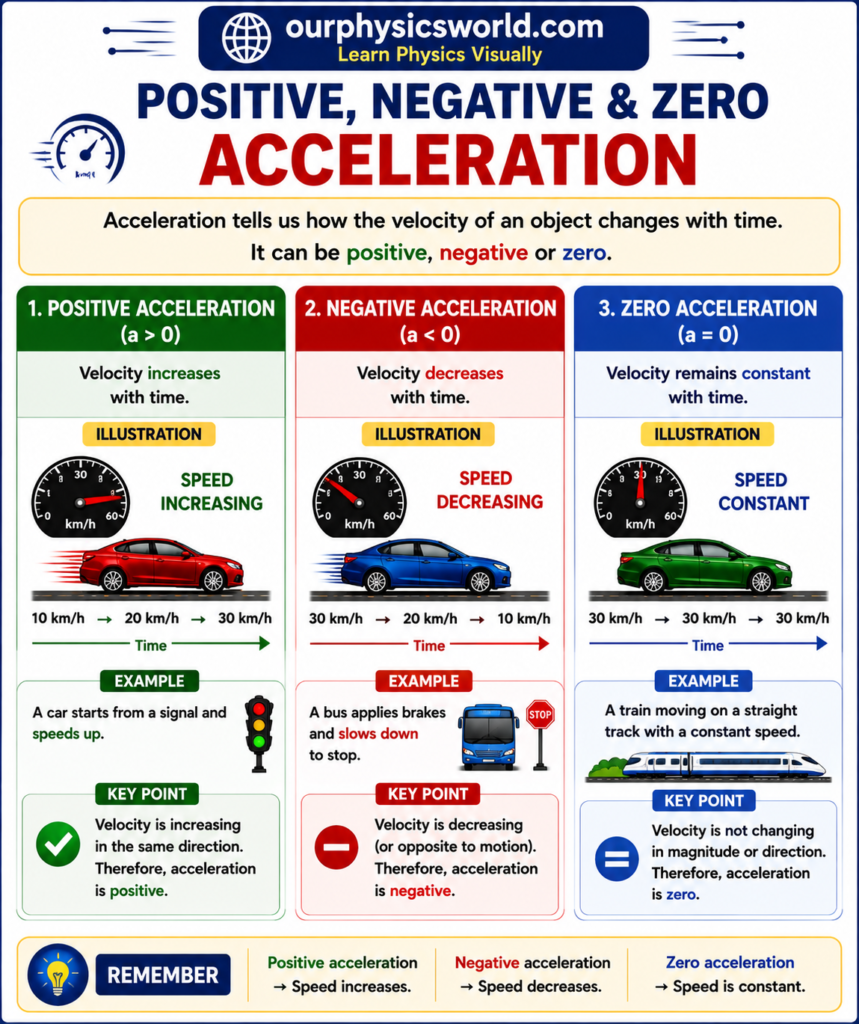
Generally the bodies do not move with uniform velocities. The velocity of a body may change either in magnitude or in direction or both in magnitude as well as in direction. For example, the motion of a car in a busy market is with variable velocity. Here we will consider motion in a straight line in which velocity changes only in magnitude (i.e., only the speed changes without change in direction of motion). In such a case, if the velocity of the body increases with the time, the motion is said to be accelerated, while if the velocity of the body decrease with the time, the motion is said to be decelerated or retarded. Thus retardation is the negative asceceleration.
In general acceleration is taken positive while retardation is taken negative.
what is acceleration ?
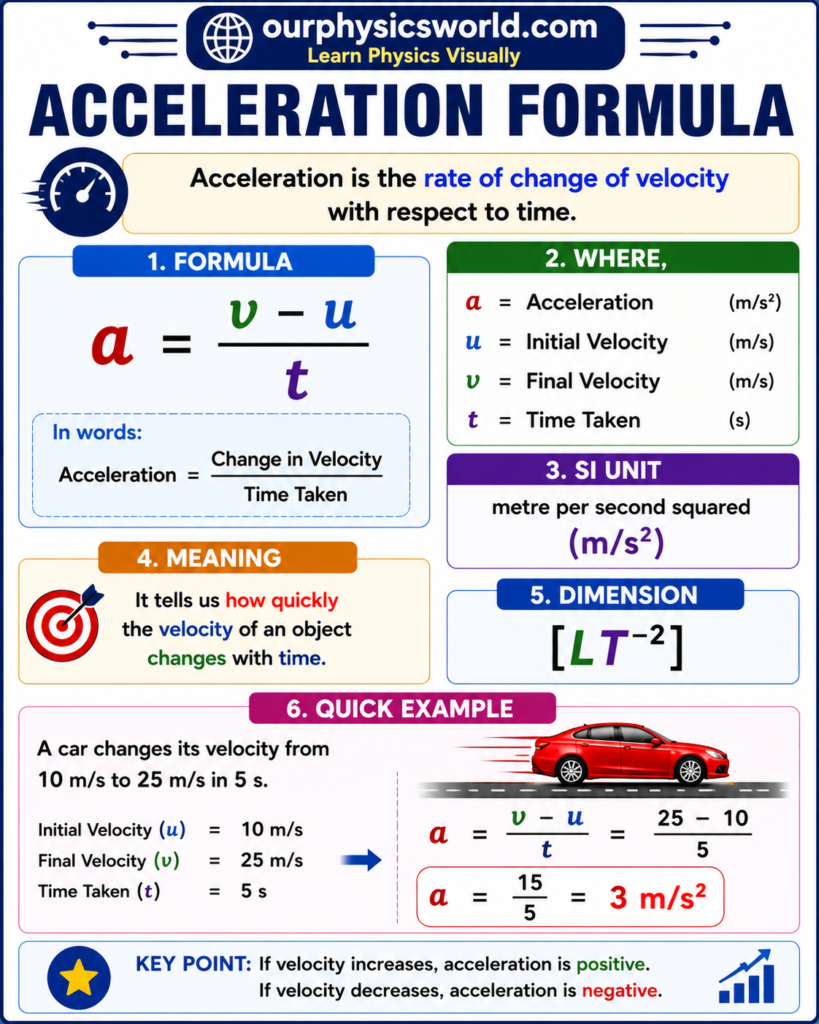
Acceleration is the rate of change of velocity with respect to time.
Simple Explanation of Acceleration
Acceleration tells us how quickly the velocity of an object changes.
The change may occur because:
- The object’s speed increases.
- The object’s speed decreases (called deceleration or negative acceleration).
- The object’s direction changes.
Formula of Acceleration
Acceleration = Change in Velocity ÷ Time Interval.
a = (v-u) / t
Where :
- a = Acceleration
- u = Initial Velocity
- v = Final Velocity
- t = Time Taken
SI Unit of Acceleration
metre per second squared (m/s²)
Characteristics of Acceleration :
- Acceleration is a Vector Quantity.
- It is represented by the symbol ‘a’
- The positive or negative sign of acceleration simply tells us whether the velocity is increasing or decreasing with time.
- Where as positive or negative sign of velocity depends on its direction of motion.
Real-Life Examples of Acceleration
Example 1: A motorcycle increases its speed from 20 m/s to 30 m/s in 5 s.
Conclusion: The motorcycle has positive acceleration.
Example 2: A bus slows down while approaching a bus stop.
Conclusion: The bus has negative acceleration (deceleration).
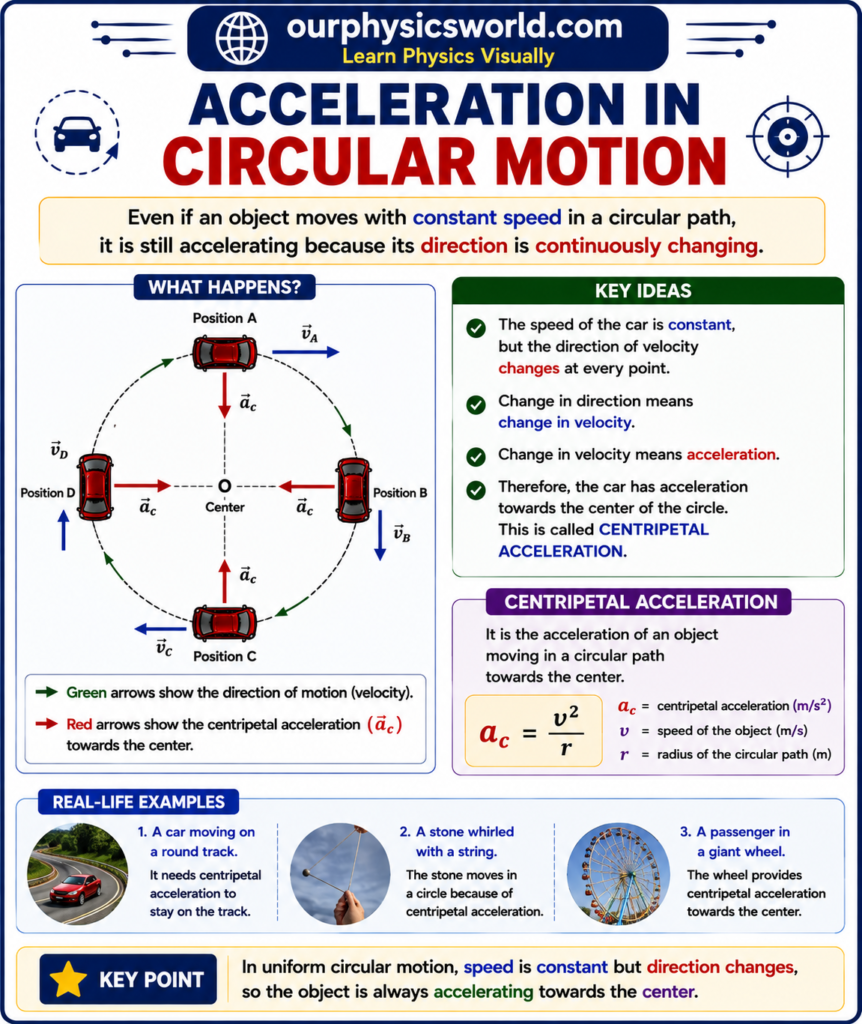
Example 3: A car moves around a circular track at constant speed.
Conclusion: The car is still accelerating because its direction is continuously changing.
Uniform Acceleration
The acceleration is said to be uniform or constant when equal changes in velocity take place in equal intervals of time.
The motion of your body under gravity (e.g. free fall of a body) is an example of uniformly accelerated motion.
Equations of Motion
Conditions for Applying Equations of Motion
The three equations of motion are valid only under the following conditions:
1. Motion must be in a straight line.
The object should move along a straight path (one-dimensional motion).
Example: A car moving on a straight road.
2. Acceleration must be constant (uniform).
The acceleration should remain the same throughout the motion.
Example: A freely falling object near the Earth’s surface (ignoring air resistance).
3. SI units should be used.
Use :
- Distance (s) → metre (m)
- Time (t) → second (s)
- Velocity (u, v) → metre per second (m/s)
- Acceleration (a) → metre per second squared (m/s²)
Using SI units ensures the equations give correct results.
Real-Life Examples
✅ Example 1: Car on a Straight Road
A car starts from rest and accelerates uniformly on a straight highway.
Conclusion: The equations of motion can be applied.
Exceptional Cases :
Example 2: Car Taking a Sharp Turn
A car moves around a circular road.
Conclusion: The basic equations of motion are not directly applicable, because the direction changes continuously.
Example 3: A Rocket During Launch
The rocket’s acceleration keeps changing because fuel burns continuously.
Conclusion: The equations of motion cannot be applied directly, since acceleration is not constant.
Key Points to Remember
- The equations of motion apply only to uniformly accelerated motion.
- Motion should be one-dimensional (straight line).
- Always use SI units while solving numerical problems.
- If acceleration changes continuously, these equations are not valid without more advanced methods.
Quick Memory Trick
Think of SUS :
- S = Straight-line motion
- U = Uniform (constant) acceleration
- S = SI units
If these three conditions are satisfied, one can confidently apply the equations of motion.
Why are they called “Equations of Motion” ?
These equations are called Equations of Motion because they mathematically describe how an object’s position and velocity change with time when it moves with uniform acceleration.
Importance of the Equations of Motion :
The equations of motion are widely used in Physics and Engineering to:
- Calculate the final velocity of moving objects.
- Determine the displacement covered by an object.
- Calculate acceleration or time of motion.
- Solve numerical problems involving uniformly accelerated motion.
- Study the motion of vehicles, trains, projectiles, and freely falling bodies.
First Equation of Motion
what is the first equation of motion ?
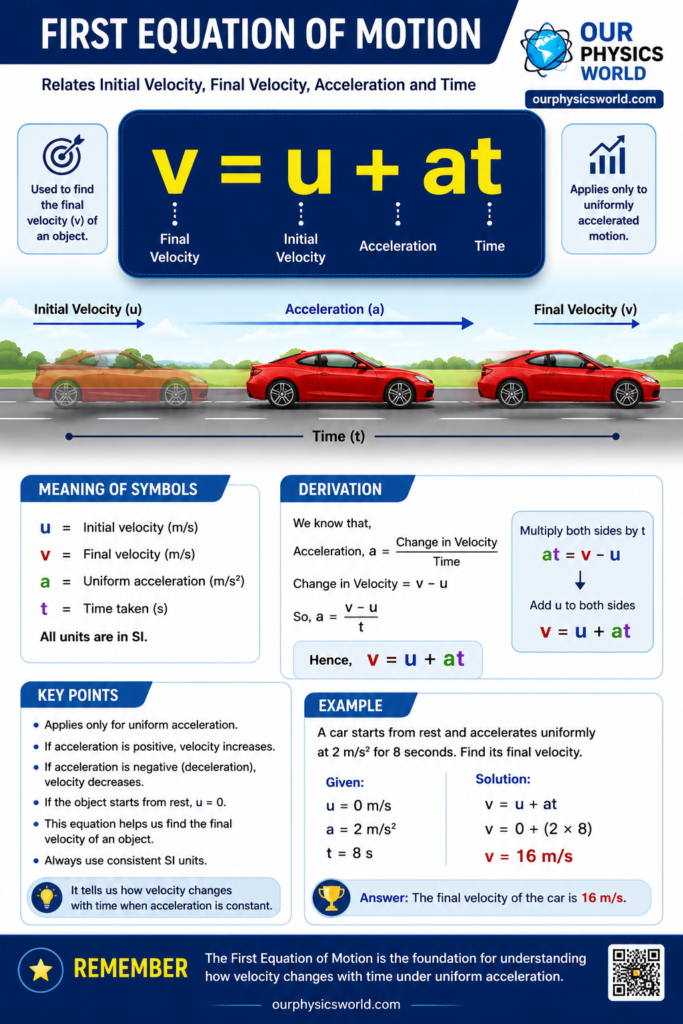
The First Equation of Motion gives the relationship between an object’s initial velocity, final velocity, uniform acceleration, and time.
It is used to calculate the final velocity of an object after it has moved with uniform acceleration for a certain period of time.
Formula :
v = u+at
Where,
- u = Initial velocity (m/s)
- v = Final velocity (m/s)
- a = Uniform acceleration (m/s²)
- t = Time taken (s)
Derivation of the First Equation of Motion :
We know that,
Acceleration = Change in Velocity / Time Taken
Since, change in velocity = v-u
Therefore,
- a = (v-u) / t
- v-u = at ( on cross multiplication)
- v = u+at
Hence, v = u+at
This is called the First Equation of Motion
Explanation :
- The first equation of motion tells us how the velocity of an object changes with time when it moves with constant (uniform) acceleration.
- If the acceleration is positive, the final velocity increases.
- If the acceleration is negative (deceleration), the final velocity decreases.
Key Points to Remember
- It is applicable only for uniformly accelerated motion.
- It relates initial velocity, final velocity, acceleration, and time.
- If an object starts from rest, then u = 0.
- Always use SI units while applying the equation.
- This equation is mainly used to calculate the final velocity.
Second Equation of Motion
What is the Second Equation of Motion?
The Second Equation of Motion establishes the relationship between an object’s displacement (s), initial velocity (u), acceleration (a), and time (t).
It is used to calculate the displacement covered by an object during a given time interval when it moves with uniform acceleration.
Formula :
s = ut+(1/2)at2
Where,
- s = Displacement
- u = Initial velocity (m/s)
- a = Uniform acceleration (m/s²)
- t = Time taken (s)
We know that the displacement covered by an object is equal to the product of its average velocity and time.
i.e. Displacement = Average Velocity × Time
i.e. S = Vavg× t
The average velocity of an object moving with uniform acceleration is:
Substituting the value of average velocity in the displacement equation:
From the First Equation of Motion,
Then we have,
Hence, the second Equation of Motion is
Key Points to Remember
- The Second Equation of Motion is applicable only when the object moves with uniform (constant) acceleration.
- It relates displacement, initial velocity, acceleration, and time.
- It is mainly used to calculate the displacement covered by an object.
- If the object starts from rest, then u = 0, and the equation becomes:
- Always use SI units while solving numerical problems.
Third Equation of Motion
What is the Third Equation of Motion ?
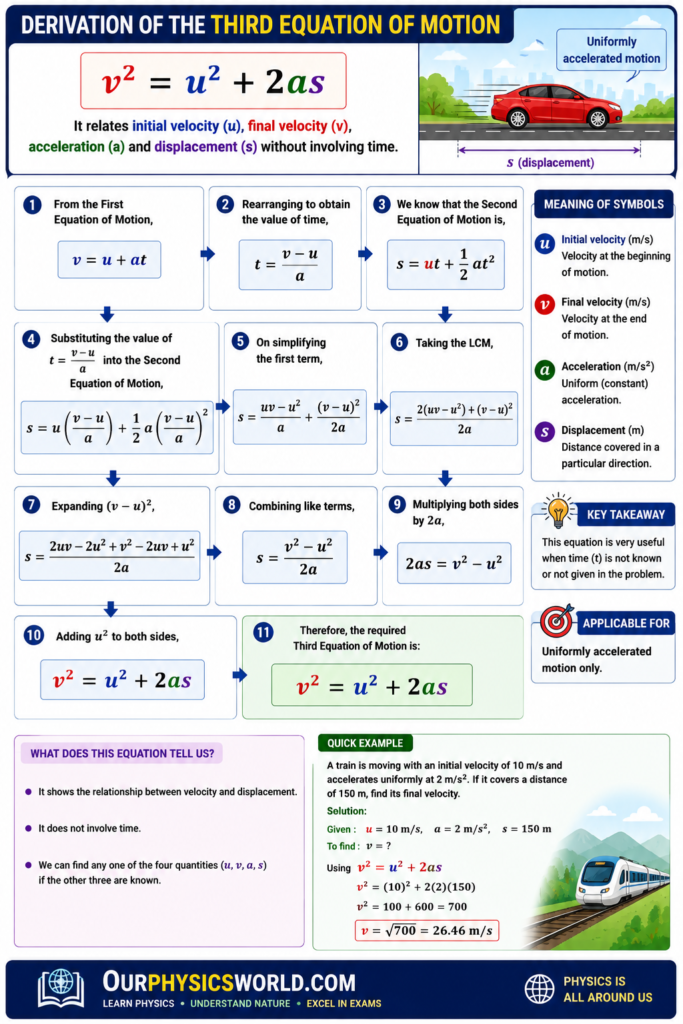
The Third Equation of Motion establishes the relationship between an object’s initial velocity, final velocity, acceleration and displacement without involving time.
It is mainly used when the time taken by the object is not given.
Meaning of the Symbols
- u = Initial velocity (m/s)
- v = Final velocity (m/s)
- a = Uniform acceleration (m/s²)
- s = Displacement (m)
Explanation of third equation of motion :
The Third Equation of Motion is useful for calculating the final velocity, initial velocity, acceleration, or displacement of an object moving with uniform acceleration when the time of motion is unknown.
Derivation of the Third Equation of Motion :
From the First Equation of Motion,
Rearranging the above equation to obtain the value of time,
We know that the Second Equation of Motion is,
Substituting the value of ‘ t ‘ in above equation, we have
On simplifying the first term,
Taking the LCM,
expanding the (v-u)2 in above equation,
combining the like terms,
On Cross Multiplication of above equation,
Or,
Therefore, the required Third Equation of Motion is:
Infographic for third equation of motion
Real-Life Example :
A car starts moving at 10 m/s and accelerates uniformly while covering a distance of 100 m. If the acceleration is known, the Third Equation of Motion can be used to calculate the final velocity without knowing the time taken.
Applications of Third Equation of Motion :
- To calculate the final velocity when time is not given.
- To determine the displacement covered by an object.
- To calculate the acceleration of an object.
- To solve numerical problems involving vehicles, trains, and freely falling objects.
Key Points to Remember :
- It is applicable only for uniformly accelerated motion.
- It does not contain time (t).
- It relates initial velocity, final velocity, acceleration, and displacement.
- Always use SI units while solving numerical problems.
Distance–Time Graph
What is a Distance–Time Graph ?
A Distance–Time Graph is a graphical representation that shows how the distance travelled by an object changes with time.
In this graph,
- The X-axis (horizontal axis) represents Time (t).
- The Y-axis (vertical axis) represents Distance (s).
A Distance–Time Graph helps us understand the nature of an object’s motion by observing the shape and slope of the graph.
Distance-Time Graph for Uniform Speed :
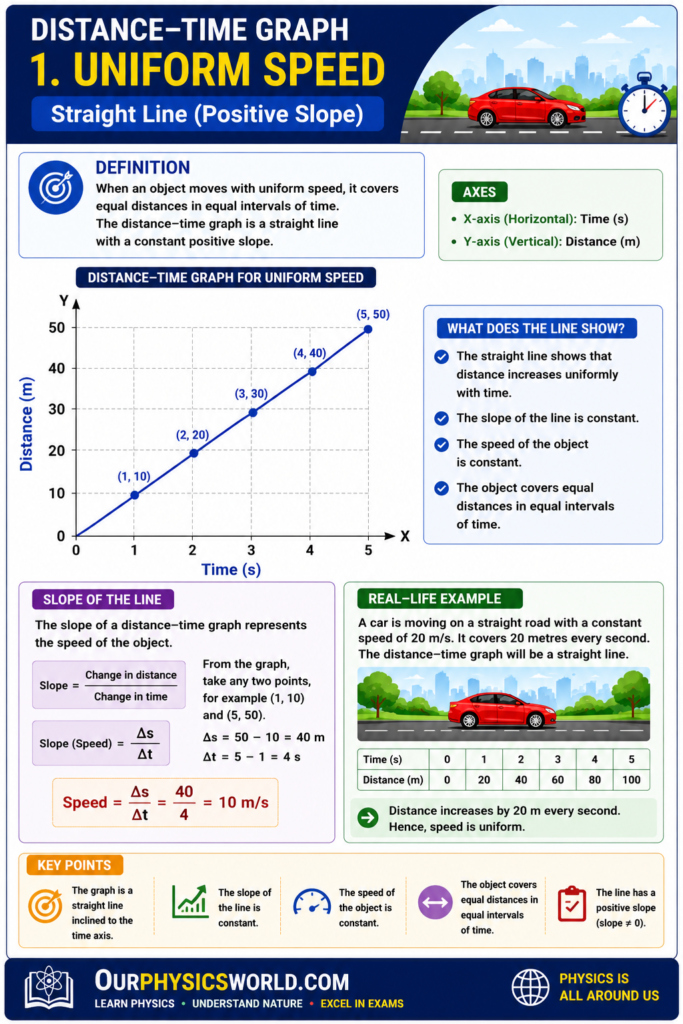
Distance-Time Graph for Non Uniform Speed:
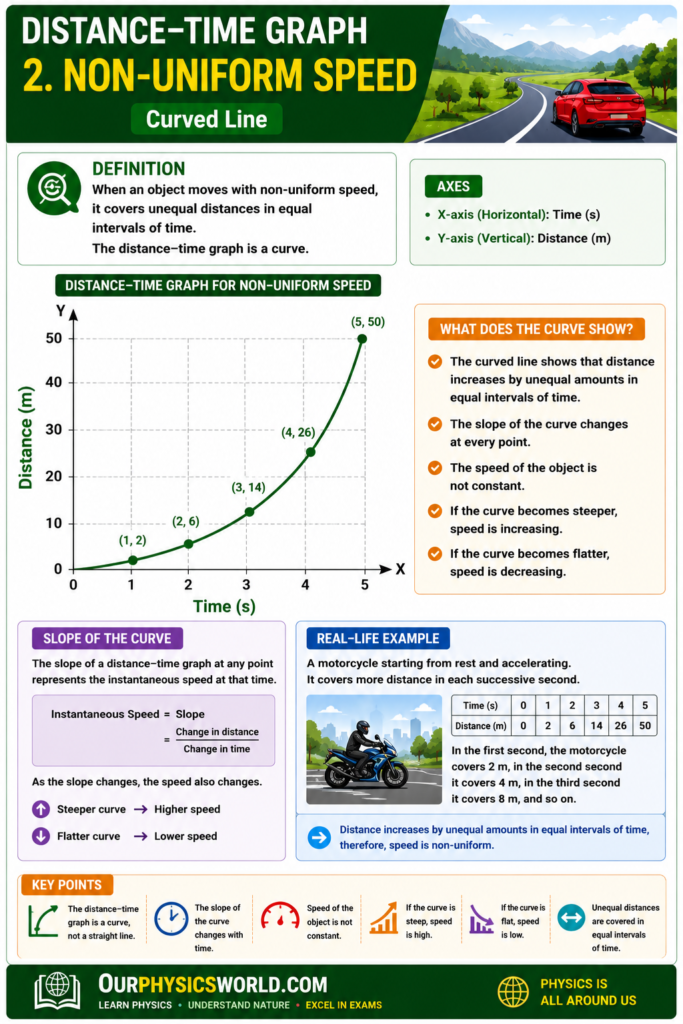
Distance-Time Graph for Object at Rest :
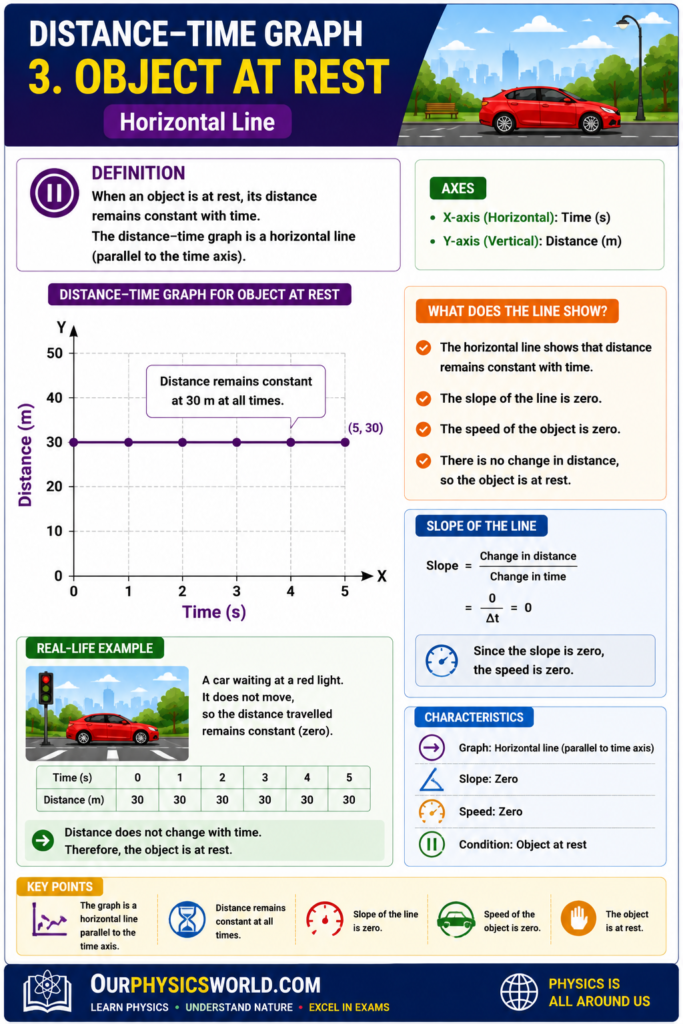
As time increases, the distance travelled by an object also changes. By plotting distance against time, we obtain a Distance–Time Graph.
The graph tells us whether the object is:
- Moving with uniform speed,
- Moving with non-uniform speed, or
- At rest.
Thus, a Distance–Time Graph provides a simple visual representation of an object’s motion.
Axes of the Distance–Time Graph
- Horizontal (X) Axis: Represents Time (seconds, minutes, or hours).
- Vertical (Y) Axis: Represents Distance (metres or kilometres).
Why is a Distance–Time Graph Important?
- It helps us understand motion easily.
- It allows us to compare different types of motion.
- It helps determine whether an object is moving uniformly, non-uniformly, or is at rest.
- It is widely used in Physics, transportation, engineering, and scientific studies.
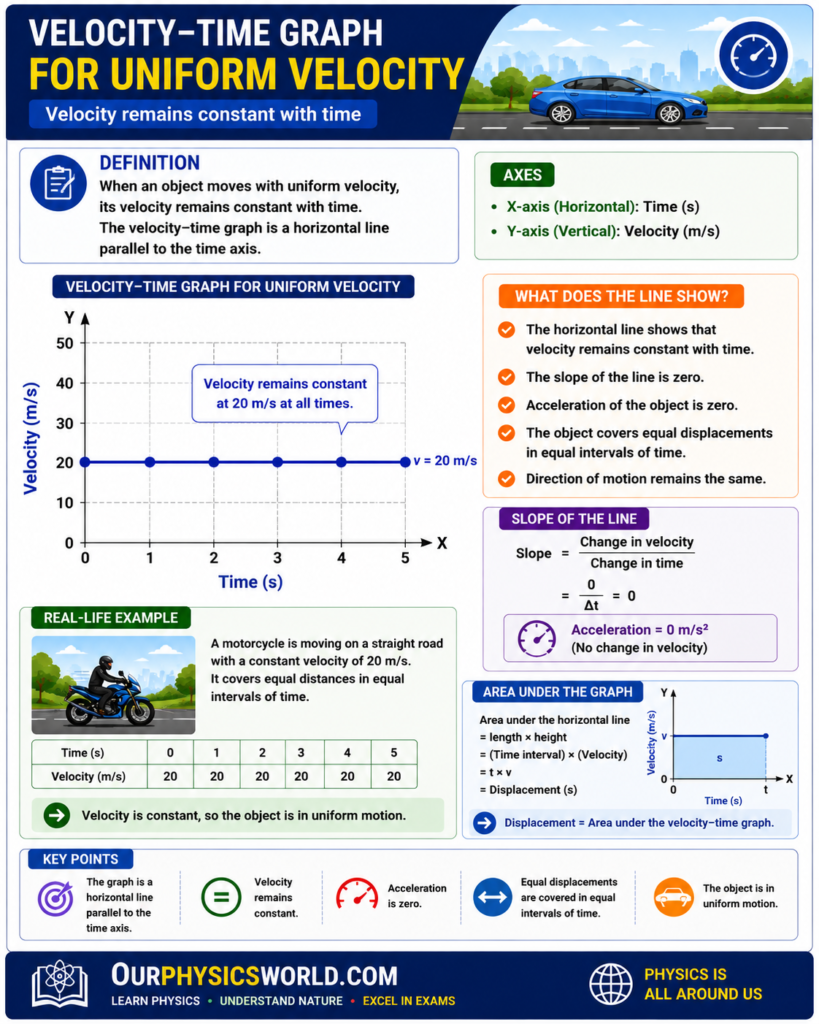
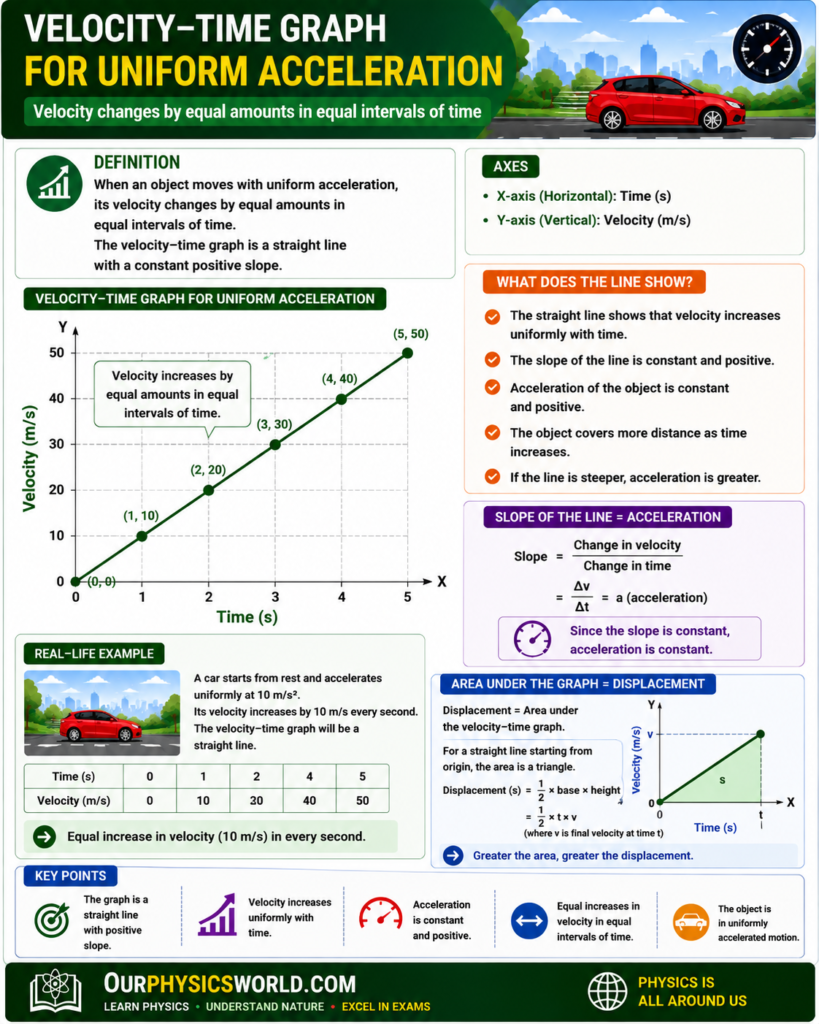
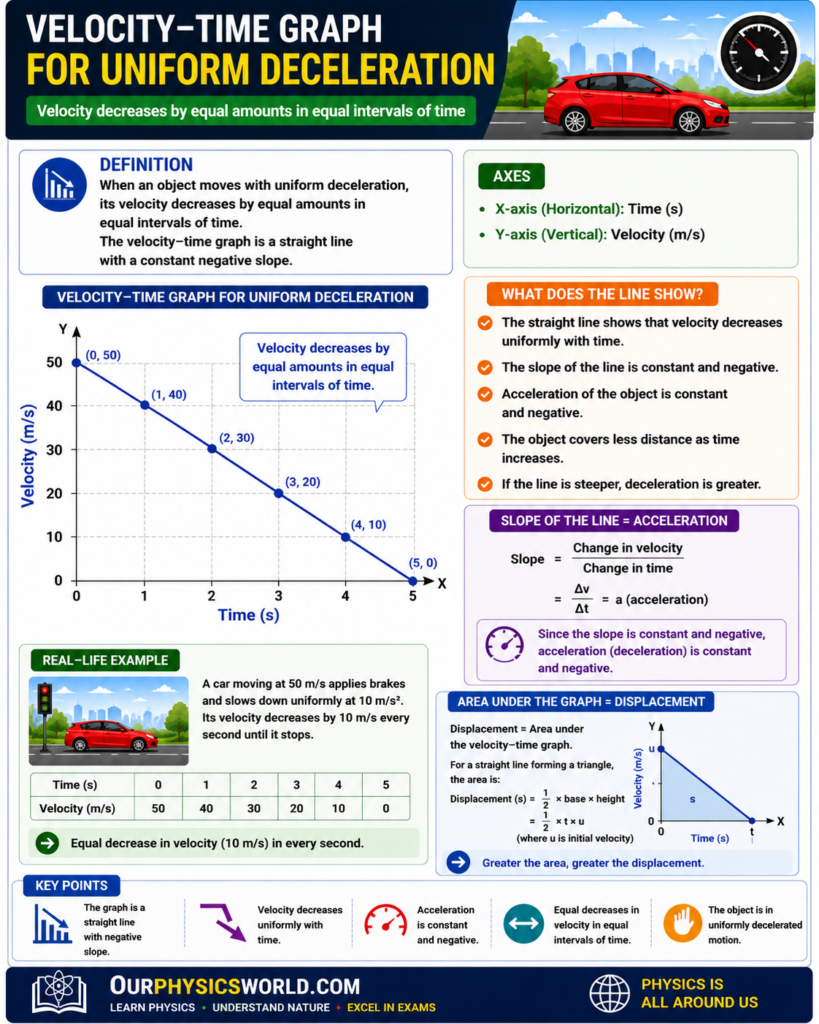
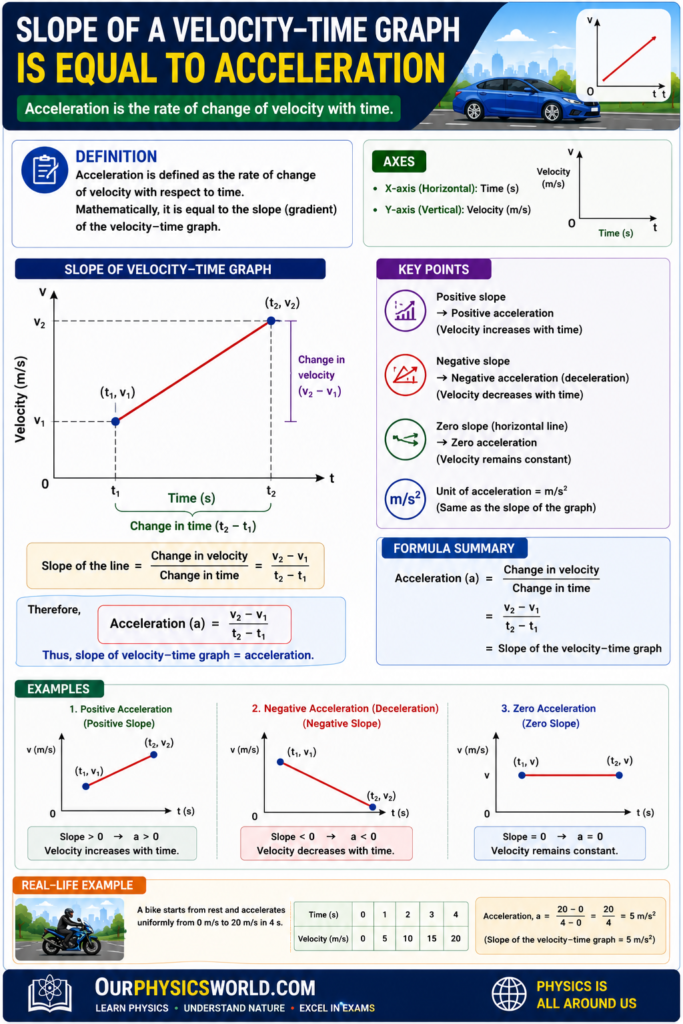
Velocity-Time Graph :
What is a Velocity–Time Graph?
A Velocity–Time Graph is a graphical representation that shows how the velocity of an object changes with time.
In this graph,
- X-axis (Horizontal axis): Represents Time (t)
- Y-axis (Vertical axis): Represents Velocity (v)
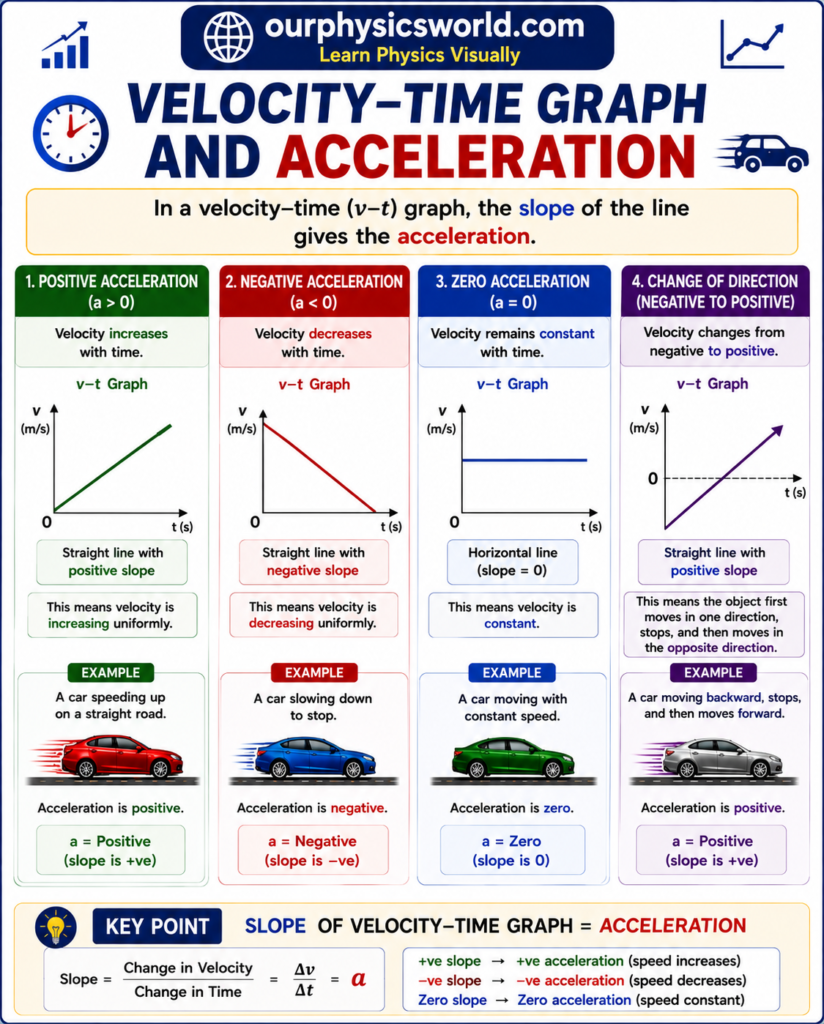
A Velocity–Time Graph helps us understand whether an object is moving with uniform velocity, uniform acceleration, or uniform deceleration.
Explanation :
As time passes, the velocity of an object may remain constant, increase, or decrease. By plotting velocity against time, we obtain a Velocity–Time Graph.
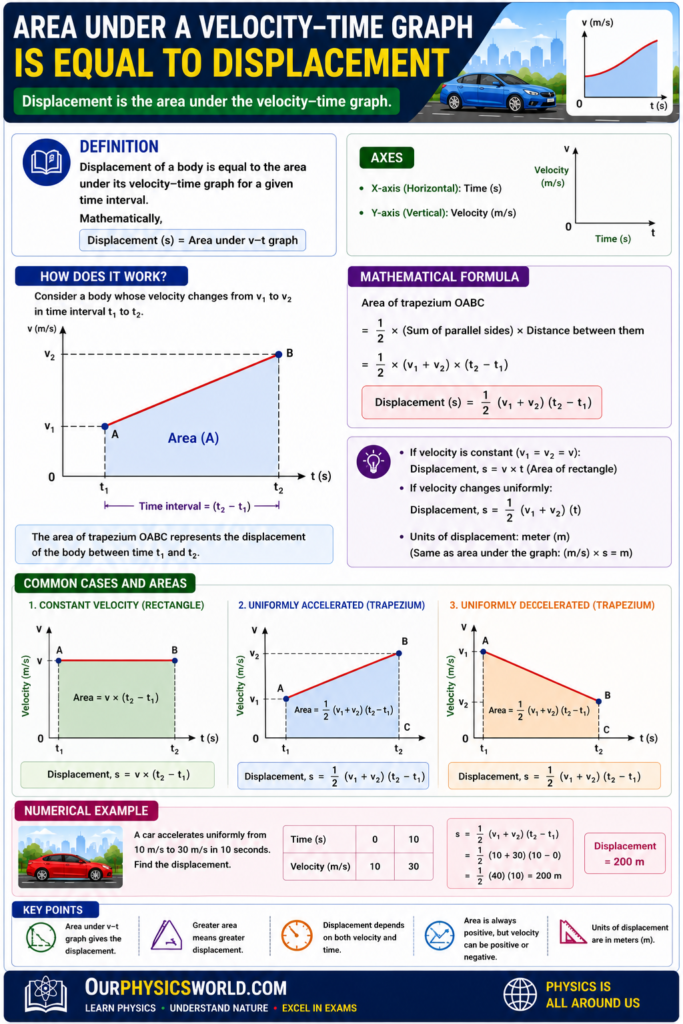
The slope (gradient) of the graph represents the acceleration of the object, while the area under the graph represents the displacement covered by the object.
Thus, a Velocity–Time Graph is one of the most useful tools for studying motion.
Axes of the Velocity–Time Graph
- Horizontal (X) Axis: Time (s)
- Vertical (Y) Axis: Velocity (m/s)
Why is a Velocity–Time Graph Important?
- Velocity-Time Graph shows how velocity changes with time.
- It helps determine the acceleration of an object.
- It helps calculate the displacement covered by the object.
- It makes the analysis of motion easier and more visual.
- It is widely used in Physics, engineering, and transportation.
Infographics of Velocity-Time Graphs of different cases :