
Table of Contents
Frames of Reference
A frame of reference is a coordinate system along with a clock, with respect to which the position, motion, and time of an object are described. The motion of an object can be described only with reference to a chosen frame of reference.
For example, consider a passenger sitting inside a moving train. The passenger is at rest with respect to the train, but the same passenger is moving with respect to a person standing on the railway platform. Thus, the state of rest or motion of an object depends on the frame of reference chosen by the observer.
Frames of reference are broadly classified into two types:
1. Inertial Frame of Reference
2. Non-Inertial Frame of Reference
i) Inertial Frame of Reference
An inertial frame of reference is a frame of reference that is either at rest or moving with constant velocity in a straight line. Therefore, its acceleration is zero.
In an inertial frame, an object remains at rest or continues to move with uniform velocity in a straight line when the net external force acting on it is zero. Newton’s laws of motion hold directly in an inertial frame without introducing fictitious forces.
For example, a train moving with constant velocity along a straight track can be considered an approximately inertial frame of reference. Similarly, a laboratory at rest relative to the Earth is generally treated as an inertial frame for ordinary mechanical experiments.
The important characteristics of an inertial frame of reference are:
- It is either at rest or moving with constant velocity in a straight line.
- Its acceleration is zero.
- Newton’s laws of motion hold directly.
- No fictitious force is required to explain motion in the frame.
Examples:
- A laboratory at rest relative to the Earth for ordinary mechanical experiments.
- A train moving with constant velocity along a straight track.
- A spacecraft moving with constant velocity in a straight line, when external effects are negligible.
ii) Non-Inertial Frame of Reference
A non-inertial frame of reference is a frame of reference that is accelerating or rotating. Its velocity may change either in magnitude or in direction.
In a non-inertial frame, Newton’s laws of motion do not hold in their simple form unless appropriate fictitious forces, also called pseudo-forces, are introduced.
For example, when a bus suddenly accelerates forward, a passenger appears to move backward relative to the bus. This apparent backward motion is explained by introducing a fictitious force in the accelerating frame of the bus.
Similarly, when a car takes a sharp turn, passengers appear to be pushed towards the outside of the turn. The car provides an accelerating frame of reference, making it a non-inertial frame.
The important characteristics of a non-inertial frame of reference are:
- It is accelerating or rotating.
- Its velocity changes in magnitude or direction.
- Newton’s laws require fictitious forces for their direct application in the frame.
- Apparent forces may be observed from within the accelerating or rotating frame.
Examples:
- An accelerating or decelerating car.
- A bus taking a sharp turn.
- A rotating merry-go-round.
- An elevator accelerating upward or downward.
Difference Between Inertial and Non-Inertial Frames of Reference
| Inertial Frame of Reference | Non-Inertial Frame of Reference |
|---|---|
| It is at rest or moves with constant velocity in a straight line. | It is accelerating or rotating. |
| Its acceleration is zero. | Its acceleration is non-zero in general. |
| Newton’s laws hold directly. | Fictitious forces may be required to apply Newton’s laws in the frame. |
| No fictitious force is required. | Fictitious or pseudo-forces may appear. |
| Example: a train moving with constant velocity along a straight track. | Example: an accelerating bus or a rotating merry-go-round. |
Key Point: An inertial frame of reference is one that is at rest or moving with constant velocity in a straight line, whereas a non-inertial frame is accelerating or rotating. Newton’s laws take their simplest form in an inertial frame of reference.
Inertial Mass and Gravitational Mass
Mass appears in two different roles in mechanics: inertial mass determines the resistance of a body to acceleration, while gravitational mass determines how strongly a body participates in gravitational interaction.
i) Inertial Mass
Inertial mass is a measure of the resistance offered by a body to any change in its state of motion when an external force is applied.
According to Newton’s second law of motion, the force acting on a body is proportional to the product of its inertial mass and acceleration:
\[ F = m_i a \]Therefore, the inertial mass of a body is:
\[ \boxed{m_i = \frac{F}{a}} \]where \(m_i\) is the inertial mass, \(F\) is the applied force, and \(a\) is the acceleration produced.
A body having greater inertial mass offers greater resistance to acceleration for the same applied force.
SI unit: kilogram (kg)
ii) Gravitational Mass
Gravitational mass is a measure of the strength with which a body participates in gravitational interaction. It determines the gravitational force experienced by a body in a gravitational field.
Consider a body of gravitational mass \(m_g\) placed in the gravitational field of a large body such as the Earth. If the gravitational field strength is \(g\), the gravitational force acting on the body is:
\[ F = m_g g \]Therefore, the gravitational mass of the body is:
\[ \boxed{m_g = \frac{F}{g}} \]where \(m_g\) is the gravitational mass, \(F\) is the gravitational force, and \(g\) is the gravitational field strength.
The gravitational mass determines how strongly a body interacts gravitationally with another body.
SI unit: kilogram (kg)
Relation Between Inertial Mass and Gravitational Mass
The equivalence of inertial mass and gravitational mass can be understood by considering a freely falling body near the Earth’s surface.
The gravitational force acting on a body is:
\[ F = m_g g \]According to Newton’s second law, the same force produces acceleration according to:
\[ F = m_i a \]For a freely falling body, the acceleration \(a\) is the acceleration due to gravity \(g\). Therefore:
\[ m_i g = m_g g \]Since \(g \neq 0\), cancelling \(g\) from both sides gives:
\[ m_i = m_g \]Hence, experimentally, inertial mass and gravitational mass are found to be equal:
\[ \boxed{m_i = m_g} \]This equality means that the mass which measures a body’s resistance to acceleration is equal to the mass that determines its gravitational interaction.
Experimental Verification of the Equivalence of Masses
The equality of inertial mass and gravitational mass has been tested with very high precision using experiments that compare the free-fall behaviour of different materials. The results show that different bodies experience the same acceleration in a given gravitational field when effects such as air resistance are negligible.
This equivalence is one of the fundamental ideas underlying Einstein’s equivalence principle.
Difference Between Inertial Mass and Gravitational Mass
| Inertial Mass | Gravitational Mass |
|---|---|
| It measures the resistance of a body to acceleration. | It measures the strength of a body’s participation in gravitational interaction. |
| Defined using Newton’s second law. | Defined through gravitational interaction. |
| \[ m_i = \frac{F}{a} \] | \[ m_g = \frac{F}{g} \] |
| SI unit: kilogram (kg) | SI unit: kilogram (kg) |
| Determines how strongly a body resists acceleration. | Determines how strongly a body interacts gravitationally. |
| Experimentally equal to gravitational mass. | Experimentally equal to inertial mass. |
Key Result: Inertial mass and gravitational mass represent different physical roles, but experiments show that their values are equal:
\[ \boxed{m_i = m_g} \]This equivalence explains why, in the absence of air resistance and other non-gravitational forces, all bodies at the same location fall with the same acceleration due to gravity, irrespective of their masses.
Principle of Equivalence
The principle of equivalence states that a uniformly accelerated reference frame in the absence of any gravitational effect is completely equivalent to a homogeneous gravitational field.
In simple terms, the observations made inside a closed, uniformly accelerating system are locally indistinguishable from the observations made inside a uniform gravitational field.
Einstein recognised the equivalence of inertial mass and gravitational mass as a fundamental idea and used it as the starting point for his general theory of relativity.
Case 1: Astronaut in a Stationary Spaceship on the Earth
Let us consider an astronaut standing inside a stationary spaceship on the Earth. The astronaut feels the reaction force exerted by the floor of the spaceship on their feet.
This happens because the Earth exerts a gravitational force on the astronaut. The floor of the spaceship prevents the astronaut from falling towards the Earth’s surface and exerts an upward normal force.
If the astronaut releases a ball from a certain height above the floor, the ball falls towards the floor with an acceleration equal to the acceleration due to gravity.
\[ a = g \]Thus, the astronaut observes the effects of a gravitational field inside the stationary spaceship.
Case 2: Astronaut in Free Space
Now let us consider that the astronaut turns on the engines of the spaceship and travels to a place where there is virtually no gravitational effect, that is, free space.
Suppose the spaceship remains stationary at that place. Since there is virtually no gravitational field, the astronaut will not feel the reaction force of the floor on their feet.
Moreover, if the astronaut releases a ball from a certain height above the floor of the spaceship, the ball will not fall towards the floor. It will simply float there.
Thus, in this situation, the astronaut experiences a state of apparent weightlessness because there is virtually no gravitational field and the spaceship is not accelerating.
Case 3: Astronaut in Free Space with Acceleration g
Now let us assume that the astronaut in free space, where there is virtually no gravity, again turns on the engines of the spaceship and accelerates the spaceship with an acceleration equal to \(g\).
\[ a = g \]The astronaut will then again feel the force of the floor on their feet. Although there is virtually no gravitational field, the upward acceleration of the floor causes it to exert a force on the astronaut.
If the astronaut releases a ball from a certain height, the ball will appear to fall towards the floor of the spaceship.
The acceleration with which the ball appears to fall relative to the accelerating spaceship is:
\[ a = g \]Therefore, the observations made inside this accelerating spaceship are exactly the same, locally, as those made inside a stationary spaceship on the Earth with a gravitational field of strength \(g\).
Analysis of the Three Cases
The first and third cases produce the same observable effects inside the spaceship. In Case 1, the astronaut is in a gravitational field while the spaceship is stationary. In Case 3, there is virtually no gravitational field, but the spaceship is accelerating with \(g\).
In both situations, the astronaut feels the reaction force of the floor, and a released ball appears to fall towards the floor with acceleration \(g\).
| Case | Condition | Observation |
|---|---|---|
| Case 1 | Stationary spaceship on Earth | Astronaut feels the floor; released ball falls with acceleration \(g\). |
| Case 2 | Stationary spaceship in free space | Astronaut feels no reaction from the floor; released ball floats. |
| Case 3 | Spaceship in free space accelerating with \(g\) | Astronaut feels the floor; released ball appears to fall with acceleration \(g\). |
The analysis of these three cases shows that observations made in an accelerated frame can be indistinguishable from observations made in a gravitational field.
Therefore, the principle of equivalence can also be stated as:
No experiment performed inside an accelerated, closed system can distinguish between the effects of a gravitational field and the effects of accelerated motion.
Key Point: A uniformly accelerating reference frame in the absence of a gravitational field can locally reproduce the effects of a uniform gravitational field.
\[ \boxed{\text{Gravitational effects} \equiv \text{effects of suitable acceleration}} \]Gravitational Potential
Gravitational potential at a point in a gravitational field is defined as the work done by an external agent in bringing a unit positive test mass from infinity to that point, without changing its kinetic energy.
The gravitational potential is a scalar quantity. Since gravitational force is attractive, the gravitational potential at a finite distance from an isolated mass is negative when the potential at infinity is taken as zero.
Consider a point mass \(M\). Let a unit mass be brought from infinity to a point at a distance \(r\) from \(M\).
The gravitational force acting on a mass \(m\) at a distance \(r\) from \(M\) is:
\[ F = \frac{GMm}{r^2} \]For a unit mass, \(m=1\) kg. Therefore:
\[ F = \frac{GM}{r^2} \]The work done by the gravitational force in moving the unit mass from infinity to distance \(r\) is:
\[ W_g = \int_{\infty}^{r} \frac{GM}{r^2}\,dr \]Evaluating the integral:
\[ W_g = GM\left[-\frac{1}{r}\right]_{\infty}^{r} \]\[ W_g = -\frac{GM}{r} \]Therefore, the gravitational potential at a distance \(r\) from a point mass \(M\) is:
\[ \boxed{V = -\frac{GM}{r}} \]The negative sign indicates that the gravitational potential at a finite distance is lower than the potential at infinity, where it is conventionally taken as zero.
SI unit: joule per kilogram (J/kg)
Dimensional formula:
\[ \boxed{[V] = L^2T^{-2}} \]Since gravitational potential is energy per unit mass, its dimensions are the same as those of specific energy.
Important points:
- Gravitational potential is a scalar quantity.
- Its value at infinity is conventionally taken as zero.
- The gravitational potential due to an isolated mass is negative at a finite distance.
- For a point mass, gravitational potential depends on the mass \(M\) and distance \(r\).
- The gravitational potential becomes less negative as the distance from the mass increases.
Gravitational Potential Energy
Gravitational potential energy of a body at a point is the energy possessed by the body due to its position in a gravitational field.
If a mass \(m\) is placed at a distance \(r\) from a point mass \(M\), its gravitational potential energy is equal to the product of its mass and the gravitational potential at that point.
\[ U = mV \]Since the gravitational potential is:
\[ V = -\frac{GM}{r} \]we obtain:
\[ U = m\left(-\frac{GM}{r}\right) \]\[ \boxed{U = -\frac{GMm}{r}} \]Thus, the gravitational potential energy of a mass \(m\) at a distance \(r\) from a point mass \(M\), taking the potential energy at infinity as zero, is:
\[ \boxed{U = -\frac{GMm}{r}} \]The negative sign indicates that the body is gravitationally bound to the mass \(M\). Positive external work must be done to take the body from distance \(r\) to infinity.
SI unit: joule (J)
Dimensional formula:
\[ \boxed{[U] = ML^2T^{-2}} \]Gravitational Potential Energy Near the Earth’s Surface
When a body is raised through a small height \(h\) near the Earth’s surface, the acceleration due to gravity can be considered approximately constant. The increase in gravitational potential energy is then given by:
\[ \boxed{\Delta U = mgh} \]If the ground level is chosen as the zero level of potential energy, the gravitational potential energy of a body of mass \(m\) at height \(h\) is:
\[ \boxed{U = mgh} \]Here, \(m\) is the mass of the body, \(g\) is the acceleration due to gravity, and \(h\) is the height above the chosen reference level.
The expression \(U=mgh\) is an approximation valid when the height \(h\) is small compared with the Earth’s radius, so that \(g\) remains approximately constant.
Relation Between Gravitational Potential and Gravitational Potential Energy
Gravitational potential is the gravitational potential energy per unit mass. Therefore:
\[ \boxed{V = \frac{U}{m}} \]Equivalently:
\[ \boxed{U = mV} \]For a point mass \(M\):
\[ V = -\frac{GM}{r} \]Therefore:
\[ U = mV \]\[ U = -\frac{GMm}{r} \]Thus, gravitational potential describes the gravitational potential energy per unit mass, whereas gravitational potential energy is the total energy associated with a particular mass.
| Gravitational Potential | Gravitational Potential Energy |
|---|---|
| Work done per unit mass in bringing a test mass from infinity to a point. | Energy possessed by a mass due to its position in a gravitational field. |
| \[ V=-\frac{GM}{r} \] | \[ U=-\frac{GMm}{r} \] |
| Scalar quantity | Scalar quantity |
| SI unit: J/kg | SI unit: J |
| Independent of the test mass. | Depends on the mass of the body. |
Key Point: Gravitational potential is the gravitational potential energy per unit mass, while gravitational potential energy is the total energy associated with a mass at a particular position in a gravitational field.
\[ \boxed{V=\frac{U}{m}} \]\[ \boxed{U=mV} \]Escape and Orbital Velocities
The motion of an object under the influence of a planet’s gravitational field depends on the velocity with which the object is projected. Two important velocities associated with gravitational motion are escape velocity and orbital velocity.
Escape velocity is the minimum velocity required to project an object from the surface of a planet so that it can escape completely from the planet’s gravitational field without any further propulsion.
Orbital velocity is the velocity required by an object to move in a stable circular orbit around a planet or other massive body.
i) Escape Velocity
The escape velocity of a body from the surface of a planet is the minimum initial velocity with which the body must be projected so that it reaches infinitely far away from the planet with zero final speed, neglecting air resistance and other external effects.
Consider a body of mass \(m\) projected vertically upward from the surface of a planet of mass \(M\) and radius \(R\) with escape velocity \(v_e\).
The initial kinetic energy of the body is:
\[ K_i = \frac{1}{2}mv_e^2 \]Taking the gravitational potential energy at infinity as zero, the initial gravitational potential energy at the surface is:
\[ U_i = -\frac{GMm}{R} \]At infinity, for the minimum escape velocity, the final velocity is zero. Therefore:
\[ K_f = 0 \]The gravitational potential energy at infinity is:
\[ U_f = 0 \]According to the law of conservation of mechanical energy:
\[ K_i + U_i = K_f + U_f \]Substituting the values:
\[ \frac{1}{2}mv_e^2-\frac{GMm}{R}=0 \]Therefore:
\[ \frac{1}{2}mv_e^2=\frac{GMm}{R} \]Cancelling \(m\) from both sides:
\[ \frac{1}{2}v_e^2=\frac{GM}{R} \]Multiplying both sides by 2:
\[ v_e^2=\frac{2GM}{R} \]Taking the square root:
\[ \boxed{v_e=\sqrt{\frac{2GM}{R}}} \]Since:
\[ g=\frac{GM}{R^2} \]we have:
\[ GM=gR^2 \]Substituting this into the escape velocity equation:
\[ v_e=\sqrt{\frac{2gR^2}{R}} \]\[ \boxed{v_e=\sqrt{2gR}} \]For the Earth, taking \(g=9.8\ \text{m/s}^2\) and \(R=6.37\times10^6\ \text{m}\):
\[ v_e=\sqrt{2(9.8)(6.37\times10^6)} \]\[ v_e\approx1.117\times10^4\ \text{m/s} \]\[ v_e\approx11.17\ \text{km/s} \]Thus, the escape velocity from the Earth’s surface is approximately:
\[ \boxed{v_e\approx11.2\ \text{km/s}} \]Important characteristics of escape velocity:
- It is the minimum velocity required for an object to escape permanently from a planet’s gravitational field.
- It does not depend on the mass of the escaping object.
- It depends on the mass and radius of the planet.
- For a given planet, the escape velocity is independent of the direction of projection when air resistance is neglected.
- For the Earth, the escape velocity at the surface is approximately \(11.2\ \text{km/s}\).
ii) Orbital Velocity
The orbital velocity of a satellite is the tangential velocity required for the satellite to remain in a circular orbit around a planet.
Consider a satellite of mass \(m\) moving in a circular orbit of radius \(r\) around a planet of mass \(M\).
The gravitational force acting between the planet and the satellite is:
\[ F_g=\frac{GMm}{r^2} \]This gravitational force provides the centripetal force required for the circular motion of the satellite:
\[ F_c=\frac{mv_o^2}{r} \]Equating gravitational force and centripetal force:
\[ \frac{GMm}{r^2}=\frac{mv_o^2}{r} \]Cancelling \(m\) from both sides:
\[ \frac{GM}{r^2}=\frac{v_o^2}{r} \]Multiplying by \(r\):
\[ v_o^2=\frac{GM}{r} \]Taking the square root:
\[ \boxed{v_o=\sqrt{\frac{GM}{r}}} \]For a satellite very close to the Earth’s surface, \(r\approx R\). Therefore:
\[ v_o=\sqrt{\frac{GM}{R}} \]Using:
\[ g=\frac{GM}{R^2} \]we obtain:
\[ GM=gR^2 \]Therefore:
\[ v_o=\sqrt{\frac{gR^2}{R}} \]\[ \boxed{v_o=\sqrt{gR}} \]For the Earth, taking \(g=9.8\ \text{m/s}^2\) and \(R=6.37\times10^6\ \text{m}\):
\[ v_o=\sqrt{(9.8)(6.37\times10^6)} \]\[ v_o\approx7.90\times10^3\ \text{m/s} \]\[ v_o\approx7.90\ \text{km/s} \]Thus, the orbital velocity of a satellite in a circular orbit very close to the Earth’s surface is approximately:
\[ \boxed{v_o\approx7.9\ \text{km/s}} \]Important characteristics of orbital velocity:
- It is the tangential velocity required for a satellite to maintain a circular orbit.
- It depends on the mass of the central body and the radius of the orbit.
- It does not depend on the mass of the satellite.
- For a circular orbit, gravitational force provides the required centripetal force.
- The orbital velocity decreases as the orbital radius increases.
Difference Between Escape Velocity and Orbital Velocity
| Escape Velocity | Orbital Velocity |
|---|---|
| It is the minimum velocity required to escape from a planet’s gravitational field. | It is the velocity required to maintain a circular orbit around a planet. |
| \[ v_e=\sqrt{\frac{2GM}{R}} \] | \[ v_o=\sqrt{\frac{GM}{r}} \] |
| For Earth near the surface: approximately \(11.2\ \text{km/s}\) | For a circular orbit very close to Earth’s surface: approximately \(7.9\ \text{km/s}\) |
| The object does not remain gravitationally bound to the planet in the ideal escape case. | The object remains gravitationally bound in its circular orbit. |
Key Point: Escape velocity is the minimum velocity needed to escape from a planet’s gravitational field, whereas orbital velocity is the velocity required to continuously move around the planet in a circular orbit.
Relation Between Escape Velocity and Orbital Velocity
The escape velocity and orbital velocity of a body around the same central celestial body are closely related. For a satellite in a circular orbit close to the surface of a planet, the escape velocity is greater than the orbital velocity by a factor of \(\sqrt{2}\).
The orbital velocity of a satellite in a circular orbit of radius \(r\) is:
\[ v_o = \sqrt{\frac{GM}{r}} \]The escape velocity from the same distance \(r\) from the centre of the planet is:
\[ v_e = \sqrt{\frac{2GM}{r}} \]Squaring both equations:
\[ v_o^2 = \frac{GM}{r} \]\[ v_e^2 = \frac{2GM}{r} \]Dividing the escape-velocity equation by the orbital-velocity equation:
\[ \frac{v_e^2}{v_o^2} = \frac{\frac{2GM}{r}}{\frac{GM}{r}} \]Cancelling \(GM/r\):
\[ \frac{v_e^2}{v_o^2}=2 \]Therefore:
\[ v_e^2 = 2v_o^2 \]Taking the positive square root:
\[ \boxed{v_e=\sqrt{2}\,v_o} \]Hence, the relation between escape velocity and orbital velocity is:
\[ \boxed{\frac{v_e}{v_o}=\sqrt{2}} \]Therefore, the escape velocity is approximately 1.414 times the orbital velocity at the same distance from the centre of the planet.
For a satellite very close to the Earth’s surface:
\[ v_o \approx 7.9\ \text{km/s} \]\[ v_e \approx 11.2\ \text{km/s} \]Verification:
\[ v_e=\sqrt{2}(7.9) \]\[ v_e\approx11.17\ \text{km/s} \]which is approximately \(11.2\ \text{km/s}\).
Key Point: At the same distance from the centre of a planet, the escape velocity is \(\sqrt{2}\) times the circular orbital velocity.
\[ \boxed{v_e=\sqrt{2}\,v_o} \]Geostationary Satellite
A geostationary satellite is an artificial satellite that revolves around the Earth in a circular orbit in the equatorial plane, from west to east, with the same angular velocity and the same period of rotation as the Earth. As a result, it appears to remain stationary above a fixed point on the Earth’s surface.
For a satellite to appear geostationary, it must satisfy the following conditions:
- Its orbit must be circular.
- Its orbit must lie in the equatorial plane of the Earth.
- It must revolve from west to east, in the same direction as the Earth’s rotation.
- Its orbital period must be equal to the Earth’s rotational period, approximately 24 hours.
- Its angular velocity must be equal to the angular velocity of the Earth.
Because these conditions are satisfied, the satellite remains above approximately the same point on the equator as viewed from the Earth.
Orbital Radius of a Geostationary Satellite
The orbital radius of a geostationary satellite is the distance from the centre of the Earth to the satellite.
For a circular orbit, the gravitational force provides the centripetal force:
\[ \frac{GMm}{r^2}=\frac{mv^2}{r} \]The orbital velocity is related to the orbital period \(T\) by:
\[ v=\frac{2\pi r}{T} \]Substituting this expression for \(v\):
\[ \frac{GMm}{r^2} = \frac{m}{r}\left(\frac{2\pi r}{T}\right)^2 \]Simplifying:
\[ GM = \frac{4\pi^2r^3}{T^2} \]Therefore:
\[ r^3=\frac{GMT^2}{4\pi^2} \]Hence, the orbital radius is:
\[ \boxed{r=\left(\frac{GMT^2}{4\pi^2}\right)^{1/3}} \]For a geostationary satellite, the orbital period is approximately one day. Using the Earth’s mass and the corresponding rotational period gives an orbital radius of approximately:
\[ \boxed{r\approx4.216\times10^7\ \text{m}} \]Therefore:
\[ \boxed{r\approx42,164\ \text{km}} \]This distance is measured from the centre of the Earth, not from the Earth’s surface.
Height of a Geostationary Satellite Above the Earth’s Surface
The height of the satellite above the Earth’s surface is obtained by subtracting the Earth’s equatorial radius from the orbital radius.
\[ h=r-R_E \]Taking the Earth’s equatorial radius as approximately \(6,378\ \text{km}\):
\[ h=42,164-6,378 \]\[ h\approx35,786\ \text{km} \]Therefore, the height of a geostationary satellite above the Earth’s equatorial surface is approximately:
\[ \boxed{h\approx35,786\ \text{km}} \]Thus, remember the distinction:
\[ \boxed{\text{Orbital radius}\approx42,164\ \text{km}} \]\[ \boxed{\text{Height above Earth’s surface}\approx35,786\ \text{km}} \]The orbital radius is measured from the centre of the Earth, whereas the height is measured from the Earth’s surface.
Orbital Period of a Geostationary Satellite
A geostationary satellite takes approximately one sidereal day to complete one revolution around the Earth. Its orbital period is approximately:
\[ \boxed{T\approx23\ \text{h}\ 56\ \text{min}\ 4\ \text{s}} \]This is approximately 24 hours and matches the Earth’s rotational period relative to the stars.
i) Uses of Geostationary Satellites
Geostationary satellites are particularly useful for communication and continuous monitoring because they remain approximately fixed over the same region of the Earth.
- Telecommunication: They are used for long-distance telephone, data, and communication services.
- Television broadcasting: They are widely used for transmitting television signals over large geographical areas.
- Weather monitoring: They continuously observe cloud systems, cyclones, storms, and other large-scale atmospheric phenomena.
- Disaster monitoring: They help in monitoring cyclones, severe storms, floods, and other natural disasters.
- Internet and data communication: They can provide communication links over large and remote areas.
- Navigation and communication support: They can support certain communication and tracking services, although dedicated navigation satellite systems generally use different orbital configurations.
Key Point: A geostationary satellite revolves in a circular equatorial orbit from west to east with a period equal to the Earth’s rotation. It therefore appears stationary above a fixed point on the equator.
\[ \boxed{T\approx24\ \text{hours}} \]\[ \boxed{r\approx42,164\ \text{km}} \]\[ \boxed{h\approx35,786\ \text{km}} \]Polar Satellite
A polar satellite is an artificial satellite that revolves around the Earth in an orbit passing approximately over the North and South Poles. Its orbit is highly inclined to the Earth’s equatorial plane, and it passes over or close to the polar regions during each revolution.
Polar satellites generally travel in a north-south direction relative to the Earth’s surface, while the Earth rotates beneath their orbital path. Therefore, successive revolutions allow the satellite to observe different regions of the Earth’s surface.
Orbit of a Polar Satellite
The orbital plane of a polar satellite is highly inclined to the Earth’s equatorial plane and is ideally close to perpendicular to it. A polar orbit has an inclination of approximately \(90^\circ\) with respect to the equator.
\[ \boxed{i\approx90^\circ} \]As the satellite moves around the Earth, the Earth rotates below it. This allows the satellite to pass over different parts of the Earth during successive orbits.
Many Earth-observation satellites use polar or near-polar orbits because they can provide extensive coverage of the Earth’s surface.
Height of a Polar Satellite
Unlike geostationary satellites, polar satellites do not have one fixed orbital height. Many polar Earth-observation satellites operate in low Earth orbit (LEO), typically at a few hundred kilometres to around a thousand kilometres above the Earth’s surface, depending on their mission.
The orbital radius is the distance from the centre of the Earth to the satellite:
\[ \boxed{r=R_E+h} \]where \(R_E\) is the Earth’s radius and \(h\) is the satellite’s altitude above the Earth’s surface.
Orbital Period of a Polar Satellite
The orbital period of a polar satellite depends mainly on its orbital radius. For a circular orbit, the orbital period is given by:
\[ \boxed{T=2\pi\sqrt{\frac{r^3}{GM}}} \]Since many polar satellites operate in low Earth orbits, their orbital periods are commonly around 90 to 110 minutes, depending on their altitude.
Characteristics of a Polar Satellite
- Its orbit passes over or close to the North and South Poles.
- Its orbital plane is highly inclined to the Earth’s equatorial plane.
- A true polar orbit has an inclination of approximately \(90^\circ\).
- It generally operates at a much lower altitude than a geostationary satellite.
- The Earth rotates beneath the satellite as it completes successive revolutions.
- It can provide coverage of large portions of the Earth’s surface.
- Its orbital period depends on its altitude and is generally much shorter than that of a geostationary satellite.
Uses of Polar Satellites
Polar satellites are particularly useful for observing and studying the Earth’s surface and atmosphere.
- Earth observation: They are used to obtain detailed images and data of the Earth’s surface.
- Weather monitoring: They provide atmospheric and meteorological observations used in weather forecasting.
- Remote sensing: They are used to study land, water, vegetation, and other natural resources.
- Agriculture: Satellite data can help monitor crops, vegetation, soil conditions, and agricultural regions.
- Environmental monitoring: They help monitor forests, glaciers, oceans, pollution, and changes in the Earth’s environment.
- Disaster management: They can provide observations useful for monitoring floods, cyclones, forest fires, and other natural disasters.
- Mapping and surveying: They are used for mapping the Earth’s surface and collecting geographical information.
Polar Satellite and Geostationary Satellite
| Polar Satellite | Geostationary Satellite |
|---|---|
| Orbit passes over or close to the polar regions. | Orbit lies in the equatorial plane. |
| Orbital inclination is approximately \(90^\circ\) for a true polar orbit. | Orbital inclination is \(0^\circ\). |
| Usually operates in low Earth orbit. | Operates at an altitude of approximately \(35,786\) km above the equator. |
| Does not remain fixed over one point on Earth. | Appears stationary over a fixed point on the equator. |
| Widely used for Earth observation and remote sensing. | Widely used for communication and continuous weather monitoring. |
Key Point: A polar satellite travels in an orbit passing over or close to the Earth’s polar regions. Because the Earth rotates beneath its orbit, successive passes allow the satellite to observe different regions of the Earth’s surface.
Weightlessness
Weightlessness is the condition in which a body experiences no apparent weight because the normal reaction or supporting force acting on it becomes zero. It does not necessarily mean that gravity is absent. A person in a freely falling lift or an orbiting spacecraft can experience weightlessness because both the person and the surroundings are accelerating together under gravity.
Apparent Weight
The apparent weight of a body is the normal reaction force exerted by a supporting surface on the body. When a person stands on the ground, the ground exerts an upward normal reaction that is felt as weight. Therefore, apparent weight is represented by the normal reaction force.
For a person of mass \(m\) standing at rest on a horizontal surface:
\[ N = mg \]
where \(N\) is the normal reaction and \(mg\) is the gravitational force. If the supporting force becomes zero, the apparent weight becomes zero and the person experiences weightlessness.
Weightlessness in Free Fall
When a body and its surroundings are freely falling under gravity with the same acceleration, there is no supporting force between them. Hence, the normal reaction becomes zero and the body experiences apparent weightlessness.
For a freely falling person:
\[ N = 0 \]
Therefore, the apparent weight is zero even though the gravitational force \(mg\) continues to act on the person.
Weightlessness in an Orbiting Spacecraft
Astronauts inside an orbiting spacecraft experience apparent weightlessness because the spacecraft and the astronauts are continuously falling freely towards Earth under gravity. Their forward orbital motion causes them to keep missing the Earth’s surface while moving around it.
Since the astronaut and the spacecraft have nearly the same gravitational acceleration, the floor of the spacecraft does not need to provide an upward supporting force. Thus:
\[ N = 0 \]
Hence, the astronaut feels weightless. This is why astronauts appear to float inside an orbiting spacecraft.
Weightlessness in a Freely Falling Lift
Consider a person standing on a weighing machine inside a lift. If the lift is freely falling with acceleration \(g\), the person and the weighing machine fall together with the same acceleration. The normal reaction between the person and the weighing machine becomes zero.
\[ N = m(g-g) \]
\[ N = 0 \]
Therefore, the weighing machine reads zero and the person experiences apparent weightlessness.
Is Weightlessness the Same as Zero Gravity?
Weightlessness does not mean that the gravitational force is completely absent. In an orbiting spacecraft, Earth’s gravitational force is still significant. The astronaut feels weightless because there is no normal supporting force acting on the body.
Thus, weightlessness refers to zero apparent weight, not necessarily zero gravitational force.
Conditions for Weightlessness
- The body must be in a state of free fall or approximately free fall.
- The supporting normal reaction on the body becomes zero.
- The apparent weight of the body becomes zero.
- Gravity may still act on the body during weightlessness.
Key point: A body experiences weightlessness when its apparent weight, represented by the normal reaction force, becomes zero.
Kepler’s Laws of Planetary Motion
Kepler’s laws of planetary motion describe the motion of planets around the Sun. These laws were formulated by the German astronomer Johannes Kepler in the early seventeenth century using accurate astronomical observations, particularly those made by Tycho Brahe. Kepler showed that planetary orbits are not perfect circles and that planets do not move with constant speed throughout their orbits.
Kepler’s three laws describe the shape of planetary orbits, the variation of the speed of a planet during its revolution, and the relationship between the orbital period and the size of the orbit. These laws later became consistent with Newton’s law of universal gravitation and the laws of motion.
The three laws of Kepler are:
- Law of Orbits: Every planet moves around the Sun in an elliptical orbit, with the Sun at one of the two foci.
- Law of Areas: The line joining the Sun and a planet sweeps out equal areas in equal intervals of time.
- Law of Periods: The square of the orbital period of a planet is proportional to the cube of the semi-major axis of its orbit.
First Law of Kepler – Law of Orbits
Kepler’s first law states that every planet moves around the Sun in an elliptical orbit, with the Sun situated at one of the two foci of the ellipse.
An ellipse is a closed plane curve having two fixed points called foci. The distance of a point on the ellipse from one focus plus its distance from the other focus remains constant.
Therefore, the distance between a planet and the Sun changes continuously during the revolution. The planet is closest to the Sun at perihelion and farthest from the Sun at aphelion.
If the semi-major axis of the ellipse is \(a\) and its eccentricity is \(e\), the distances of the planet from the Sun at perihelion and aphelion are:
\[ r_p=a(1-e) \]
\[ r_a=a(1+e) \]
where \(r_p\) is the perihelion distance and \(r_a\) is the aphelion distance.
For a circular orbit, \(e=0\). Therefore:
\[ r_p=a \]
\[ r_a=a \]
Thus, a circle is a special case of an ellipse. Planetary orbits are generally elliptical, although many planetary orbits have small eccentricities and therefore appear nearly circular.
Second Law of Kepler – Law of Areas
Kepler’s second law states that the line joining a planet and the Sun sweeps out equal areas in equal intervals of time.
This means that a planet does not move around the Sun with constant speed. It moves faster when it is closer to the Sun and slower when it is farther from the Sun.
Consider a planet moving from position \(P_1\) to \(P_2\) during a small time interval \(\Delta t\). The line joining the Sun to the planet sweeps out a small area \(\Delta A\).
Mathematical Expression of the Second Law
Consider a planet of mass \(m\) at a distance \(r\) from the Sun. During a small time interval \(dt\), suppose the planet moves through a small distance \(ds\).
\[ dA=\frac{1}{2}r\,ds \]
Since the instantaneous speed of the planet is:
\[ v=\frac{ds}{dt} \]
Therefore:
\[ ds=v\,dt \]
Substituting:
\[ dA=\frac{1}{2}rv\,dt \]
Dividing by \(dt\):
\[ \frac{dA}{dt}=\frac{1}{2}rv \]
The quantity \(\frac{dA}{dt}\) is called the areal velocity. Therefore, for Kepler’s second law:
\[ \boxed{\frac{dA}{dt}=\text{constant}} \]
Hence:
\[ rv=\text{constant} \]
Therefore, when the planet is closer to the Sun, \(r\) is smaller and \(v\) must be larger. When the planet is farther from the Sun, \(r\) is larger and \(v\) becomes smaller.
Relation of the Second Law with Angular Momentum
The gravitational force exerted by the Sun on a planet acts along the line joining the Sun and the planet. Therefore, the torque of the gravitational force about the Sun is zero.
\[ \tau=0 \]
Since torque is the rate of change of angular momentum:
\[ \tau=\frac{dL}{dt} \]
Therefore:
\[ \frac{dL}{dt}=0 \]
\[ L=\text{constant} \]
For a planet:
\[ L=mrv \]
Hence:
\[ mrv=\text{constant} \]
Since the mass \(m\) of the planet remains constant:
\[ rv=\text{constant} \]
Thus, Kepler’s second law is a consequence of the conservation of angular momentum for planetary motion.
Third Law of Kepler – Law of Periods
Kepler’s third law states that the square of the orbital period of a planet is proportional to the cube of the semi-major axis of its orbit.
If \(T\) is the orbital period of a planet and \(a\) is the semi-major axis of its elliptical orbit, then:
\[ \boxed{T^2\propto a^3} \]
For planets revolving around the same Sun, the ratio is approximately constant:
\[ \boxed{\frac{T^2}{a^3}=\text{constant}} \]
Derivation of Kepler’s Third Law
The exact planetary orbit is an ellipse. For a simple mathematical derivation, consider a planet of mass \(m\) moving approximately in a circular orbit of radius \(r\) around the Sun of mass \(M\). The same proportional relationship extends to elliptical orbits when \(r\) is replaced by the semi-major axis \(a\).
The gravitational force between the Sun and the planet is:
\[ F=\frac{GMm}{r^2} \]
For circular orbital motion, the required centripetal force is:
\[ F=\frac{mv^2}{r} \]
Equating gravitational force and centripetal force:
\[ \frac{GMm}{r^2}=\frac{mv^2}{r} \]
Cancel \(m\):
\[ \frac{GM}{r^2}=\frac{v^2}{r} \]
Therefore:
\[ v^2=\frac{GM}{r} \]
\[ v=\sqrt{\frac{GM}{r}} \]
The distance travelled by the planet in one complete revolution is:
\[ 2\pi r \]
Therefore, the orbital speed is:
\[ v=\frac{2\pi r}{T} \]
Substituting this expression for \(v\):
\[ \left(\frac{2\pi r}{T}\right)^2=\frac{GM}{r} \]
Squaring the numerator:
\[ \frac{4\pi^2r^2}{T^2}=\frac{GM}{r} \]
Multiplying both sides by \(T^2r\):
\[ 4\pi^2r^3=GMT^2 \]
Therefore:
\[ T^2=\frac{4\pi^2}{GM}r^3 \]
For planets orbiting the same Sun, \(G\) and \(M\) are constant. Hence:
\[ \boxed{T^2\propto r^3} \]
For an elliptical orbit, the characteristic orbital size is its semi-major axis \(a\). Therefore, the more general form of Kepler’s third law is:
\[ \boxed{T^2=\frac{4\pi^2}{GM}a^3} \]
Hence:
\[ \boxed{\frac{T^2}{a^3}=\frac{4\pi^2}{GM}} \]
This shows that planets farther from the Sun take longer to complete one revolution.
Importance of Kepler’s Laws
- Kepler’s laws describe the actual motion of planets around the Sun.
- The first law establishes that planetary orbits are elliptical.
- The second law explains why a planet moves faster near the Sun and slower farther away.
- The second law is closely related to the conservation of angular momentum.
- The third law relates the orbital period of a planet to the size of its orbit.
- Newton later showed that Kepler’s laws can be explained using his laws of motion and universal gravitation.
Summary of Kepler’s Laws
| Law | Statement | Mathematical Expression |
|---|---|---|
| First Law | Planets move in elliptical orbits with the Sun at one focus. | Elliptical orbit |
| Second Law | The radius vector sweeps equal areas in equal times. | \(\frac{dA}{dt}=\text{constant}\) |
| Third Law | The square of the orbital period is proportional to the cube of the semi-major axis. | \(T^2\propto a^3\) |
Key idea: Kepler’s laws together describe the shape of a planetary orbit, the variation of planetary speed, and the relationship between orbital size and orbital period. They form an important foundation for understanding planetary motion and artificial satellite motion.
KEPLER’S LAWS
The three laws of Kepler can be stated as follows :
1. Law of Orbits :
” All planets move in elliptical orbits with the Sun situated at one of the focii (S and S’) of the ellipse “.
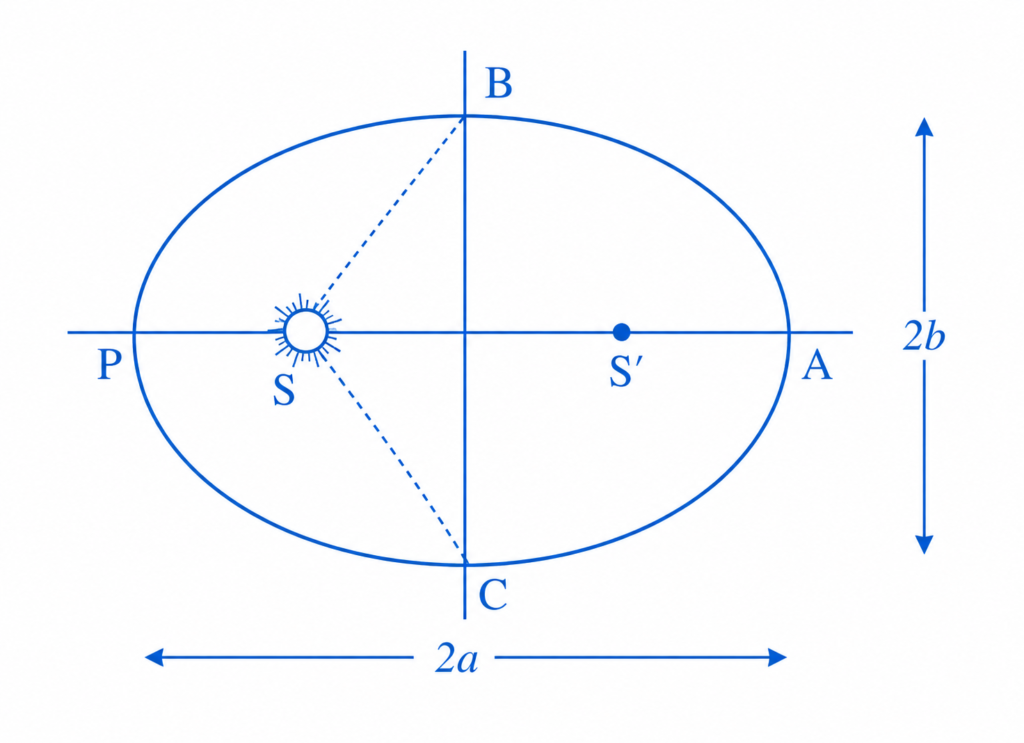
” An ellipse traced out by a planet around the Sun. The closest point is ‘p’ and the farthest point is ‘A’. P is called the perihelion and A is the Aphelion. The semi major axis ‘a’ is half the distance AP (2a) “.
This law was a deviation from the Copernican model which allowed only circular orbits. The ellipse, of which the circle is a special case, is a closed curve which can be drawn very simply as follows.
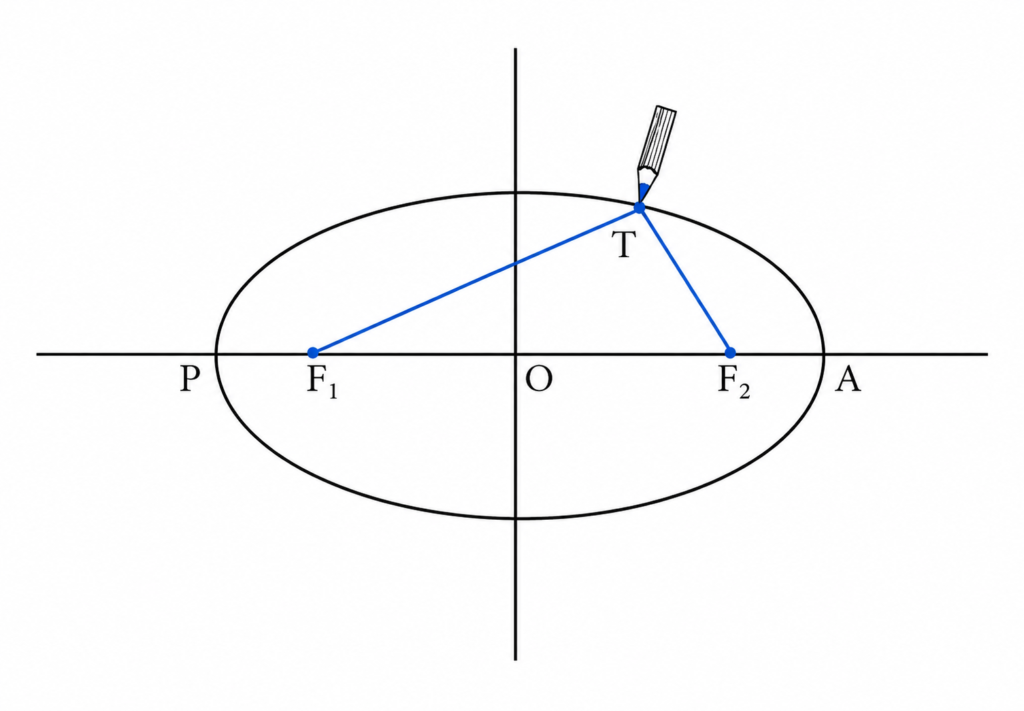
” Drawing an ellipse. A string has its ends fixed at F1 and F2. The tip of a pencil holds the string taut and is moved around “.
Select two points F1 and F2. Take a length of a string and fix its ends at F1 and F2 by pins. With the tip of a pencil stretch the string taut and then draw a curve by moving the pencil keeping the string taut throughout. The closed curve you get is called an ellipse. Clearly for any point ‘T’ on the ellipse, the sum of the distances from F1 and F2 is a constant. F1 and F2 are called the focii. Join the points F1 and F2 and extend the line to intersect the ellipse at points ‘P’ and ‘A’ as shown in figure. The midpoint of the line PA is the centre of the ellipse ‘O’ and the length PO = AO is called the semi major axis of the ellipse. For a circle, the two focii merge into one and the semi-major axis becomes the radius of the circle.
2. Law of Areas :
” The line that joins any planet to the Sun sweeps equal areas in equal intervals of time “.
This law comes from the observation that planets appear to move slow or when they are further from the sun then when they are nearer.
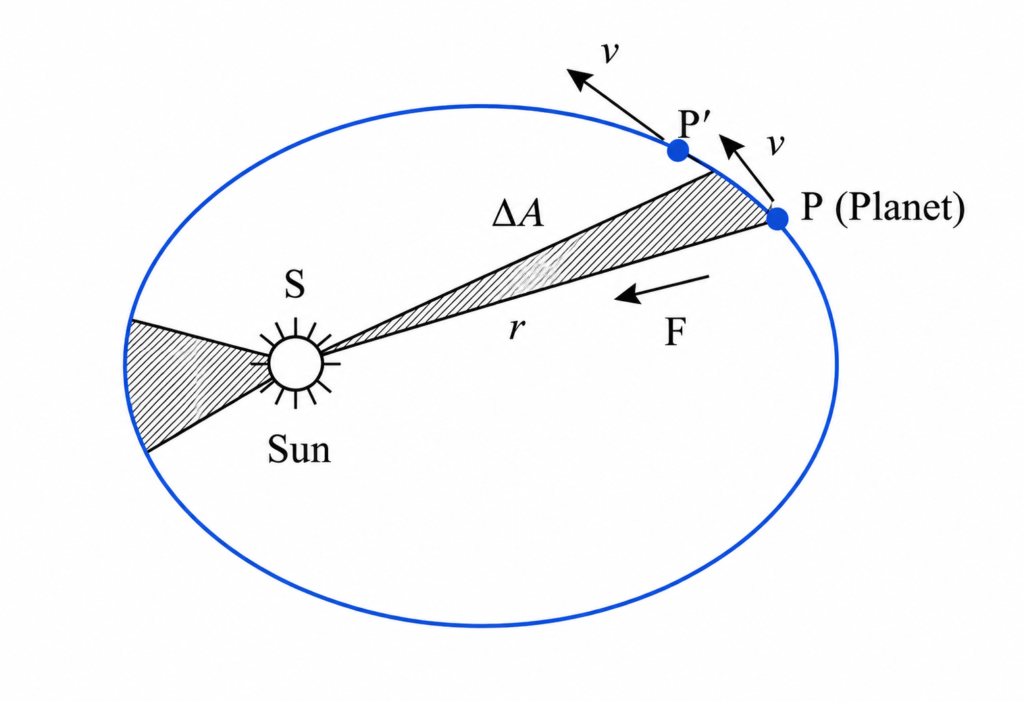
The planet ‘P‘ moves around the Sun in an electrical orbit. The shaded area is the area ΔA swept out in a small interval of time Δt.
The law of areas can be understood as a consequence of conservation of angular momentum which is valid for any Central force. A central force is such that the force on the planet is along the vector joining the Sun and the planet. Let the Sun be at the origin and let the position and momentum of the planet be denoted by r and p respectively. Then the area swept out by the planet of mass m in time interval Δt is given by
(Since, Momentum P = mass m × Velocity v)
Therefore, the above equation is called Law of Areas.
Where L is the angular momentum equal to (r×p). For a central force, which is directed along r. L is a constant as the planet goes around. Hence, ΔA/Δt is a constant according to the final equation.
Gravitation is a central force and hence the law of areas follows.
3. Law of Periods :
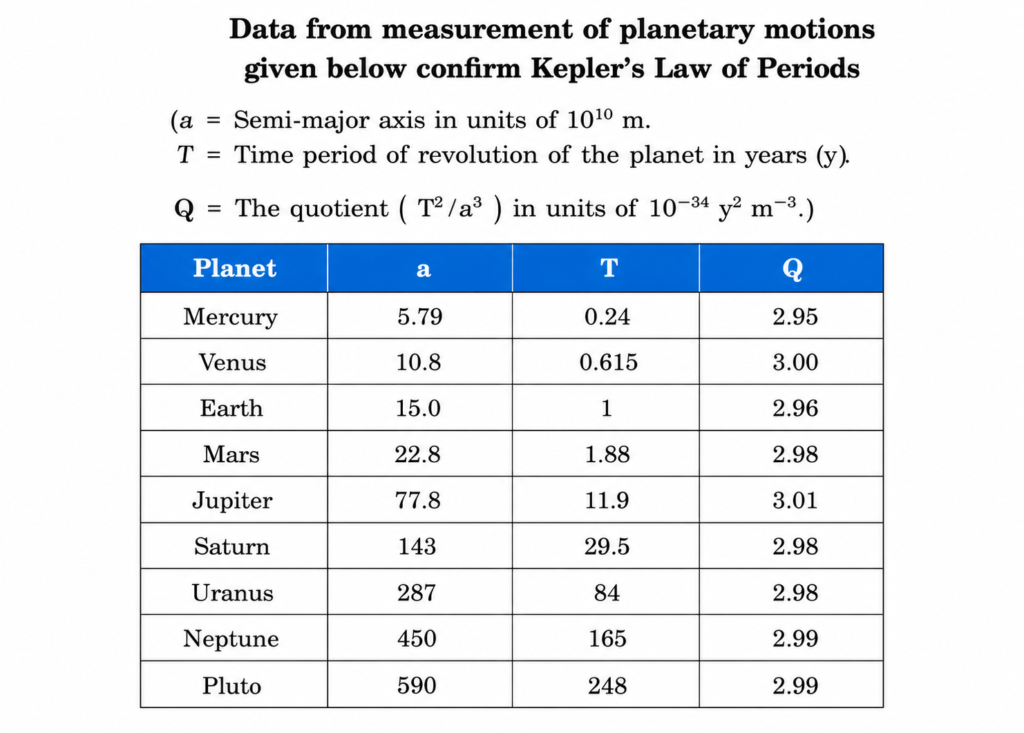
” The square of the time period of revolution of a planet is proportional to the cube of the semi major axis of the ellipse traced out by the planet “.
- Where a is semi major axis in units of 1010 m.
- T is Time Period of revolution of the Planet in years (y).
- Q is the quotient in units of 10-34 y2m-3
Conceptual Understanding Questions
What is the apparent weight of a body in a freely falling lift?
The apparent weight of a body in a freely falling lift is zero. When the lift falls freely with acceleration \(g\), the person and the lift accelerate downward together. Therefore, the normal reaction exerted by the floor becomes zero.
\[ N=m(g-g) \]
\[ \boxed{N=0} \]
Thus, the weighing machine inside the lift reads zero and the person experiences apparent weightlessness.
Which type of frame of reference does a bus starting from rest represent?
A bus starting from rest and accelerating forward represents a non-inertial frame of reference. Its velocity changes with time, so the bus has acceleration. Newton’s laws cannot be directly applied in this accelerating frame without introducing a pseudo force.
What should be the escape velocity of a rocket to escape from the gravitational attraction of Earth?
The minimum speed required for a rocket to escape completely from Earth’s gravitational field, neglecting air resistance and Earth’s rotation, is called the escape velocity.
\[ v_e=\sqrt{\frac{2GM}{R}} \]
For Earth:
\[ \boxed{v_e\approx11.2\text{ km/s}} \]
Thus, a rocket must have a speed of approximately 11.2 km/s at Earth’s surface to escape Earth’s gravitational attraction.
What is the escape velocity of an object from the surface of a black hole?
At the event horizon of a black hole, the classical escape velocity is equal to the speed of light \(c\). The radius at which the escape velocity becomes \(c\) is called the Schwarzschild radius.
\[ v_e=\sqrt{\frac{2GM}{R_s}} \]
For the Schwarzschild radius:
\[ R_s=\frac{2GM}{c^2} \]
Substituting:
\[ v_e=\sqrt{\frac{2GM}{2GM/c^2}} \]
\[ \boxed{v_e=c} \]
Therefore, at the event horizon, the classical escape velocity is approximately \(3\times10^8\) m/s, the speed of light. In general relativity, the more precise description is that nothing can escape from inside the event horizon because of the causal structure of spacetime.
What is the apparent weight of an object in a satellite that revolves around the Earth?
The apparent weight of an object in an orbiting satellite is approximately zero. The satellite and the object inside it are both continuously falling towards Earth under gravity while moving forward with sufficient orbital speed.
\[ \boxed{N=0} \]
Therefore, the object does not press against the floor of the satellite and appears to float. This condition is called weightlessness. Gravity is still acting on the object; it is not absent.
What is the minimum number of satellites required to cover the entire area of the Earth?
For ideal continuous communication coverage of the entire Earth using geostationary satellites, a minimum of three geostationary satellites is commonly considered necessary. They are placed approximately \(120^\circ\) apart in the equatorial plane.
These three satellites can provide nearly continuous coverage of most of the Earth’s inhabited regions. However, the polar regions are difficult or impossible to cover directly from geostationary orbit because geostationary satellites are located above the equator.
When a body is projected with a velocity equal to the orbital velocity, how does it move?
If a body is projected horizontally with a velocity equal to the required circular orbital velocity at that distance from the centre of the Earth, it enters a circular orbit around the Earth, provided air resistance and other disturbances are neglected.
\[ v_o=\sqrt{\frac{GM}{r}} \]
The gravitational force continuously changes the direction of the body’s velocity and provides the required centripetal acceleration.
Why doesn’t the Moon hit the Earth because of Earth’s gravity?
Earth’s gravity continuously pulls the Moon towards Earth, so the Moon is actually in continuous free fall towards Earth. However, the Moon also has a large velocity perpendicular to the direction of Earth’s gravitational pull.
As a result, while the Moon falls towards Earth, its forward motion carries it around Earth. Therefore, the Moon continuously misses the Earth’s surface and remains in orbit.
Thus, the Moon does not escape Earth’s gravity, nor does it fall directly onto Earth; it remains in a gravitational orbit.
When a body is projected with a velocity greater than escape velocity, how does it move?
If a body is projected with a speed greater than the escape velocity, its total mechanical energy is positive. It escapes from the gravitational field of the Earth and moves away indefinitely.
\[ v>v_e \]
Its path is an open trajectory. Depending on the direction and the gravitational situation, the trajectory can be hyperbolic or another appropriate unbound trajectory. For an ideal two-body gravitational problem with positive total energy, the trajectory is hyperbolic.
When a body is projected with a velocity greater than orbital velocity but less than escape velocity, how does it move?
When a body is projected with a speed greater than the circular orbital velocity but less than the escape velocity, it remains gravitationally bound to the Earth but does not follow a circular orbit.
\[
v_o
For a suitable tangential projection, the body follows an elliptical orbit, with the point of projection becoming one point of the elliptical trajectory. Its speed varies along the orbit.
When a body is projected with exactly the escape velocity, its total mechanical energy is zero. It is just able to escape from Earth’s gravitational field and reaches infinitely far away with zero speed in the idealized case.
\[
v=v_e
\]
For a suitable tangential projection in the ideal two-body problem, the trajectory is a parabolic path.
\[
\boxed{\text{Escape velocity} \rightarrow \text{Parabolic trajectory}}
\]
A body appears weightless whenever it is in free fall and no supporting force acts on it. In such situations, the apparent weight or normal reaction becomes zero.
1. Freely falling lift: If a lift falls freely under Earth’s gravity, the person and the lift accelerate downward together. The floor exerts no normal reaction on the person, so the apparent weight is zero.
\[
N=0
\]
2. Orbiting satellite: An object inside an orbiting satellite is continuously falling towards Earth along with the satellite. Since both have nearly the same acceleration, there is no supporting force between the object and the satellite floor.
3. Astronaut in an orbiting spacecraft: The astronaut and spacecraft are in continuous free fall around Earth. The astronaut therefore experiences apparent weightlessness and floats relative to the spacecraft.
4. Freely falling body after projection: A body moving only under gravity, with air resistance neglected, is in free fall. During this motion, there is no supporting contact force acting on the body, so its apparent weight is zero.
Thus, weightlessness means zero apparent weight, not necessarily the absence of gravitational force.
The Moon has only a very thin exosphere rather than a dense atmosphere like Earth. Its gravitational field is much weaker because its mass is much smaller, and its escape velocity is only about \(2.38\) km/s.
\[
v_{e,\text{Moon}}\approx2.38\text{ km/s}
\]
Gas molecules on the Moon can therefore escape more easily, especially the lighter and faster-moving molecules. The Moon also lacks a strong global magnetic field and has little ability to retain and replenish a dense atmosphere over geological timescales.
Hence, the Moon cannot retain a thick atmosphere like Earth. Strictly speaking, however, the Moon is not completely devoid of gases; it has an extremely tenuous exosphere.
There is no separate escape velocity specifically for the atmosphere. The escape velocity depends on the mass and radius of the Earth and is approximately the same for an object or atmospheric particle at the same distance from Earth’s centre.
At Earth’s surface:
\[
v_e=\sqrt{\frac{2GM_E}{R_E}}
\]
\[
\boxed{v_e\approx11.2\text{ km/s}}
\]
Therefore, an atmospheric particle at Earth’s surface would need a speed of about 11.2 km/s to escape Earth’s gravitational field, neglecting other effects.
Earth’s atmosphere does not rapidly escape because most atmospheric molecules have speeds much smaller than Earth’s escape velocity of about \(11.2\) km/s. Earth’s relatively strong gravity therefore keeps most atmospheric gases bound to the planet.
The average thermal speed of atmospheric molecules is generally far below the escape velocity. Although a small fraction of molecules can have unusually high speeds, continuous escape of the atmosphere is limited and occurs gradually through processes such as thermal escape and interactions with the solar wind.
Earth’s magnetic field and atmosphere also help reduce atmospheric loss caused by the solar wind. Therefore, the atmosphere is retained over very long periods, although it is not completely immune to atmospheric escape.
Key idea: Earth’s atmosphere remains gravitationally bound because the typical molecular speeds are much smaller than Earth’s escape velocity. Atmospheric escape does occur, but it is a relatively slow process rather than the entire atmosphere escaping at once.
The following solved numerical problems cover the important mathematical concepts from Part 2 of Gravitation, including inertial and gravitational mass, gravitational potential, gravitational potential energy, escape velocity, orbital velocity, satellites, weightlessness and Kepler’s laws of planetary motion. Given:
\[
F=20\text{ N}
\]
\[
a=4\text{ m/s}^2
\] Formula:
\[
F=m_i a
\]
Therefore:
\[
m_i=\frac{F}{a}
\] Substitution:
\[
m_i=\frac{20}{4}
\]
\[
\boxed{m_i=5\text{ kg}}
\]
Answer: The inertial mass of the body is 5 kg. Given:
\[
F=49\text{ N}
\]
\[
g=9.8\text{ m/s}^2
\] Formula:
\[
F=m_g g
\]
\[
m_g=\frac{F}{g}
\] Substitution:
\[
m_g=\frac{49}{9.8}
\]
\[
\boxed{m_g=5\text{ kg}}
\]
Answer: The gravitational mass of the body is 5 kg. Given:
\[
M=5.98\times10^{24}\text{ kg}
\]
\[
r=6.4\times10^6\text{ m}
\]
\[
G=6.674\times10^{-11}\text{ N m}^2\text{/kg}^2
\] Formula:
\[
V=-\frac{GM}{r}
\] Substitution:
\[
V=-\frac{(6.674\times10^{-11})(5.98\times10^{24})}{6.4\times10^6}
\]
\[
V\approx-6.23\times10^7\text{ J/kg}
\]
\[
\boxed{V\approx-6.23\times10^7\text{ J/kg}}
\]
Answer: The gravitational potential at the Earth’s surface is approximately −6.23 × 10⁷ J/kg. Given:
\[
m=10\text{ kg}
\]
\[
M=5.98\times10^{24}\text{ kg}
\]
\[
R=6.4\times10^6\text{ m}
\] Formula:
\[
U=-\frac{GMm}{R}
\] Substitution:
\[
U=-\frac{(6.674\times10^{-11})(5.98\times10^{24})(10)}
{6.4\times10^6}
\]
\[
U\approx-6.23\times10^8\text{ J}
\]
\[
\boxed{U\approx-6.23\times10^8\text{ J}}
\]
Answer: The gravitational potential energy is approximately −6.23 × 10⁸ J. Given:
\[
g=9.8\text{ m/s}^2
\]
\[
R=6.4\times10^6\text{ m}
\] Formula:
\[
v_e=\sqrt{2gR}
\] Substitution:
\[
v_e=\sqrt{2(9.8)(6.4\times10^6)}
\]
\[
v_e=\sqrt{1.2544\times10^8}
\]
\[
v_e\approx1.12\times10^4\text{ m/s}
\]
\[
\boxed{v_e\approx11.2\text{ km/s}}
\]
Answer: The escape velocity from Earth’s surface is approximately 11.2 km/s. Given:
\[
g=9.8\text{ m/s}^2
\]
\[
R=6.4\times10^6\text{ m}
\] Formula:
\[
v_o=\sqrt{gR}
\] Substitution:
\[
v_o=\sqrt{(9.8)(6.4\times10^6)}
\]
\[
v_o=\sqrt{6.272\times10^7}
\]
\[
v_o\approx7.92\times10^3\text{ m/s}
\]
\[
\boxed{v_o\approx7.9\text{ km/s}}
\]
Answer: The orbital velocity close to Earth’s surface is approximately 7.9 km/s. Given:
\[
r=7.0\times10^6\text{ m}
\]
\[
GM=3.986\times10^{14}\text{ m}^3\text{/s}^2
\] Formula:
\[
v_o=\sqrt{\frac{GM}{r}}
\] Substitution:
\[
v_o=\sqrt{\frac{3.986\times10^{14}}{7.0\times10^6}}
\]
\[
v_o=\sqrt{5.694\times10^7}
\]
\[
v_o\approx7.55\times10^3\text{ m/s}
\]
\[
\boxed{v_o\approx7.55\text{ km/s}}
\]
Answer: The orbital velocity of the satellite is approximately 7.55 km/s. Given:
\[
r=42164\text{ km}
\]
\[
r=4.2164\times10^7\text{ m}
\]
\[
GM=3.986\times10^{14}\text{ m}^3\text{/s}^2
\] Formula:
\[
T=2\pi\sqrt{\frac{r^3}{GM}}
\] Substitution:
\[
T=2\pi\sqrt{
\frac{(4.2164\times10^7)^3}
{3.986\times10^{14}}
}
\]
\[
T\approx86164\text{ s}
\]
Converting seconds into hours:
\[
T=\frac{86164}{3600}
\]
\[
T\approx23.93\text{ h}
\]
\[
\boxed{T\approx23\text{ h }56\text{ min}}
\]
Answer: The orbital period is approximately 23 h 56 min, which is one sidereal day. This is the orbital period required for a geostationary satellite. Given:
\[
m=60\text{ kg}
\]
\[
g=9.8\text{ m/s}^2
\]
For a lift accelerating downward with acceleration \(a\), the apparent weight is:
\[
N=m(g-a)
\]
For a freely falling lift:
\[
a=g
\] Substitution:
\[
N=60(9.8-9.8)
\]
\[
N=60(0)
\]
\[
\boxed{N=0\text{ N}}
\]
Answer: The apparent weight of the person is zero. The person experiences weightlessness. Given:
\[
h=300\text{ km}
\]
\[
R=6400\text{ km}
\]
Orbital radius:
\[
r=R+h
\]
\[
r=6400+300
\]
\[
r=6700\text{ km}
\]
\[
r=6.7\times10^6\text{ m}
\] Formula:
\[
v_o=\sqrt{\frac{GM}{r}}
\]
Since:
\[
g=\frac{GM}{R^2}
\]
Therefore:
\[
GM=gR^2
\]
Hence:
\[
v_o=\sqrt{\frac{gR^2}{r}}
\] Substitution:
\[
v_o=
\sqrt{
\frac{(9.8)(6.4\times10^6)^2}
{6.7\times10^6}
}
\]
\[
v_o\approx7.73\times10^3\text{ m/s}
\]
\[
\boxed{v_o\approx7.73\text{ km/s}}
\]
Answer: The orbital velocity of the satellite is approximately 7.73 km/s. Given:
\[
a_B=4a_A
\]
\[
T_A=2\text{ years}
\] Kepler’s third law:
\[
T^2\propto a^3
\]
Therefore:
\[
\frac{T_B^2}{T_A^2}
=
\frac{a_B^3}{a_A^3}
\]
Substituting \(a_B=4a_A\):
\[
\frac{T_B^2}{T_A^2}=4^3
\]
\[
\frac{T_B^2}{T_A^2}=64
\]
\[
\frac{T_B}{T_A}=8
\]
Therefore:
\[
T_B=8T_A
\]
\[
T_B=8(2)
\]
\[
\boxed{T_B=16\text{ years}}
\]
Answer: Planet B takes 16 years to complete one revolution. Given:
\[
T_1=8\text{ years}
\]
\[
a_1=4\text{ AU}
\]
\[
T_2=27\text{ years}
\] Kepler’s third law:
\[
\frac{T_1^2}{a_1^3}
=
\frac{T_2^2}{a_2^3}
\]
Rearranging:
\[
a_2^3
=
a_1^3
\frac{T_2^2}{T_1^2}
\]
Substituting:
\[
a_2^3
=
4^3
\frac{27^2}{8^2}
\]
\[
a_2^3
=
64\times\frac{729}{64}
\]
\[
a_2^3=729
\]
\[
a_2=\sqrt[3]{729}
\]
\[
\boxed{a_2=9\text{ AU}}
\]
Answer: The semi-major axis of the second planet’s orbit is 9 AU. Given:
\[
v_o=7.9\text{ km/s}
\] Relation between escape velocity and orbital velocity:
\[
v_e=\sqrt{2}v_o
\] Substitution:
\[
v_e=\sqrt{2}(7.9)
\]
\[
v_e\approx1.414(7.9)
\]
\[
v_e\approx11.17\text{ km/s}
\]
\[
\boxed{v_e\approx11.2\text{ km/s}}
\]
Answer: The escape velocity at that distance is approximately 11.2 km/s. Given:
\[
r=42164\text{ km}
\]
\[
R_E=6378\text{ km}
\] Formula:
\[
h=r-R_E
\] Substitution:
\[
h=42164-6378
\]
\[
\boxed{h=35786\text{ km}}
\]
Answer: The geostationary satellite is approximately 35,786 km above Earth’s surface. Given:
\[
M’=2M
\]
\[
R’=R
\]
\[
g=9.8\text{ m/s}^2
\] Formula:
\[
g=\frac{GM}{R^2}
\]
For the new planet:
\[
g’=\frac{GM’}{R’^2}
\]
Substituting \(M’=2M\) and \(R’=R\):
\[
g’=\frac{G(2M)}{R^2}
\]
\[
g’=2\frac{GM}{R^2}
\]
\[
g’=2g
\]
Therefore:
\[
g’=2(9.8)
\]
\[
\boxed{g’=19.6\text{ m/s}^2}
\]
Answer: The acceleration due to gravity on the planet is 19.6 m/s². Given:
\[
g_h=\frac{g}{4}
\] Formula:
\[
g_h=g\left(\frac{R}{R+h}\right)^2
\]
Therefore:
\[
\frac{g}{4}
=
g\left(\frac{R}{R+h}\right)^2
\]
Cancel \(g\):
\[
\frac{1}{4}
=
\left(\frac{R}{R+h}\right)^2
\]
\[
\frac{1}{2}
=
\frac{R}{R+h}
\]
Therefore:
\[
R+h=2R
\]
\[
\boxed{h=R}
\]
For Earth, if \(R\approx6400\) km:
\[
\boxed{h\approx6400\text{ km}}
\]
Answer: The acceleration due to gravity becomes one-fourth of its surface value at a height equal to approximately one Earth radius above the surface. Given:
\[
M=6.0\times10^{24}\text{ kg}
\]
\[
R=6.0\times10^6\text{ m}
\]
\[
G=6.674\times10^{-11}\text{ N m}^2\text{/kg}^2
\] Formula:
\[
v_e=\sqrt{\frac{2GM}{R}}
\] Substitution:
\[
v_e=
\sqrt{
\frac{2(6.674\times10^{-11})(6.0\times10^{24})}
{6.0\times10^6}
}
\]
\[
v_e=\sqrt{1.3348\times10^8}
\]
\[
v_e\approx1.155\times10^4\text{ m/s}
\]
\[
\boxed{v_e\approx11.55\text{ km/s}}
\]
Answer: The escape velocity from the planet is approximately 11.55 km/s. Given:
\[
m=2\text{ kg}
\]
\[
V_1=-20\text{ J/kg}
\]
\[
V_2=-5\text{ J/kg}
\] Formula:
\[
U=mV
\]
Therefore, the change in potential energy is:
\[
\Delta U=m(V_2-V_1)
\] Substitution:
\[
\Delta U=2[-5-(-20)]
\]
\[
\Delta U=2(15)
\]
\[
\boxed{\Delta U=30\text{ J}}
\]
Answer: The gravitational potential energy increases by 30 J.
Overall conclusion: These numerical problems demonstrate how the mathematical relationships of gravitation are applied to real physical situations. Important results include \(v_e=\sqrt{2gR}\), \(v_o=\sqrt{gR}\) near Earth’s surface, \(T^2\propto a^3\) for planetary motion, \(U=mV\), and zero apparent weight during free fall.When a body is projected with a velocity equal to the escape velocity, what path does it follow?
In what cases of a freely falling body does the weight of the body appear to be zero? Explain each case.
Why is an atmosphere not present on the Moon’s surface?
What is the escape velocity of Earth’s atmosphere?
Why does the atmosphere of the Earth not escape into space?
Solved Numerical Problems
1. A force of 20 N produces an acceleration of 4 m/s² in a body. Find its inertial mass.
2. A body experiences a gravitational force of 49 N at a place where the acceleration due to gravity is 9.8 m/s². Find its gravitational mass.
3. Find the gravitational potential at a point 6.4 × 10⁶ m from the centre of the Earth. Take the mass of Earth as 5.98 × 10²⁴ kg and G = 6.674 × 10⁻¹¹ N m²/kg².
4. Find the gravitational potential energy of a 10 kg body placed at the Earth’s surface. Take M = 5.98 × 10²⁴ kg, R = 6.4 × 10⁶ m and G = 6.674 × 10⁻¹¹ N m²/kg².
5. Calculate the escape velocity from the surface of Earth. Take g = 9.8 m/s² and Earth’s radius R = 6.4 × 10⁶ m.
6. Calculate the orbital velocity of a satellite moving close to the surface of Earth. Take g = 9.8 m/s² and R = 6.4 × 10⁶ m.
7. A satellite is revolving around Earth at a distance of 7.0 × 10⁶ m from the centre of Earth. Calculate its orbital velocity. Take GM = 3.986 × 10¹⁴ m³/s².
8. A satellite revolves around Earth in a circular orbit at a distance of 42,164 km from Earth’s centre. Calculate its orbital period. Take GM = 3.986 × 10¹⁴ m³/s².
9. A person of mass 60 kg is standing inside a lift. What is the apparent weight of the person if the lift is freely falling? Take g = 9.8 m/s².
10. A satellite is orbiting Earth at a distance of 300 km above the surface. Calculate its orbital velocity. Take Earth’s radius as 6400 km and g = 9.8 m/s².
11. Two planets revolve around the same star. The orbital radius of Planet B is four times that of Planet A. If Planet A takes 2 years to complete one revolution, how long does Planet B take?
12. The orbital period of a planet is 8 years. If the semi-major axis of its orbit is 4 astronomical units, find the semi-major axis of another planet whose orbital period is 27 years.
13. A satellite has an orbital velocity of 7.9 km/s at a particular distance from the centre of Earth. Find the escape velocity at the same distance.
14. A geostationary satellite orbits Earth at a distance of 42,164 km from Earth’s centre. If Earth’s radius is 6,378 km, find the height of the satellite above Earth’s surface.
15. A planet has the same radius as Earth but twice the mass of Earth. If the acceleration due to gravity on Earth is 9.8 m/s², find the acceleration due to gravity on the planet.
16. At what height above Earth’s surface will the acceleration due to gravity become one-fourth of its surface value? Take Earth’s radius as R.
17. A planet has a mass of 6.0 × 10²⁴ kg and a radius of 6.0 × 10⁶ m. Calculate its escape velocity. Take G = 6.674 × 10⁻¹¹ N m²/kg².
18. A body of mass 2 kg is moved from a point where gravitational potential is −20 J/kg to another point where it is −5 J/kg. Find the change in its gravitational potential energy.