
Introduction
Gravitation is the force of attraction that exists between any two objects having mass. It is one of the fundamental forces of nature and is responsible for many phenomena observed in our everyday life and in the universe. The motion of planets around the Sun, the motion of the Moon around the Earth, the falling of objects towards the Earth, ocean tides, and the motion of artificial satellites are all influenced by gravitation.
The study of gravitation helps us understand how objects interact with one another through gravitational force and how this force determines the motion of celestial bodies. In this chapter, we study the nature and characteristics of gravitational force, Newton’s law of universal gravitation, acceleration due to gravity, gravitational fields, and some fascinating objects such as neutron stars and black holes.
Basic Forces in Nature
All interactions observed in nature can be understood in terms of four fundamental forces. These forces are responsible for the interactions between matter and energy at different scales, from subatomic particles to planets and galaxies. The four basic forces in nature are gravitational force, electromagnetic force, strong nuclear force, and weak nuclear force.
i) Gravitational Force
Definition: Gravitational force is the force of attraction that exists between any two objects having mass.
Gravitational force is the weakest of the four fundamental forces, but it has an unlimited range and always acts as an attractive force. It becomes significant when the masses involved are very large. The motion of planets around the Sun, the motion of the Moon around the Earth, the falling of objects towards the Earth, ocean tides, and the motion of artificial satellites are governed by gravitational interaction.
According to Newton’s law of universal gravitation, the gravitational force between two masses is directly proportional to the product of their masses and inversely proportional to the square of the distance between their centres.
\[ F=G\frac{m_1m_2}{r^2} \]
Here, \(G\) is the universal gravitational constant, \(m_1\) and \(m_2\) are the masses of the two objects, and \(r\) is the distance between their centres.
ii) Electromagnetic Force
Definition: Electromagnetic force is the force that acts between electrically charged particles due to their electric charges and motion.
The electromagnetic force can be either attractive or repulsive. Unlike gravitational force, which acts between all objects having mass, electromagnetic force acts between particles possessing electric charge. It is much stronger than gravitational force at the atomic and subatomic scale.
Electromagnetic interaction is responsible for a wide range of everyday phenomena, including electricity, magnetism, light, chemical bonding, friction, and the forces that hold atoms and molecules together. Electric and magnetic forces are different aspects of the same fundamental electromagnetic interaction.
For two stationary point charges, the magnitude of the electric force is given by Coulomb’s law:
\[ F=k\frac{q_1q_2}{r^2} \]
Here, \(q_1\) and \(q_2\) are the charges and \(r\) is the distance between them.
iii) Strong Nuclear Force
Definition: The strong nuclear force is the fundamental force that binds quarks together and, through the residual strong interaction, helps bind protons and neutrons inside atomic nuclei.
The strong interaction is the strongest of the four fundamental forces. It acts over an extremely short range, roughly of the order of \(10^{-15}\,\text{m}\). The fundamental strong interaction acts on particles called quarks and is carried by particles known as gluons.
The residual strong interaction between protons and neutrons is responsible for holding the atomic nucleus together despite the electrical repulsion between positively charged protons. Without this interaction, stable atomic nuclei would not exist.
iv) Weak Nuclear Force
Definition: The weak nuclear force is a fundamental force responsible for certain types of radioactive decay and for transformations between different types of elementary particles.
The weak interaction acts over an extremely short range, much smaller than the size of an atomic nucleus. It is responsible for processes such as beta decay, in which a neutron can transform into a proton while producing an electron and an antineutrino.
The weak interaction is important in nuclear reactions occurring inside stars. It also plays a crucial role in the processes that allow particles to change from one type to another. The weak force is mediated by the massive W and Z bosons.
Comparison of the Four Basic Forces
| Force | Nature | Relative Strength | Range | Main Role |
|---|---|---|---|---|
| Gravitational | Always attractive | Weakest | Infinite | Controls large-scale motion of matter |
| Electromagnetic | Attractive or repulsive | Very strong | Infinite | Interactions between charged particles |
| Strong Nuclear | Attractive/repulsive depending on interaction and scale | Strongest | Very short | Binds quarks and contributes to nuclear binding |
| Weak Nuclear | Responsible for particle transformations | Very weak compared with strong and electromagnetic | Extremely short | Radioactive decay and particle transformations |
Nature of Gravitational Force
Every body in the universe having mass attracts every other body having mass. This attractive interaction is called gravitational force or simply gravity. The nature of gravitational force can be understood through the following important characteristics.
1. Gravitational Force Depends on the Masses and Distance
The gravitational force between two bodies depends on the product of their masses and decreases as the square of the distance between their centres increases. According to Newton’s law of universal gravitation:
\[ F=G\frac{m_1m_2}{r^2} \]
Thus, greater masses produce a greater gravitational force, whereas greater separation between the bodies produces a smaller gravitational force.
2. Gravitational Force is Always Attractive
Gravitational force between two masses is always attractive. Unlike electromagnetic force, gravity does not have a repulsive form between ordinary masses. Each body attracts the other body along the line joining their centres of mass.
3. Gravitational Force is a Central Force
The gravitational force between two bodies acts along the straight line joining their centres of mass. Therefore, gravitational force is called a central force. For two spherically symmetric bodies, the force can be considered to act along the line joining their centres.
4. Gravitational Force is a Long-Range Force
Gravitational force has an unlimited range. It acts between masses even when they are separated by extremely large distances. The gravitational attraction between the Sun and planets, for example, acts across enormous distances in space.
5. Gravitational Force is the Weakest Fundamental Force
Gravitational interaction is the weakest of the four fundamental interactions when compared at the elementary-particle scale. However, gravity becomes dominant on astronomical scales because masses are always attractive and cannot be shielded, while positive and negative electric charges can cancel each other.
The weakness of gravity at the particle level can be illustrated by comparing the gravitational and electric forces between two electrons.
The electric force between two electrons is:
\[ F_e=\frac{e^2}{4\pi\varepsilon_0r^2} \]
The gravitational force between two electrons is:
\[ F_g=\frac{Gm_e^2}{r^2} \]
Therefore,
\[ \frac{F_e}{F_g} = \frac{e^2}{4\pi\varepsilon_0Gm_e^2} \]
Using the known values of the constants,
\[ \frac{F_e}{F_g}\approx4.17\times10^{42} \]
Thus, the electric force between two electrons is enormously greater than their gravitational force.
6. Gravitational Force is a Conservative Force
Gravitational force is a conservative force. The work done by gravity in moving an object between two positions depends only on the initial and final positions and not on the path followed. Therefore, gravitational potential energy can be defined for a gravitational field.
7. Gravity and the Curvature of Space-Time
According to Einstein’s general theory of relativity, gravity can be understood as the effect of the curvature of space-time produced by the presence of mass and energy. Massive objects change the geometry of space-time around them, and other objects follow paths determined by this curved geometry.
Newton’s law describes gravitational attraction extremely well in many ordinary situations, while Einstein’s description becomes essential for very strong gravitational fields and high-precision situations.
8. Gravitons as a Hypothetical Quantum Description
In attempts to describe gravity using quantum theory, a hypothetical elementary particle called the graviton is proposed as the quantum carrier of gravitational interaction. However, gravitons have not been experimentally detected, and a complete experimentally confirmed quantum theory of gravity has not yet been established.
9. Gravitational Force Has a Universal Nature
Gravitational interaction is universal because every object having mass participates in gravitational interaction. It operates at all scales, from microscopic particles to planets, stars, galaxies, and the large-scale structure of the universe.
Summary of the Nature of Gravitational Force
| Characteristic | Description |
|---|---|
| Depends on mass and distance | Increases with masses and decreases with the square of separation. |
| Always attractive | Massive bodies attract one another. |
| Central force | Acts along the line joining the centres of mass. |
| Long-range | Has an unlimited range. |
| Weakest fundamental interaction | Extremely weak at the elementary-particle scale. |
| Conservative | Work done depends only on initial and final positions. |
| Space-time curvature | In general relativity, gravity is associated with curved space-time. |
| Graviton | A hypothetical quantum carrier of gravity that has not been experimentally detected. |
| Universal nature | Acts between all objects possessing mass. |
Newton’s Law of Universal Gravitation
Every object in the universe attracts every other object with a force of gravitational attraction. Newton’s law of universal gravitation gives the mathematical relationship between the gravitational force, the masses of the two objects, and the distance between them.
Statement: Newton’s law of universal gravitation states that every two bodies in the universe attract each other with a force that is directly proportional to the product of their masses and inversely proportional to the square of the distance between their centres.
Mathematical Expression of Newton’s Law of Universal Gravitation
Consider two bodies having masses \(m_1\) and \(m_2\), whose centres are separated by a distance \(r\). Let the gravitational force between them be \(F\).
The gravitational force is directly proportional to the product of their masses:
\[ F\propto m_1m_2 \]
The gravitational force is inversely proportional to the square of the distance between their centres:
\[ F\propto\frac{1}{r^2} \]
Combining these two relationships:
\[ F\propto\frac{m_1m_2}{r^2} \]
Introducing the proportionality constant \(G\), we obtain:
\[ \boxed{F=G\frac{m_1m_2}{r^2}} \]
This is the mathematical expression for Newton’s law of universal gravitation.
Meaning of the Symbols
| Symbol | Meaning | SI Unit |
|---|---|---|
| \(F\) | Gravitational force | newton (N) |
| \(m_1\) | Mass of first body | kilogram (kg) |
| \(m_2\) | Mass of second body | kilogram (kg) |
| \(r\) | Distance between the centres of the two bodies | metre (m) |
| \(G\) | Universal gravitational constant | N m² kg⁻² |
Universal Gravitational Constant \(G\)
\(G\) is called the universal gravitational constant. It is the proportionality constant that relates the gravitational force between two masses to the product of their masses and the inverse square of the distance between them.
From Newton’s law:
\[ F=G\frac{m_1m_2}{r^2} \]
Rearranging:
\[ G=\frac{Fr^2}{m_1m_2} \]
The accepted SI value of the universal gravitational constant is approximately:
\[ \boxed{G=6.67430\times10^{-11}\,\text{N m}^2\text{kg}^{-2}} \]
The very small value of \(G\) indicates that gravitational interaction is extremely weak compared with the other fundamental interactions at the microscopic scale.
SI Unit of \(G\)
From:
\[ G=\frac{Fr^2}{m_1m_2} \]
The SI unit of force is newton (N), the SI unit of distance is metre (m), and the SI unit of mass is kilogram (kg).
Therefore, the SI unit of \(G\) is:
\[ \boxed{\text{N m}^2\text{kg}^{-2}} \]
Since:
\[ 1\,\text{N}=1\,\text{kg m s}^{-2} \]
the SI unit can also be written as:
\[ \boxed{\text{m}^3\text{kg}^{-1}\text{s}^{-2}} \]
CGS Unit of \(G\)
In the CGS system, force is measured in dyne, distance in centimetre, and mass in gram.
Therefore, the CGS unit of \(G\) is:
\[ \boxed{\text{dyne cm}^2\text{g}^{-2}} \]
Dimensional Formula of \(G\)
From Newton’s law:
\[ F=G\frac{m_1m_2}{r^2} \]
Therefore:
\[ G=\frac{Fr^2}{m_1m_2} \]
The dimensions of force are:
\[ [F]=[MLT^{-2}] \]
The dimensions of \(r^2\) are:
\[ [r^2]=[L^2] \]
The dimensions of \(m_1m_2\) are:
\[ [m_1m_2]=[M^2] \]
Therefore:
\[ [G]=\frac{[MLT^{-2}][L^2]}{[M^2]} \]
\[ [G]=[M^{-1}L^3T^{-2}] \]
Hence, the dimensional formula of \(G\) is:
\[ \boxed{[M^{-1}L^3T^{-2}]} \]
Dependence of Gravitational Force on Mass
From:
\[ F=G\frac{m_1m_2}{r^2} \]
For a fixed distance and fixed value of \(G\):
\[ F\propto m_1m_2 \]
Therefore, if either mass is increased, the gravitational force increases proportionally. If one of the masses is doubled while all other quantities remain unchanged, the gravitational force also doubles.
Dependence of Gravitational Force on Distance
From Newton’s law:
\[ F\propto\frac{1}{r^2} \]
Therefore, gravitational force decreases rapidly as the distance between the two bodies increases.
If the distance between two bodies is doubled:
\[ F’=\frac{F}{4} \]
If the distance is tripled:
\[ F’=\frac{F}{9} \]
Thus, gravitational force follows an inverse-square law.
Nature of the Gravitational Force
The gravitational force between two masses is always attractive and acts along the line joining their centres. The two bodies exert equal and opposite gravitational forces on each other.
For two spherically symmetric bodies, the distance \(r\) in Newton’s law is the distance between their centres.
Diagram of Gravitational Force Between Two Masses
The diagram shows two masses \(m_1\) and \(m_2\) separated by a distance \(r\). Each mass attracts the other with an equal-magnitude gravitational force directed toward the other mass.
Important Points
- Gravitational force is directly proportional to \(m_1m_2\).
- Gravitational force is inversely proportional to \(r^2\).
- The gravitational force is always attractive.
- \(G\) is a universal constant and does not depend on the masses or distance between the bodies.
- The SI value of \(G\) is approximately \(6.67430\times10^{-11}\,\text{N m}^2\text{kg}^{-2}\).
- The SI unit of \(G\) is \(\text{N m}^2\text{kg}^{-2}\) or \(\text{m}^3\text{kg}^{-1}\text{s}^{-2}\).
- The dimensional formula of \(G\) is \([M^{-1}L^3T^{-2}]\).
Relation Between Universal Gravitational Constant ‘G’ and Acceleration Due to Gravity ‘g’
The universal gravitational constant \(G\) and the acceleration due to gravity \(g\) are closely related, but they represent different physical quantities. \(G\) is a universal constant that determines the strength of gravitational interaction between masses, whereas \(g\) is the acceleration experienced by an object due to the gravitational attraction of a particular celestial body.
The relation between \(G\) and \(g\) can be obtained by considering a body of mass \(m\) placed on the surface of the Earth.
Derivation of the Relation Between \(G\) and \(g\)
Let the mass of the Earth be \(M\) and its radius be \(R\). Consider an object of mass \(m\) placed on the surface of the Earth.
The gravitational force exerted by the Earth on the object, according to Newton’s law of universal gravitation, is:
\[ F=G\frac{Mm}{R^2} \]
The same gravitational force is responsible for producing the acceleration \(g\) in the object. Therefore, from Newton’s second law of motion:
\[ F=mg \]
Since both expressions represent the same gravitational force:
\[ mg=G\frac{Mm}{R^2} \]
Cancelling \(m\) from both sides:
\[ g=G\frac{M}{R^2} \]
Therefore, the required relation is:
\[ \boxed{g=\frac{GM}{R^2}} \]
Relation Between \(G\) and \(g\)
Rearranging the above equation, the universal gravitational constant can also be expressed as:
\[ \boxed{G=\frac{gR^2}{M}} \]
Thus, the acceleration due to gravity at the surface of a spherical body depends on its mass and radius. A more massive body generally produces a greater value of \(g\), while a larger radius reduces \(g\) for the same mass.
Meaning of the Quantities
| Symbol | Meaning | SI Unit |
|---|---|---|
| \(G\) | Universal gravitational constant | N m² kg⁻² |
| \(g\) | Acceleration due to gravity | m s⁻² |
| \(M\) | Mass of the Earth | kg |
| \(R\) | Radius of the Earth | m |
| \(m\) | Mass of the object | kg |
Important Observations
- \(G\) is a universal constant and has the same value throughout the universe in Newtonian physics.
- \(g\) depends on the mass and radius of the celestial body.
- The acceleration due to gravity is independent of the mass of the falling object when air resistance is neglected.
- For the Earth, the average value of \(g\) near the surface is approximately \(9.8\,\text{m/s}^2\).
- The relation \(g=\frac{GM}{R^2}\) applies to the surface of a spherical body, or more precisely outside a spherically symmetric body when \(R\) is the distance from its centre.
Physical Significance of the Relation
The equation
\[ g=\frac{GM}{R^2} \]
shows that the acceleration due to gravity is determined by the mass and size of the celestial body. Therefore, different planets and other celestial bodies have different values of \(g\). For example, a body on the Moon experiences a much smaller acceleration due to gravity than a body near the surface of the Earth because the Moon has a much smaller mass.
Variation of Acceleration Due to Gravity
The acceleration due to gravity \(g\) is not exactly the same at every location on the Earth. Its value varies with the altitude above the Earth’s surface, depth below the surface, latitude, and the shape of the Earth.
Near the surface of the Earth, the average value of acceleration due to gravity is approximately \(9.8\,\text{m/s}^2\). The different factors affecting \(g\) are discussed below.
i) Variation of Acceleration Due to Gravity with Altitude
The acceleration due to gravity decreases as we move upward from the surface of the Earth. This is because the distance from the centre of the Earth increases with altitude.
Derivation
Let \(M\) be the mass of the Earth and \(R\) be its radius. Consider a body of mass \(m\) at a height \(h\) above the Earth’s surface.
Its distance from the centre of the Earth is:
\[ r=R+h \]
According to Newton’s law of universal gravitation, the gravitational force acting on the body is:
\[ F=G\frac{Mm}{(R+h)^2} \]
If the acceleration due to gravity at height \(h\) is \(g_h\), then:
\[ F=mg_h \]
Equating the two expressions:
\[ mg_h=G\frac{Mm}{(R+h)^2} \]
Cancelling \(m\):
\[ g_h=\frac{GM}{(R+h)^2} \]
At the surface of the Earth:
\[ g=\frac{GM}{R^2} \]
Therefore:
\[ \frac{g_h}{g} = \frac{GM/(R+h)^2}{GM/R^2} \]
\[ \frac{g_h}{g} = \frac{R^2}{(R+h)^2} \]
Hence:
\[ \boxed{g_h=g\left(\frac{R}{R+h}\right)^2} \]
For Small Altitudes
If the altitude \(h\) is very small compared with the Earth’s radius \(R\), then \(h\ll R\).
We can write:
\[ g_h=g\left(1+\frac{h}{R}\right)^{-2} \]
Using the approximation \((1+x)^{-2}\approx1-2x\) for \(x\ll1\):
\[ \boxed{g_h\approx g\left(1-\frac{2h}{R}\right)} \]
Therefore, for small altitudes, the decrease in \(g\) is approximately proportional to the altitude.
Diagram: Variation of \(g\) with Altitude
The diagram shows that when a body is moved from the Earth’s surface to a height \(h\), its distance from the Earth’s centre becomes \(R+h\), causing the value of \(g\) to decrease.
ii) Variation of Acceleration Due to Gravity with Depth
The acceleration due to gravity decreases as we move below the Earth’s surface. At the centre of the Earth, the value of \(g\) becomes zero.
To derive the relation, we assume the Earth to be a sphere of uniform density.
Derivation
Let \(R\) be the radius of the Earth and \(M\) its total mass. Consider a body at a depth \(d\) below the surface.
Its distance from the centre of the Earth is:
\[ r=R-d \]
For a uniformly dense Earth, the mass enclosed within radius \(r\) is proportional to the volume of the sphere of radius \(r\).
Therefore:
\[ M_r=M\frac{r^3}{R^3} \]
The gravitational force on a body of mass \(m\) at distance \(r\) from the centre is:
\[ F=G\frac{M_rm}{r^2} \]
Substituting \(M_r\):
\[ F=G\frac{Mm}{R^3}r \]
If the acceleration due to gravity at depth \(d\) is \(g_d\):
\[ F=mg_d \]
Therefore:
\[ mg_d=G\frac{Mm}{R^3}r \]
Cancelling \(m\):
\[ g_d=G\frac{M}{R^3}r \]
At the Earth’s surface:
\[ g=G\frac{M}{R^2} \]
Therefore:
\[ g_d=g\frac{r}{R} \]
Since \(r=R-d\):
\[ g_d=g\frac{R-d}{R} \]
Hence:
\[ \boxed{g_d=g\left(1-\frac{d}{R}\right)} \]
At the centre of the Earth, \(d=R\). Therefore:
\[ g_d=g\left(1-\frac{R}{R}\right) \]
\[ \boxed{g_d=0} \]
Diagram: Variation of \(g\) with Depth
Thus, under the uniform-density Earth model, \(g\) decreases linearly with depth and becomes zero at the centre.
iii) Variation of Acceleration Due to Gravity with Latitude
The value of acceleration due to gravity varies with latitude because the Earth rotates about its axis. The centrifugal effect produced by Earth’s rotation reduces the effective value of \(g\), and this effect is greatest at the equator and zero at the poles.
Derivation
Let \(R\) be the Earth’s radius and \(\omega\) its angular velocity. Consider a body of mass \(m\) at latitude \(\lambda\).
The perpendicular distance of the body from the Earth’s axis of rotation is:
\[ R\cos\lambda \]
Therefore, the centrifugal acceleration due to Earth’s rotation is:
\[ a_c=\omega^2R\cos\lambda \]
The component of this acceleration directed radially outward is:
\[ a_{c,r}=\omega^2R\cos^2\lambda \]
Therefore, neglecting the small effect of the Earth’s oblateness and treating \(g\) as the non-rotating gravitational acceleration, the effective acceleration due to gravity is approximately:
\[ \boxed{g_\lambda=g-\omega^2R\cos^2\lambda} \]
At the equator, \(\lambda=0^\circ\):
\[ \cos0^\circ=1 \]
Therefore:
\[ \boxed{g_e=g-\omega^2R} \]
At the poles, \(\lambda=90^\circ\):
\[ \cos90^\circ=0 \]
Therefore:
\[ \boxed{g_p=g} \]
Hence, Earth’s rotation causes the effective value of \(g\) to be minimum at the equator and maximum at the poles.
Diagram: Variation of \(g\) with Latitude
iv) Variation of Acceleration Due to Gravity with Shape of the Earth
The Earth is not a perfect sphere. It is slightly flattened at the poles and bulged at the equator. Therefore, the Earth’s polar radius is smaller than its equatorial radius.
Since the acceleration due to gravity is approximately related to the distance from the Earth’s centre by:
\[ g=\frac{GM}{R^2} \]
the difference between the equatorial and polar radii produces a difference in the value of \(g\).
Derivation
Let \(R_e\) be the equatorial radius and \(R_p\) be the polar radius of the Earth.
Since the Earth is oblate:
\[ R_e>R_p \]
At the equator, neglecting rotational effects for this shape-only comparison:
\[ g_e^{(\text{shape})}=\frac{GM}{R_e^2} \]
At the poles:
\[ g_p^{(\text{shape})}=\frac{GM}{R_p^2} \]
Dividing the two equations:
\[ \frac{g_p^{(\text{shape})}}{g_e^{(\text{shape})}} = \frac{R_e^2}{R_p^2} \]
Therefore:
\[ \boxed{ \frac{g_p^{(\text{shape})}}{g_e^{(\text{shape})}} = \left(\frac{R_e}{R_p}\right)^2 } \]
Since \(R_e>R_p\):
\[ \boxed{g_p^{(\text{shape})}>g_e^{(\text{shape})}} \]
Thus, because of the Earth’s shape alone, the gravitational acceleration is greater at the poles than at the equator.
In reality, the observed variation of \(g\) with latitude is caused by both the Earth’s oblate shape and its rotation. The rotational effect further reduces the effective value of \(g\) near the equator.
Diagram: Shape of the Earth and Variation of \(g\)
The equatorial radius is greater than the polar radius. Since \(g\) varies approximately as \(1/R^2\), the smaller polar radius contributes to a larger value of \(g\) at the poles.
Summary of Variation of Acceleration Due to Gravity
| Factor | Effect on \(g\) | Important Relation |
|---|---|---|
| Altitude | \(g\) decreases as altitude increases. | \(g_h=g\left(\frac{R}{R+h}\right)^2\) |
| Depth | \(g\) decreases as depth increases. | \(g_d=g\left(1-\frac{d}{R}\right)\) |
| Latitude | Effective \(g\) is minimum near the equator and maximum near the poles. | \(g_\lambda\approx g-\omega^2R\cos^2\lambda\) |
| Shape of Earth | The smaller polar radius contributes to greater \(g\) at the poles. | \(g\propto\frac{1}{R^2}\) |
Characteristics of Gravitational Force
- The gravitational force between two bodies forms an action-reaction pair. The two forces are equal in magnitude and opposite in direction. However, the accelerations produced in the two bodies need not be equal because their masses may be different.
- Gravitational force acts along the line joining the two interacting bodies. Therefore, it is a central force. Its magnitude depends only on the distance between the bodies and has no angular dependence. For spherically symmetric bodies, the gravitational interaction has spherical symmetry.
- The gravitational force between two bodies is independent of the presence of other bodies. When several masses are present, the resultant gravitational force can be determined using the principle of superposition.
- The gravitational force between two bodies does not depend on the properties of the medium between them. In the Newtonian description, the gravitational force between two masses remains the same whether they are in air, vacuum, water, or separated by a wall, provided the masses and their separation remain unchanged.
- Gravitational force is a conservative force. The work done by gravitational force in moving an object between two positions depends only on the initial and final positions and not on the path followed.
- The gravitational force is a universal force. It acts between all objects having mass and is responsible for the attraction between objects ranging from microscopic particles to planets, stars, and galaxies.
Limitations of Newton’s Third Law
Newton’s third law states that when two bodies interact, the force exerted by one body on the other is equal in magnitude and opposite in direction to the force exerted by the second body on the first. This law works extremely well for ordinary macroscopic interactions described by classical mechanics. However, its classical form has certain limitations when interactions involving finite propagation speeds and relativistic effects are considered.
- Newton’s third law is based on the idea that the action and reaction forces exist simultaneously. For bodies separated by a very large distance, an interaction cannot be communicated instantaneously, because physical influences cannot propagate faster than the speed of light.
- For electromagnetic and gravitational interactions, the interaction is described more fundamentally through fields. When the source of a field changes its position or motion, the resulting change in the field propagates at a finite speed. Therefore, the simple picture of two equal and opposite forces acting instantaneously is not generally sufficient.
- At relativistic speeds, the classical form of Newton’s third law is not always adequate. Conservation of momentum remains fundamental, but momentum can also be carried by fields. Therefore, considering only the mechanical forces on two particles may not give an equal-and-opposite force pair at every instant.
- At atomic and subatomic scales, classical mechanics is not sufficient to describe all interactions. Quantum mechanics and quantum field theory provide the more appropriate descriptions of microscopic interactions.
- Thus, Newton’s third law should not be interpreted as an unrestricted statement that every force must always appear as an instantaneous equal-and-opposite pair between two bodies. It is an extremely useful law within its domain of classical mechanics.
Important: Newton’s third law is not simply “wrong” for gravitational force. In ordinary Newtonian mechanics, gravitational forces between two bodies form an equal and opposite action-reaction pair. The limitation arises when the classical instantaneous-force picture is extended to situations where relativistic effects or field momentum become important.
Gravitational Field
A gravitational field is the region of space around a mass in which another mass experiences a gravitational force. Every object having mass produces a gravitational field around it.
The gravitational field provides a way to understand how one body can influence another body even when the two bodies are separated by a distance. For example, the Earth produces a gravitational field around itself, and an object placed within this field experiences a gravitational force towards the Earth.
There are two important concepts used to explain gravitational interaction between separated bodies:
- Action-at-a-Distance Concept
- Field Concept
Action-at-a-Distance Concept
Newton’s law of universal gravitation describes the gravitational force between two masses even when they are separated by a distance. According to the classical Newtonian view, the gravitational force acts between the two bodies without requiring physical contact or an intervening material medium.
This idea is known as the action-at-a-distance or force-at-a-distance concept. According to this concept, two bodies can exert gravitational forces on each other even though they are not in direct physical contact.
For example, the Earth and the Moon are separated by a very large distance, yet they exert gravitational forces on each other. Newton’s law gives the magnitude of this force as:
However, the action-at-a-distance concept does not explain the physical mechanism by which a gravitational influence is transmitted through space. In particular, the classical Newtonian description treats the interaction as instantaneous, whereas modern physics recognizes that changes in gravitational influence cannot propagate with infinite speed.
Field Concept
The field concept provides a more useful way of describing gravitational interaction. According to this concept, a mass modifies the space around it and establishes a gravitational field.
When another mass enters this gravitational field, it experiences a gravitational force. Thus, the field acts as an intermediary for describing the interaction between the two bodies.
For example, the Earth produces a gravitational field around itself. When a stone is released near the Earth’s surface, the stone experiences a gravitational force due to the Earth’s gravitational field and falls towards the Earth.
The strength of a gravitational field depends on the mass producing the field and the distance from that mass. For an isolated spherical body of mass M, the gravitational field strength at a distance r from its centre is related to the gravitational constant G by:
The field concept is especially important in modern physics because gravitational effects are not regarded simply as an instantaneous force acting across empty space. In general relativity, gravity is described in terms of the curvature of spacetime produced by mass and energy.
Therefore, the gravitational field provides a convenient physical description of how a mass influences the space around it and how another mass placed in that region experiences gravitational interaction.
Gravitational Field Strength
Gravitational field strength at a point in a gravitational field is defined as the gravitational force experienced by a unit mass placed at that point.
If a body of mass m placed at a point in a gravitational field experiences a gravitational force F, then the gravitational field strength at that point is given by:
Here, F is the gravitational force acting on the body and m is the mass of the body. Gravitational field strength is also called the intensity of gravitational field.
Gravitational Field Strength Near the Earth’s Surface
Consider a body of mass m placed close to the surface of the Earth. The body experiences a gravitational force equal to its weight.
Using the definition of gravitational field strength:
Substituting \(F = mg\):
Therefore:
Thus, near the surface of the Earth, the magnitude of gravitational field strength is equal to the magnitude of acceleration due to gravity.
However, gravitational field strength and acceleration due to gravity are conceptually different physical quantities. Gravitational field strength describes the gravitational force acting per unit mass at a point, whereas acceleration due to gravity describes the acceleration acquired by a freely falling body.
Gravitational Field Strength Due to a Point Mass
Consider a point mass M producing a gravitational field. Let a small test mass m be placed at a distance r from the mass M.
According to Newton’s law of universal gravitation, the gravitational force acting on the test mass is:
By definition, gravitational field strength is force per unit mass:
Substituting the value of \(F\):
Canceling the test mass m:
This shows that the gravitational field strength produced by a point mass is directly proportional to the mass producing the field and inversely proportional to the square of the distance from it.
SI Unit of Gravitational Field Strength
From the relation
the SI unit of gravitational field strength is:
Since \(1\,\mathrm{N} = 1\,\mathrm{kg\,m\,s^{-2}}\), we also have:
Therefore, gravitational field strength can be expressed in both N kg−1 and m s−2.
Dimensional Formula
Gravitational field strength is force per unit mass. Therefore:
The dimensional formula of force is:
Hence:
Therefore, the dimensional formula of gravitational field strength is:
Direction of Gravitational Field Strength
Gravitational field strength is a vector quantity because it has both magnitude and direction.
At any point, the direction of gravitational field strength is the direction in which a small positive test mass would accelerate due to gravity. For an isolated mass, the gravitational field is directed towards the mass producing the field.
For the Earth’s gravitational field near its surface, the gravitational field strength is directed approximately vertically downward, towards the centre of the Earth.
Important Points
- Gravitational field strength is the gravitational force acting per unit mass.
- It is represented by the symbol g when referring to gravitational field strength in this context.
- For a point mass \(M\), \(g = \frac{GM}{r^2}\).
- It is a vector quantity.
- Its SI unit is N kg−1.
- It is dimensionally equivalent to acceleration, with dimensional formula \([M^0L^1T^{-2}]\).
- Near the Earth’s surface, the magnitude of gravitational field strength is approximately equal to the acceleration due to gravity.
- For an isolated spherical mass, the gravitational field strength decreases with the square of the distance from its centre.
Properties of Gravitational Field
A gravitational field at a point can be described by a vector quantity called gravitational field strength or by a scalar quantity called gravitational potential. The gravitational field has several important properties that distinguish it from other physical fields.
- Gravitational field is a vector field: Gravitational field strength has both magnitude and direction. Therefore, gravitational fields due to different masses combine according to the rules of vector addition.
- Acceleration is independent of the mass of the test body: For a body of mass m placed in a gravitational field of strength g, the gravitational force is \[ F = mg \] Therefore, the acceleration produced is \[ a = \frac{F}{m} \] Substituting \(F = mg\), \[ a = g \] Thus, in a given gravitational field, all bodies acquire the same gravitational acceleration when effects such as air resistance are neglected.
- Gravitational field has a definite direction at every point: The direction of the gravitational field at a point is the direction of the gravitational force acting on a small test mass placed at that point. The tangent to a gravitational field line at any point gives the direction of the field at that point.
- Gravitational field is produced by mass and energy: In modern physics, mass-energy is the source of gravity. The presence of matter and energy affects the geometry of spacetime and gives rise to gravitational effects.
- Gravitational field extends through space: A massive body produces a gravitational field around it. The field is not restricted to the physical surface of the body and, for an isolated mass, its strength decreases with distance but does not become exactly zero at any finite distance.
- Gravitational field obeys the principle of superposition: When several masses are present, the resultant gravitational field at a point is the vector sum of the gravitational fields produced by the individual masses. \[ \vec{g} = \vec{g}_1 + \vec{g}_2 + \vec{g}_3 + \cdots \]
- Gravitational field is conservative: The work done by a gravitational force in moving a body between two points depends only on the initial and final positions, not on the path followed. Therefore, gravitational force is a conservative force.
- Gravitational field can be represented by field lines: Gravitational field lines are imaginary lines used to represent the direction of the gravitational field. At any point, the tangent to a field line gives the direction of the gravitational field at that point. For an isolated spherical mass, the field lines are directed radially inward.
- Gravitational effects propagate at a finite speed: According to modern physics, changes in the gravitational field do not propagate instantaneously. Changes in the gravitational field propagate through space at the speed of light.
- Gravitational field is always attractive: Unlike electric fields, gravitational fields produced by ordinary positive mass do not have repulsive gravitational field lines. The gravitational force between masses is always attractive.
Thus, a gravitational field is a vector field associated with matter and energy. Its strength has a definite direction, follows the principle of superposition, produces the same gravitational acceleration for bodies of different masses in a given field, and changes in the gravitational field propagate at a finite speed.
Black Holes
A black hole is a region of space where gravity is so extremely strong that nothing, not even light, can escape from it once it crosses a certain boundary called the event horizon.
Black holes are among the most extreme objects predicted by Einstein’s general theory of relativity. They are formed when a sufficiently massive amount of matter becomes compressed into an extremely small region of space, producing an intense gravitational field and a strong curvature of spacetime.
The gravitational attraction of a black hole is not fundamentally different from the gravitational attraction of any other massive object when observed from sufficiently far away. What makes a black hole special is that its mass is concentrated within a region so compact that an event horizon forms around it.
Concept of a Black Hole
To understand the basic idea of a black hole, consider the escape velocity from a massive body. The escape velocity is the minimum velocity required for an object to escape permanently from the gravitational field of a body, when air resistance and other effects are neglected.
For a spherical body of mass M and radius R, the escape velocity from its surface is:
According to this expression, the escape velocity increases when the mass of the body increases and decreases when its radius increases.
If a massive object is compressed to a sufficiently small radius, its escape velocity can become equal to the speed of light. The radius at which this occurs is called the Schwarzschild radius for a non-rotating, uncharged black hole.
Here, Rs is the Schwarzschild radius, G is the universal gravitational constant, M is the mass of the object, and c is the speed of light in vacuum.
When a sufficiently massive object is compressed within its Schwarzschild radius, an event horizon forms. Once an object or light crosses this boundary from the outside, it cannot return to the outside region according to classical general relativity.
Event Horizon
The event horizon is the boundary surrounding a black hole beyond which escape to the distant outside is impossible. It is not a solid surface and cannot be regarded as the physical surface of the black hole.
For a non-rotating, uncharged black hole, the radius of the event horizon is equal to the Schwarzschild radius:
An important consequence is that an observer far away cannot receive light signals from an object after it has crossed the event horizon. This is why the region is called a black hole.
Why Are Black Holes Black?
A black hole does not emit or reflect light from within its event horizon in a way that allows the light to escape to a distant observer. Since visible light cannot escape after crossing the event horizon, a black hole cannot be seen directly like an ordinary luminous object.
Black holes can nevertheless be detected indirectly. Their presence can be inferred from the motion of nearby stars and gas, the effects of their gravity on surrounding matter, radiation produced by hot material in an accretion disk, and gravitational waves produced when black holes interact or merge.
Central Singularity
In the simplest mathematical description of a black hole based on general relativity, the collapsing matter is predicted to form a region called a singularity, where the curvature of spacetime becomes extremely large and the classical theory ceases to provide a complete physical description.
The singularity should not be interpreted simply as an ordinary point that has been experimentally observed inside every black hole. Rather, it indicates a breakdown of the classical description and suggests that a theory combining gravity with quantum physics is needed to understand the deepest interior of a black hole.
Gravity Near a Black Hole
The gravitational field becomes extremely strong near a black hole. However, it is important to understand that a black hole does not automatically pull in everything around it from an unlimited distance. An object can orbit a black hole if it has suitable speed and trajectory, just as objects can orbit other massive bodies.
The extreme gravitational effects become especially important when an object approaches the event horizon. Near a black hole, spacetime is strongly curved, and the motion of matter and light is significantly affected by gravity.
Why Are Black Holes Important?
Black holes provide an important natural laboratory for studying gravity under extreme conditions. They help scientists test predictions of general relativity and understand the behaviour of matter, energy, space, and time in very strong gravitational fields.
The study of black holes is closely connected with the life cycle of massive stars, neutron stars, gravitational waves, galaxies, and the evolution of the universe. Understanding how black holes form and evolve therefore plays an important role in modern astrophysics.
In the following sections, we will examine how black holes originate, the role of the Chandrasekhar limit, the formation and properties of neutron stars, and the complete sequence involved in the formation of a black hole.
Origin of Black Holes
Black holes are formed when a sufficiently massive star reaches the end of its life and its core collapses under the action of its own gravity. The formation of a black hole is therefore closely connected with the life cycle of massive stars.
A star remains stable for most of its lifetime because two opposing effects are approximately balanced. The inward gravitational force tends to compress the star, while the outward pressure produced by the hot interior and nuclear reactions tends to support it against gravitational collapse.
During the main-sequence stage, the star obtains most of its energy from nuclear fusion in its core. Hydrogen nuclei fuse to form helium and release a large amount of energy. This energy maintains the high temperature and pressure required to support the star against gravity.
What Happens When a Star Uses Up Its Nuclear Fuel?
As a star consumes the hydrogen in its core, the amount of hydrogen available for nuclear fusion decreases. The balance between gravity and internal pressure changes, and the star begins to evolve into a later stage of its life.
The final stage of a star depends mainly on its initial mass. Stars of different masses follow different evolutionary paths. This distinction is essential for understanding the formation of white dwarfs, neutron stars, and black holes.
Formation of a Red Giant
A star whose mass is not sufficiently large to undergo the massive-star evolution expands after the hydrogen in its core is substantially exhausted. Hydrogen fusion continues in a shell surrounding the helium-rich core. The outer layers of the star expand greatly and cool at the surface.
Because the surface temperature decreases while the star becomes much larger, the star appears reddish in colour. Such an evolved star is called a red giant.
A red giant can be much larger than the original main-sequence star, even though its surface is cooler. In the later stages, the core becomes increasingly dense and hot, and helium fusion can occur under suitable conditions.
What Happens to a Red Giant?
For a star with a mass similar to that of the Sun, the star does not normally become a black hole. After the later stages of nuclear burning, it loses its outer layers, leaving behind a very hot and dense stellar core.
This remaining core becomes a white dwarf. Thus, the evolutionary path of a Sun-like star is fundamentally different from that of a sufficiently massive star that can form a black hole.
White Dwarf
A white dwarf is the extremely dense, hot remnant of a low- or intermediate-mass star after the star has expelled its outer layers. It no longer produces energy through ordinary hydrogen fusion in its core.
A white dwarf is supported against further gravitational collapse mainly by electron degeneracy pressure, a quantum-mechanical effect arising from the behaviour of electrons in extremely dense matter.
White dwarfs are very small compared with ordinary stars but contain a substantial fraction of the mass of their original stars. They gradually cool with time and become fainter.
There is a maximum mass that a stable white dwarf can support, known as the Chandrasekhar limit. Its value is approximately:
The Chandrasekhar limit will be discussed in detail in the next subtopic.
Formation of a Massive Star and Red Supergiant
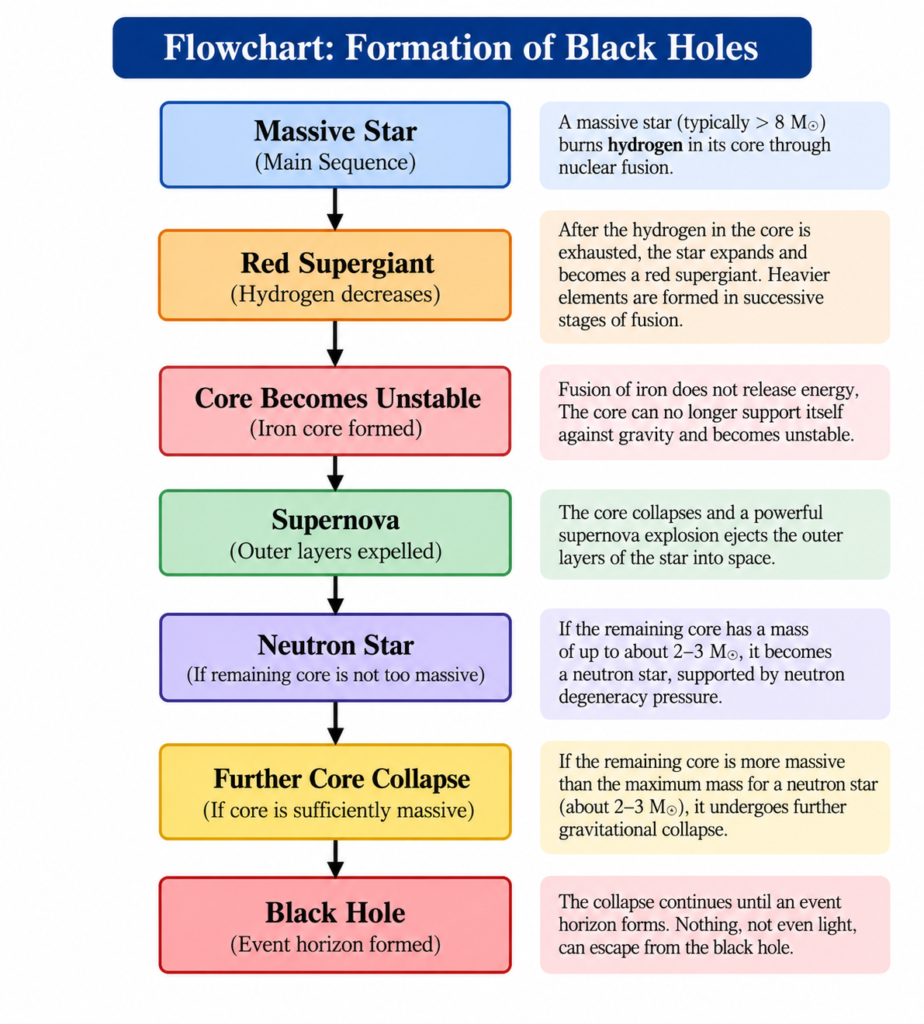
The evolution of a sufficiently massive star is different. After exhausting hydrogen in its core, the star expands and becomes a red supergiant. A red supergiant is an extremely large and luminous evolved massive star.
Inside the core, increasingly heavier elements can be produced through successive stages of nuclear fusion, depending on the mass and evolutionary stage of the star. Eventually, the core can become rich in iron-group elements.
Unlike lighter fusion reactions, the fusion of iron into heavier elements does not provide a net source of energy that can support the core against gravity. As the core loses its ability to maintain the required pressure support, gravitational collapse can occur very rapidly.
Core Collapse and Supernova
When the core of a sufficiently massive star collapses, an enormous amount of gravitational energy is released. The outer layers of the star can be violently expelled in a powerful stellar explosion called a supernova.
During this process, the core becomes extremely dense. What happens to the collapsed core depends mainly on its remaining mass and the physical conditions inside it.
How Does a Black Hole Form?
If the remaining stellar core is sufficiently massive, the known pressure mechanisms are unable to prevent continued gravitational collapse. The matter is compressed to an extremely compact state, and spacetime becomes strongly curved.
When the collapsing mass becomes confined within its characteristic gravitational radius, an event horizon forms. Once the event horizon has formed, signals and objects that cross it cannot escape to the distant outside region.
For a non-rotating, uncharged black hole, the radius of the event horizon is described by the Schwarzschild radius:
Here, Rs is the Schwarzschild radius, G is the universal gravitational constant, M is the mass of the collapsed object, and c is the speed of light in vacuum.
Therefore, the basic sequence for the formation of a stellar-mass black hole can be represented as:
Red Giant, White Dwarf and Black Hole: An Important Distinction
A red giant and a white dwarf are not simply earlier and later stages on the path to every black hole. Their formation depends strongly on the mass of the original star.
| Type of Star | Important Evolutionary Stage | Typical Final Remnant |
|---|---|---|
| Low/intermediate-mass star | Red Giant | White Dwarf |
| Sufficiently massive star | Red Supergiant | Neutron Star or Black Hole |
Thus, a black hole is the result of extreme gravitational collapse of a sufficiently massive stellar core. The formation process is governed by the competition between gravity and the mechanisms that provide pressure support inside the star. When those mechanisms can no longer support a sufficiently massive core, gravitational collapse can continue until an event horizon forms.
Thus, a black hole is formed when the core of a sufficiently massive star undergoes extreme gravitational collapse. When the remaining core becomes so compact that an event horizon forms, an object or light crossing this boundary cannot escape to the distant outside region.
The formation of a stellar-mass black hole is therefore the result of the final stages in the evolution of a massive star, in which gravitational collapse ultimately overcomes the available mechanisms of pressure support.
Chandrasekhar Limit
The Chandrasekhar limit is the maximum mass that a stable white dwarf can support against gravitational collapse by means of electron degeneracy pressure. Its value is approximately 1.4 times the mass of the Sun.
Here, \(M_{\mathrm{Ch}}\) is the Chandrasekhar limit and \(M_{\odot}\) represents the mass of the Sun.
Why Does a White Dwarf Need Support Against Gravity?
A white dwarf is extremely dense because a large amount of stellar matter is compressed into a volume comparable to that of the Earth. Its strong gravitational force tends to compress the star further.
Unlike an ordinary main-sequence star, a white dwarf does not maintain its structure primarily through ongoing nuclear fusion in its core. Instead, it is supported mainly by electron degeneracy pressure.
Electron degeneracy pressure is a quantum-mechanical pressure that arises from the Pauli exclusion principle. Electrons cannot all occupy the same quantum state, and this provides resistance to further compression of the dense stellar matter.
How Does the Chandrasekhar Limit Arise?
As the mass of a white dwarf increases, its gravitational attraction becomes stronger. The electrons inside it are consequently compressed into increasingly high-energy states.
At relatively lower densities, the electrons can provide sufficient degeneracy pressure to balance the inward pull of gravity. However, as the density becomes extremely high, the electrons become relativistic, meaning that their speeds approach the speed of light.
Under these extreme conditions, increasing the density does not increase the electron degeneracy pressure rapidly enough to provide stable support against the increasing gravitational compression. This leads to a maximum mass that electron degeneracy pressure can support.
This maximum mass is called the Chandrasekhar limit.
Value of the Chandrasekhar Limit
For an idealized white dwarf with an appropriate chemical composition, the Chandrasekhar limit is approximately:
The commonly quoted value is about 1.4 solar masses. The exact effective limit can depend on the composition and physical conditions of the stellar material.
What Happens When a White Dwarf Exceeds the Chandrasekhar Limit?
If the mass of a white dwarf exceeds the Chandrasekhar limit, electron degeneracy pressure is no longer sufficient to maintain a stable white dwarf configuration against gravitational collapse.
The subsequent evolution depends on the physical circumstances. The star may undergo further gravitational collapse, and in certain situations nuclear reactions can lead to a thermonuclear supernova. In other circumstances, the collapsing stellar core can form a more compact remnant such as a neutron star.
Therefore, it is important not to interpret the Chandrasekhar limit as meaning that every object exceeding approximately \(1.4M_{\odot}\) immediately becomes a black hole. The final outcome depends on the mass of the collapsing core and the physical processes taking place during stellar evolution.
Importance of the Chandrasekhar Limit
The Chandrasekhar limit is important because it establishes a fundamental upper mass limit for white dwarfs supported by electron degeneracy pressure. It helps explain why white dwarfs cannot remain stable beyond a certain mass and plays an important role in understanding the evolution and final stages of stars.
- The Chandrasekhar limit applies to the maximum mass of a stable white dwarf supported by electron degeneracy pressure.
- Its approximate value is \(1.4M_{\odot}\).
- The support of a white dwarf is primarily due to electron degeneracy pressure, not ordinary nuclear fusion.
- At very high densities, electrons become relativistic.
- Beyond the Chandrasekhar limit, electron degeneracy pressure cannot provide sufficient support against gravitational collapse.
- The final fate of an over-massive stellar core depends on its composition, mass, and subsequent physical processes.
Thus, the Chandrasekhar limit represents a fundamental boundary for the stability of white dwarfs. It is a direct consequence of the competition between gravity and quantum-mechanical electron degeneracy pressure in extremely dense stellar matter.
Neutron Star
A neutron star is an extremely dense and compact stellar remnant formed when the core of a sufficiently massive star undergoes gravitational collapse. During the collapse, the matter in the core is compressed to such an extreme density that protons and electrons combine predominantly to form neutrons.
A neutron star contains an enormous amount of mass packed into a very small volume. A typical neutron star has a mass comparable to that of the Sun but a radius of only about 10–15 km.
Formation of a Neutron Star
A neutron star can form during the final stages of the evolution of a massive star. After the star has exhausted the nuclear fuel needed to support its core, the core can undergo rapid gravitational collapse.
During this collapse, the pressure and density inside the core become extraordinarily high. Electrons are forced into close proximity with protons, and under suitable conditions they combine to form neutrons:
Here, \(p\) represents a proton, \(e^-\) represents an electron, \(n\) represents a neutron, and \(\nu_e\) represents an electron neutrino.
The resulting core becomes composed predominantly of extremely dense nuclear matter. The collapse can be accompanied by a powerful core-collapse supernova, which ejects the outer layers of the star into space while leaving behind the compact neutron-star remnant.
Composition of a Neutron Star
A neutron star is not made entirely of neutrons. Its interior is expected to contain matter in several forms, with the composition changing with depth. Neutrons are the dominant particles in much of the interior, while protons, electrons, and possibly other particles can also be present.
The outermost region contains a very dense crust. Deeper inside, matter becomes increasingly compressed and reaches densities comparable to or greater than those found in atomic nuclei.
Size and Density of a Neutron Star
One of the most remarkable properties of a neutron star is its extremely high density. A neutron star can contain roughly a solar mass or more within a sphere only a few tens of kilometres across.
For a spherical neutron star of mass M and radius R, its average density is:
Since the volume of a sphere is:
the average density can be written as:
Because the radius is extremely small compared with that of an ordinary star, the average density of a neutron star is extraordinarily high.
Support Against Gravitational Collapse
The enormous gravitational force of a neutron star tends to compress its matter further. The star is supported against collapse by pressure arising from the properties of extremely dense nuclear matter, including neutron degeneracy pressure and strong nuclear interactions.
This support is different from the electron degeneracy pressure that supports a white dwarf. A neutron star is therefore much more compact and dense than a white dwarf.
Gravitational Field of a Neutron Star
Because a neutron star contains a large mass within a very small radius, its gravitational field near the surface is extremely strong.
In a simple Newtonian approximation, the gravitational field strength at the surface is:
The small radius of a neutron star makes the value of \(g\) enormously larger than the gravitational field strength at the surface of the Earth.
Near the surface of a neutron star, however, Newtonian gravity is not sufficient for precise calculations. The effects predicted by general relativity become very important because of the star’s enormous compactness.
Rapid Rotation
Many neutron stars rotate extremely rapidly. This is possible because the star’s original stellar core contracts to a very small size while approximately conserving angular momentum.
As the radius decreases greatly, the rotational speed can increase dramatically. Some neutron stars rotate many times per second.
Magnetic Field of a Neutron Star
Neutron stars can possess extremely strong magnetic fields. The magnetic field may be many orders of magnitude stronger than the Earth’s magnetic field.
Some rapidly rotating, strongly magnetized neutron stars emit beams of electromagnetic radiation from regions near their magnetic poles. If these beams sweep across Earth as the star rotates, the object can appear to emit regular pulses of radiation.
Such a rotating neutron star is observed as a pulsar.
Neutron Star and White Dwarf
| Property | White Dwarf | Neutron Star |
|---|---|---|
| Main supporting mechanism | Electron degeneracy pressure | Properties of dense nuclear matter, including neutron degeneracy pressure and nuclear interactions |
| Typical radius | Comparable to Earth’s radius | About 10–15 km |
| Density | Very high | Extremely high |
| Typical origin | Low/intermediate-mass stellar evolution | Core collapse of a sufficiently massive star |
Important Characteristics of a Neutron Star
- It is an extremely dense and compact stellar remnant.
- It typically has a mass comparable to that of the Sun but a radius of only about 10–15 km.
- It is composed predominantly of neutron-rich matter, although other particles are also present.
- It can be formed following the core collapse of a sufficiently massive star.
- It is supported by the properties of ultra-dense nuclear matter.
- It can have an extremely strong gravitational field and magnetic field.
- Many neutron stars rotate rapidly.
- A rotating neutron star whose radiation produces periodic pulses as observed from Earth is called a pulsar.
A neutron star therefore represents one of the most compact forms of ordinary matter known in the universe. Its extreme density, rapid rotation, strong magnetic field, and intense gravitational field make it an important object for studying matter and gravity under conditions that cannot be reproduced easily on Earth.
Flowchart for Formation of Black Holes

Conceptual Understanding Questions
What type of force is present between the Earth and the Sun when the Earth revolves around the Sun?
Answer: Gravitational force.
What type of force is present between an electron and the nucleus when the electron revolves around the nucleus?
Answer: Electromagnetic force.
What type of force is involved when a neutron changes into a proton by emitting an electron and an antineutrino?
Answer: Weak nuclear force.
What type of force is responsible for the attractive interaction between two protons inside the nucleus?
Answer: Strong nuclear force.
What type of force is responsible for the repulsive interaction between two protons?
Answer: Electromagnetic force.
If heavier bodies are attracted more strongly by the Earth, why don’t they fall faster than lighter bodies?
A heavier body experiences a greater gravitational force because its mass is greater:
However, its inertia is also greater by the same factor. Therefore, its acceleration is:
Thus, when air resistance is neglected, all bodies fall with the same acceleration due to gravity, irrespective of their masses.
Cavendish is credited with weighing the Earth. How did he do that?
Henry Cavendish used a sensitive torsion balance to measure the extremely small gravitational attraction between known masses in the laboratory. His experiment allowed the value of the universal gravitational constant G to be determined.
Using the measured value of G, together with the known value of the Earth’s radius and the acceleration due to gravity, the mass of the Earth could be calculated from:
This is why Cavendish’s experiment is popularly described as “weighing the Earth.”
What is the value of acceleration due to gravity and weight of a body at the centre of the Earth? How does acceleration due to gravity change inside the mines?
At the centre of the Earth, the gravitational attraction from all directions balances out. Therefore, the acceleration due to gravity is:
Since the weight of a body is:
the weight of the body at the centre of the Earth is also:
Inside a mine, the acceleration due to gravity decreases as the depth below the Earth’s surface increases. Assuming uniform density, at a depth d:
If the Earth suddenly shrinks, keeping its mass the same, does acceleration due to gravity change at a point which is at a height h from its surface before shrinking?
If the point is fixed in space while the Earth shrinks, its distance from the centre of the Earth remains the same as before. Since the Earth’s mass is also unchanged, the gravitational acceleration at that fixed point remains unchanged:
However, if the point is instead maintained at the same height h above the new surface of the smaller Earth, its distance from the Earth’s centre decreases and the acceleration due to gravity at that point increases.
According to Newton’s third law of motion, if the Earth pulls the stone, the stone must also pull the Earth. Then why doesn’t the Earth fall towards the stone?
The Earth and the stone exert equal and opposite gravitational forces on each other. However, their accelerations are different because their masses are vastly different.
The acceleration produced by a force is:
Since the mass of the Earth is enormously greater than the mass of the stone, the Earth’s acceleration towards the stone is extremely small. Therefore, the Earth does move slightly towards the stone, but the motion is too small to be noticeable.
Can the Sun become a black hole?
The Sun is not massive enough to naturally undergo the type of core collapse that produces a stellar-mass black hole. It is expected to evolve into a red giant and eventually leave behind a white dwarf.
However, if the Sun’s entire mass could somehow be compressed into a sufficiently small region, a black hole could theoretically form. The Schwarzschild radius corresponding to the Sun’s mass is approximately:
Such extreme compression does not occur naturally in the Sun.
Why does a teaspoonful of neutron-star matter weigh almost thousands of tons?
Neutron-star matter has an extraordinarily high density because a huge amount of matter is compressed into a very small volume. At such extreme densities, ordinary atoms cannot retain their normal structure and the matter becomes dominated by densely packed nuclear particles.
Therefore, even a very small quantity of neutron-star matter can have an enormous mass. A teaspoon-sized quantity is commonly estimated to have a mass of millions of tonnes, depending on the assumed density and volume.
What stops the collapse of a white dwarf and a neutron star?
A white dwarf is supported mainly by electron degeneracy pressure, which arises from quantum-mechanical properties of electrons.
A neutron star is supported by the properties of extremely dense nuclear matter, including neutron degeneracy pressure and strong nuclear interactions.
These forms of pressure can resist gravitational collapse only up to certain limits.
What principle sets a limitation on the collapse of a white dwarf?
The Pauli exclusion principle is the fundamental quantum principle underlying electron degeneracy pressure. It states that two identical fermions cannot occupy the same quantum state.
Electron degeneracy pressure supports a white dwarf against gravitational collapse. However, this support has a maximum capacity, giving rise to the Chandrasekhar limit of approximately:
At what stage of a star do most of the elements originate?
Many elements originate during the evolution of stars through stellar nucleosynthesis. Light and intermediate-mass elements are produced through nuclear fusion inside stars during different stages of stellar evolution.
Many elements heavier than iron are produced through energetic processes such as supernova explosions and neutron-star mergers. Therefore, different elements originate through different nucleosynthesis processes rather than at one single stage of a star’s life.
How can the mass of the Earth be calculated?
The mass of the Earth can be calculated using the acceleration due to gravity g, the radius of the Earth R, and the universal gravitational constant G.
According to Newton’s law of universal gravitation, the gravitational force acting on a body of mass m at the Earth’s surface is:
\[ F = \frac{GMm}{R^2} \]The weight of the same body is:
\[ F = mg \]Equating the two expressions:
\[ mg = \frac{GMm}{R^2} \]Cancelling m from both sides:
\[ g = \frac{GM}{R^2} \]Therefore, the mass of the Earth is:
\[ \boxed{M = \frac{gR^2}{G}} \]For the Earth, take:
\[ g = 9.8\ \text{m/s}^2 \]\[ R = 6.37 \times 10^6\ \text{m} \]\[ G = 6.67430 \times 10^{-11}\ \text{N m}^2\text{/kg}^2 \]Substituting these values in the formula:
\[ M = \frac{(9.8)(6.37 \times 10^6)^2}{6.67430 \times 10^{-11}} \]First, square the Earth’s radius:
\[ (6.37 \times 10^6)^2 = 4.05769 \times 10^{13}\ \text{m}^2 \]Therefore:
\[ M = \frac{(9.8)(4.05769 \times 10^{13})}{6.67430 \times 10^{-11}} \]Multiplying the numerator:
\[ M = \frac{3.9765362 \times 10^{14}}{6.67430 \times 10^{-11}} \]Dividing:
\[ M \approx 5.96 \times 10^{24}\ \text{kg} \]Hence, the mass of the Earth is approximately:
\[ \boxed{M \approx 5.96 \times 10^{24}\ \text{kg}} \]Key Point: The mass of the Earth can be determined from the measured value of g, the Earth’s radius R, and the universal gravitational constant G, using the relation:
\[ \boxed{M = \frac{gR^2}{G}} \]What is the difference between a star and a black hole?
A star is a luminous astronomical object that produces and emits energy, mainly through nuclear fusion in its interior. A black hole is an extremely compact region of space where gravity is so strong that nothing, not even light, can escape from within its event horizon.
The main differences between a star and a black hole are:
| Star | Black Hole |
|---|---|
| A star is a luminous astronomical object. | A black hole does not emit light from within its event horizon. |
| A normal star is supported against gravitational collapse by pressure generated within it, mainly due to nuclear processes. | A black hole is formed when a sufficiently massive stellar core undergoes extreme gravitational collapse. |
| A star has a visible surface from which light can escape. | A black hole has an event horizon, beyond which light cannot escape. |
| Its size is generally much larger than the characteristic size of a black hole of comparable mass. | Its mass is concentrated into an extremely compact region of space. |
| Stars can produce energy through nuclear fusion during appropriate stages of their evolution. | A black hole itself does not produce energy through ordinary nuclear fusion. |
For a non-rotating black hole, the radius of its event horizon is approximately given by the Schwarzschild radius:
\[ \boxed{R_s = \frac{2GM}{c^2}} \]Thus, a star is a luminous object with an escaping surface, whereas a black hole is an extremely compact gravitational object surrounded by an event horizon from which light cannot escape.
Solved Numerical Problems
The following solved numerical problems cover the important concepts and formulas from the chapter Gravitation. Each problem is solved step by step to make the method of calculation clear.
1. Calculate the gravitational force between two bodies
Problem: Two bodies of masses 5 kg and 10 kg are separated by a distance of 2 m. Calculate the gravitational force between them.
Given:
\[ m_1 = 5\ \text{kg} \]\[ m_2 = 10\ \text{kg} \]\[ r = 2\ \text{m} \]\[ G = 6.67430 \times 10^{-11}\ \text{N m}^2\text{/kg}^2 \]To find:
\[ F = ? \]Formula:
\[ F = \frac{Gm_1m_2}{r^2} \]Substituting the values:
\[ F = \frac{(6.67430 \times 10^{-11})(5)(10)}{(2)^2} \]\[ F = \frac{6.67430 \times 10^{-11} \times 50}{4} \]\[ F = 8.342875 \times 10^{-10}\ \text{N} \]Answer:
\[ \boxed{F \approx 8.34 \times 10^{-10}\ \text{N}} \]Therefore, the gravitational force between the two bodies is approximately 8.34 × 10⁻¹⁰ N.
2. Calculate the acceleration due to gravity on the surface of a planet
Problem: A planet has a mass of \(6.0 \times 10^{24}\) kg and a radius of \(6.4 \times 10^6\) m. Calculate the acceleration due to gravity on its surface.
Given:
\[ M = 6.0 \times 10^{24}\ \text{kg} \]\[ R = 6.4 \times 10^6\ \text{m} \]\[ G = 6.67430 \times 10^{-11}\ \text{N m}^2\text{/kg}^2 \]To find:
\[ g = ? \]Formula:
\[ g = \frac{GM}{R^2} \]Substituting the values:
\[ g = \frac{(6.67430 \times 10^{-11})(6.0 \times 10^{24})} {(6.4 \times 10^6)^2} \]First, calculate the square of the radius:
\[ (6.4 \times 10^6)^2 = 4.096 \times 10^{13} \]Therefore:
\[ g = \frac{6.67430 \times 10^{-11} \times 6.0 \times 10^{24}} {4.096 \times 10^{13}} \]\[ g \approx 9.78\ \text{m/s}^2 \]Answer:
\[ \boxed{g \approx 9.78\ \text{m/s}^2} \]3. Calculate the weight of a body on Earth
Problem: Calculate the weight of a body of mass 50 kg on the surface of the Earth. Take \(g = 9.8\ \text{m/s}^2\).
Given:
\[ m = 50\ \text{kg} \]\[ g = 9.8\ \text{m/s}^2 \]To find:
\[ W = ? \]Formula:
\[ W = mg \]Substituting the values:
\[ W = (50)(9.8) \]\[ W = 490\ \text{N} \]Answer:
\[ \boxed{W = 490\ \text{N}} \]Therefore, the weight of the 50 kg body on Earth is 490 N.
4. Calculate the value of g at a certain altitude
Problem: Calculate the acceleration due to gravity at an altitude of 640 km above the Earth’s surface. Take the Earth’s radius as 6400 km and \(g = 9.8\ \text{m/s}^2\) at the surface.
Given:
\[ h = 640\ \text{km} \]\[ R = 6400\ \text{km} \]\[ g = 9.8\ \text{m/s}^2 \]Formula:
\[ g_h = g\left(\frac{R}{R+h}\right)^2 \]Substituting the values:
\[ g_h = 9.8\left(\frac{6400}{6400+640}\right)^2 \]\[ g_h = 9.8\left(\frac{6400}{7040}\right)^2 \]\[ g_h = 9.8\left(\frac{10}{11}\right)^2 \]\[ g_h = 9.8\left(\frac{100}{121}\right) \]\[ g_h \approx 8.10\ \text{m/s}^2 \]Answer:
\[ \boxed{g_h \approx 8.10\ \text{m/s}^2} \]Thus, the value of acceleration due to gravity decreases with altitude.
5. Calculate g at a depth below the Earth’s surface
Problem: Find the acceleration due to gravity at a depth of 1600 km below the Earth’s surface. Assume the Earth has uniform density, its radius is 6400 km, and \(g = 9.8\ \text{m/s}^2\) at the surface.
Given:
\[ d = 1600\ \text{km} \]\[ R = 6400\ \text{km} \]\[ g = 9.8\ \text{m/s}^2 \]Formula:
\[ g_d = g\left(1-\frac{d}{R}\right) \]Substituting the values:
\[ g_d = 9.8\left(1-\frac{1600}{6400}\right) \]\[ g_d = 9.8\left(1-\frac{1}{4}\right) \]\[ g_d = 9.8\left(\frac{3}{4}\right) \]\[ g_d = 7.35\ \text{m/s}^2 \]Answer:
\[ \boxed{g_d = 7.35\ \text{m/s}^2} \]Therefore, under the uniform-density assumption, the acceleration due to gravity decreases with depth.
6. Calculate the mass of the Earth using G, g and R
Problem: Calculate the mass of the Earth using \(g = 9.8\ \text{m/s}^2\), \(R = 6.37 \times 10^6\ \text{m}\), and \(G = 6.67430 \times 10^{-11}\ \text{N m}^2\text{/kg}^2\).
Given:
\[ g = 9.8\ \text{m/s}^2 \]\[ R = 6.37 \times 10^6\ \text{m} \]\[ G = 6.67430 \times 10^{-11}\ \text{N m}^2\text{/kg}^2 \]To find:
\[ M = ? \]Formula:
\[ M = \frac{gR^2}{G} \]Substituting the values:
\[ M = \frac{(9.8)(6.37 \times 10^6)^2} {6.67430 \times 10^{-11}} \]First, calculate the square of the Earth’s radius:
\[ (6.37 \times 10^6)^2 = 4.05769 \times 10^{13}\ \text{m}^2 \]Therefore:
\[ M = \frac{(9.8)(4.05769 \times 10^{13})} {6.67430 \times 10^{-11}} \]\[ M = \frac{3.9765362 \times 10^{14}} {6.67430 \times 10^{-11}} \]\[ M \approx 5.96 \times 10^{24}\ \text{kg} \]Answer:
\[ \boxed{M \approx 5.96 \times 10^{24}\ \text{kg}} \]Therefore, the mass of the Earth is approximately 5.96 × 1024 kg.
7. Calculate the gravitational field strength at a distance from a mass
Problem: Calculate the gravitational field strength at a distance of 2 m from a point mass of \(1000\) kg.
Given:
\[ M = 1000\ \text{kg} \]\[ r = 2\ \text{m} \]\[ G = 6.67430 \times 10^{-11}\ \text{N m}^2\text{/kg}^2 \]To find:
\[ g = ? \]Formula:
\[ g = \frac{GM}{r^2} \]Substituting the values:
\[ g = \frac{(6.67430 \times 10^{-11})(1000)}{(2)^2} \]\[ g = \frac{6.67430 \times 10^{-8}}{4} \]\[ g = 1.668575 \times 10^{-8}\ \text{N/kg} \]Answer:
\[ \boxed{g \approx 1.67 \times 10^{-8}\ \text{N/kg}} \]The gravitational field strength at that point is approximately 1.67 × 10⁻⁸ N/kg, directed towards the mass.
8. Calculate the Schwarzschild radius of the Sun
Problem: If the mass of the Sun is \(1.989 \times 10^{30}\) kg, calculate its Schwarzschild radius. Take \(G = 6.67430 \times 10^{-11}\ \text{N m}^2\text{/kg}^2\) and \(c = 3.0 \times 10^8\ \text{m/s}\).
Given:
\[ M = 1.989 \times 10^{30}\ \text{kg} \]\[ G = 6.67430 \times 10^{-11}\ \text{N m}^2\text{/kg}^2 \]\[ c = 3.0 \times 10^8\ \text{m/s} \]Formula:
\[ R_s = \frac{2GM}{c^2} \]Substituting the values:
\[ R_s = \frac{2(6.67430 \times 10^{-11})(1.989 \times 10^{30})} {(3.0 \times 10^8)^2} \]Calculate the denominator:
\[ (3.0 \times 10^8)^2 = 9.0 \times 10^{16} \]Therefore:
\[ R_s = \frac{2(6.67430 \times 10^{-11})(1.989 \times 10^{30})} {9.0 \times 10^{16}} \]\[ R_s \approx 2.95 \times 10^3\ \text{m} \]Converting metres into kilometres:
\[ R_s \approx 2.95\ \text{km} \]Answer:
\[ \boxed{R_s \approx 2.95\ \text{km}} \]Thus, if the entire mass of the Sun were compressed within a radius of approximately 2.95 km, it would form a non-rotating black hole.
9. Compare the weight of a body on Earth and on the Moon
Problem: A person’s mass is 60 kg. Calculate their weight on Earth and on the Moon. Take \(g_E = 9.8\ \text{m/s}^2\) on Earth and \(g_M = 1.62\ \text{m/s}^2\) on the Moon.
Given:
\[ m = 60\ \text{kg} \]\[ g_E = 9.8\ \text{m/s}^2 \]\[ g_M = 1.62\ \text{m/s}^2 \]Weight on Earth:
\[ W_E = mg_E \]\[ W_E = (60)(9.8) \]\[ W_E = 588\ \text{N} \]Weight on the Moon:
\[ W_M = mg_M \]\[ W_M = (60)(1.62) \]\[ W_M = 97.2\ \text{N} \]Answers:
\[ \boxed{W_E = 588\ \text{N}} \]\[ \boxed{W_M = 97.2\ \text{N}} \]The person’s mass remains 60 kg on both Earth and the Moon, but their weight is different because the acceleration due to gravity is different.
10. Find the height at which the acceleration due to gravity becomes one-fourth of its surface value
Problem: At what height above the Earth’s surface will the acceleration due to gravity become one-fourth of its value at the surface? Take the radius of the Earth as \(R\).
Given:
\[ g_h = \frac{g}{4} \]Formula:
\[ g_h = g\left(\frac{R}{R+h}\right)^2 \]Substituting \(g_h = g/4\):
\[ \frac{g}{4} = g\left(\frac{R}{R+h}\right)^2 \]Cancel \(g\) from both sides:
\[ \frac{1}{4} = \left(\frac{R}{R+h}\right)^2 \]Taking the square root:
\[ \frac{1}{2} = \frac{R}{R+h} \]Cross-multiplying:
\[ R+h = 2R \]Therefore:
\[ h = 2R-R \]\[ \boxed{h=R} \]Thus, the acceleration due to gravity becomes one-fourth of its surface value at a height equal to the Earth’s radius above the surface.
Important Formulas Used in Gravitation Numericals
The following formulas are particularly important for solving numerical problems from this chapter:
\[ \boxed{F = \frac{Gm_1m_2}{r^2}} \]\[ \boxed{g = \frac{GM}{R^2}} \]\[ \boxed{W = mg} \]\[ \boxed{g_h = g\left(\frac{R}{R+h}\right)^2} \]\[ \boxed{g_d = g\left(1-\frac{d}{R}\right)} \]\[ \boxed{M = \frac{gR^2}{G}} \]\[ \boxed{g = \frac{GM}{r^2}} \]\[ \boxed{R_s = \frac{2GM}{c^2}} \]These formulas cover the major numerical applications of gravitational force, acceleration due to gravity, variation of g, gravitational field strength, Earth’s mass, and black holes.